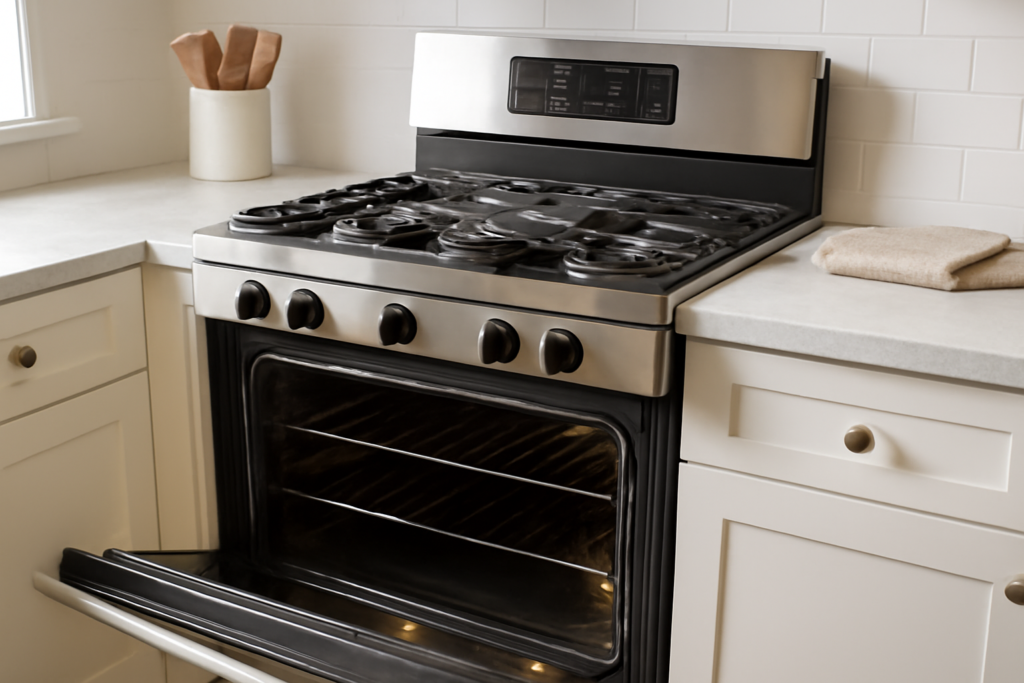
A gas range with electric oven — what the industry calls a dual-fuel range — gives you the best of both worlds: the instant, visible flame control of gas burners for the cooktop, paired with the steady, even, dry heat of an electric oven for baking. Serious home cooks gravitate to this configuration, and once you understand why, it is hard to unsee. Here is the complete picture, including the hookup realities people miss.
Why Combine the Two?
The logic is that each fuel is better at a different job. On the cooktop, gas wins: you get an open flame you can see and adjust instantly, precise low simmers, and the ability to char, flambé, and wok. In the oven, electric wins: it holds temperature more steadily, distributes heat more evenly, and — critically for baking — runs drier than gas. A gas oven introduces moisture as a byproduct of combustion, which is fine for roasts but works against crisp crusts and delicate pastry. A dual-fuel range lets you cook and bake each with the fuel suited to it.
The Baking Difference
If you bake bread, pastry, cookies, or anything where a crisp exterior and even rise matter, the electric oven is the reason to buy dual fuel. Electric ovens:
- Hold set temperature within a tighter band with less swing.
- Deliver more even top-to-bottom heat, so a tray of cookies browns uniformly.
- Run dry, producing crisper crusts and better browning.
- Pair well with true European convection (a third heating element around the fan), which most dual-fuel ovens include for even multi-rack baking.
Pastry chefs and avid bakers notice this immediately. For someone who mostly reheats and roasts, the difference is smaller.
The Cooktop Difference
Gas burners give you the responsiveness professional cooks want: dial the flame down and the heat drops that instant, dial it up and you get a hard sear. Output is measured in BTU — home dual-fuel ranges commonly offer burners from a gentle 5,000 BTU simmer burner up to a 15,000 to 18,000-plus BTU power burner for fast boiling and high-heat searing. You can see the flame, cook with a wok, and char peppers directly over the fire — none of which an electric or induction cooktop does the same way.
The Hookup Reality — Read This Before You Buy
This is where dual-fuel trips people up. Because it burns gas AND runs electric heating elements, a dual-fuel range needs both utilities, and the electrical requirement is heftier than people expect:
- Gas line: A natural gas or propane supply line to the range location, same as any gas range.
- 240-volt electrical circuit: Here is the catch. An all-gas range only needs a standard 120-volt outlet for the igniters and clock. A dual-fuel range’s electric oven needs a dedicated 240-volt, 40- or 50-amp circuit with a proper range receptacle — the same heavy circuit an all-electric range requires.
If you are converting from an all-gas range, you probably have a 120-volt outlet and a gas line, but NOT the 240-volt circuit the electric oven demands. Adding that circuit means running new heavy wire from the panel to the range location — a job for a licensed electrician, and it can cost $300 to $1,000 depending on the run. Confirm what you have before you fall in love with a model.
What It Costs
Dual-fuel ranges carry a premium over all-gas because of the added electric oven components:
- 30-inch mainstream dual fuel: Roughly $1,800 to $3,500 (GE, KitchenAid, Frigidaire, Samsung).
- 36- and 48-inch pro-style dual fuel: $4,000 to $9,000-plus (Thermador, Wolf, Café, Monogram, Bosch).
Add the potential cost of a new 240-volt circuit if your kitchen lacks one.
Top Brands and Options
- KitchenAid and Café: Strong mainstream dual-fuel with true convection and solid parts networks.
- Thermador and Wolf: Pro-style dual-fuel benchmarks — high-BTU burners, refined electric ovens, premium price.
- Bosch: Sleek, quiet, European styling with capable electric convection ovens.
- Frigidaire and Samsung: Value-oriented 30-inch dual-fuel for the baker on a budget.
Dual Fuel vs Alternatives
- vs all-gas range: Dual fuel bakes noticeably better but costs more and needs the 240-volt circuit. All-gas is cheaper and simpler to hook up.
- vs all-electric / induction range: Dual fuel gives you the live flame cooktop many cooks prefer, while all-electric and induction cooktops offer easier cleaning and, with induction, faster boiling. If you love cooking over flame, dual fuel wins.
Convection: The Feature That Completes It
Most dual-fuel ranges pair the electric oven with true European convection — a third heating element wrapped around the fan at the back of the cavity, not just a fan blowing existing oven air. That distinction matters. True convection heats the circulating air directly, giving genuinely even multi-rack results: you can bake three trays of cookies at once with uniform browning, roast faster at lower temperatures, and get crispier skin on poultry. Combined with the electric oven’s steady, dry heat, convection is what turns a dual-fuel range into a serious baking tool. When you shop, confirm it is true or European convection with the third element, not “fan convection” that just stirs the air.
Sizes and Configurations
Dual-fuel ranges come in the same widths as other ranges, and the choice shapes both cooking capacity and kitchen layout:
- 30-inch: The standard freestanding or slide-in size, with four to five gas burners and a single electric oven of about 4.5 to 5.5 cubic feet. Fits most kitchens.
- 36-inch: Five or six burners and a larger oven, or a cooktop-plus-griddle layout. A step into pro territory.
- 48-inch pro-style: Six or eight burners, often with a griddle or grill, and frequently a double oven — one large electric convection cavity plus a smaller second oven. The serious cook’s centerpiece.
Slide-in models sit flush between cabinets with a finished side for a built-in look; freestanding models have finished sides and a rear control panel and drop in anywhere.
Maintenance Notes
You are maintaining two systems. The gas burners need clean ports and properly seated caps for an even blue flame — a yellow, sooty flame means clogged ports or a mixture problem. The electric oven’s bake and broil elements are the usual wear items; a failed element is a cheap, easy swap, though gas-side work on the burners and valves should go to a pro. Any gas smell means stop and call for service immediately.
Who Should Buy Dual Fuel
Match the range to how you actually cook:
- Buy dual fuel if: you bake bread, pastry, or cakes with any seriousness and want the steady, even, dry electric oven, while still cooking on a live gas flame. You already have or can add a 240-volt circuit.
- Skip it if: you rarely bake and mostly boil, fry, and reheat — an all-gas range costs less and hooks up to a simple 120-volt outlet. Or if you want the easiest cleanup and fastest boil, in which case an all-induction range may suit you better.
The buyers who love dual fuel most are avid home bakers and cooking enthusiasts who refuse to compromise on either the cooktop or the oven. If that is you, the premium and the electrical work pay off every time you pull a perfectly even tray out of that dry electric oven. And if you already have a 240-volt range circuit from a previous all-electric range, the biggest hurdle is already handled — you only need a gas line run to the location, which many kitchens with a nearby gas supply can accommodate affordably.
Bottom Line
A gas range with electric oven is the connoisseur’s choice: flame-controlled gas burners for cooking, a steady dry electric oven for superior baking. The performance is genuinely better if you bake with any seriousness. Just go in clear-eyed about the hookup — the electric oven demands a dedicated 240-volt circuit, not the 120-volt outlet an all-gas range uses. Confirm your electrical service first, budget for an electrician if needed, and you will get a range that does both jobs better than any single-fuel unit can.