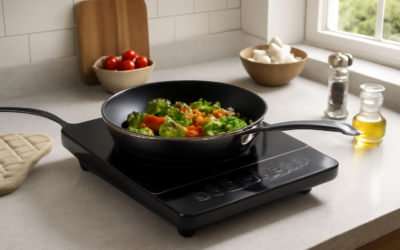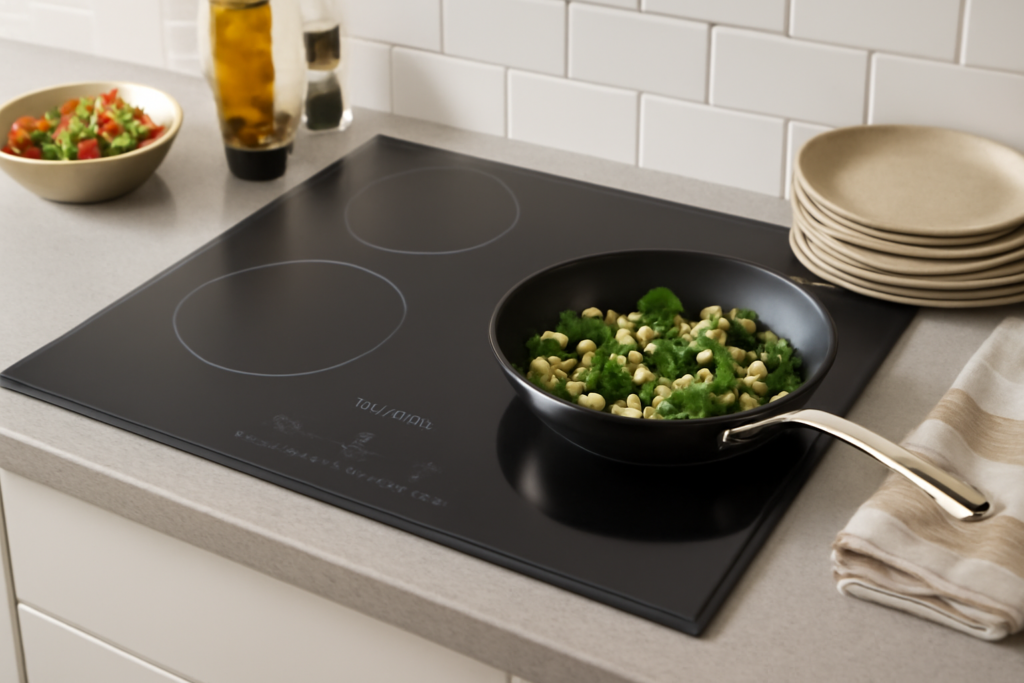
A Bosch induction cooktop heats a pan in seconds by inducing a magnetic field directly in the cookware, not the glass. If you have cooked on gas or radiant electric your whole life, the first time you watch water boil in under 90 seconds on a Bosch induction cooktop feels like cheating. I install and service these units regularly, so here is the straight version — what to buy, how it wires, what breaks, and what it actually costs.
- How Induction Actually Works
- Bosch Lineup and Sizes
- Electrical Requirements — Read This Before You Buy
- Cookware: The One Rule That Matters
- Installation Notes From the Field
- Induction vs. Gas vs. Radiant Electric
- Power Boost and Real-World Speed
- Common Problems and Quick Fixes
- Cleaning and Daily Care
- Is It Worth It?
How Induction Actually Works
Underneath the smooth ceramic glass sits a coil of copper wire. Run alternating current through it and you generate a rapidly switching magnetic field. Set a ferrous pan on top and that field induces eddy currents in the pan’s base, and the pan’s own electrical resistance turns those currents into heat. The glass stays relatively cool — it only warms from contact with the hot pan.
Two practical consequences fall out of that. First, efficiency runs around 85 to 90 percent versus roughly 40 percent for gas, because you are not heating the air around the burner. Second, response is instant — cut the power and the field collapses, so it behaves more like gas than radiant electric.
Bosch Lineup and Sizes
Bosch sells induction under its 500, 800, and Benchmark series. The differences are cosmetic trim, bridge-zone flexibility, and how many power boost levels you get.
- 30-inch: the standard drop-in for most US kitchens, usually four elements. Expect $1,300 to $2,200.
- 36-inch: four or five elements, often with a flexible bridge zone for griddles. Roughly $2,000 to $3,200.
- 24-inch: two or three elements for apartments and secondary kitchens, around $1,100 to $1,600.
The Benchmark models add FlexInduction, where two zones merge into one large surface that tracks a pan wherever you slide it. Handy for oval roasters and long griddles.
Electrical Requirements — Read This Before You Buy
This is where most DIY plans fall apart. A full-size Bosch induction cooktop is a 240-volt appliance that draws serious current. A 30-inch unit typically needs a dedicated 40-amp circuit on 8-gauge copper wire; a 36-inch may call for 50 amps on 6-gauge. The unit hardwires to a junction box — most Bosch cooktops do not ship with a plug and cord.
If your kitchen was wired for a gas cooktop, there is no 240V line behind the cabinet, and running one from the panel is a licensed-electrician job that commonly runs $400 to $900 depending on panel distance and whether the box has a free double-pole breaker slot. Do not tap a 30-amp dryer circuit to save money — the cooktop will nuisance-trip under load and you will have created a code violation. Confirm the exact amperage on the model’s spec sheet before ordering the wire.
Cookware: The One Rule That Matters
Induction only works with magnetic cookware. The test costs nothing — stick a refrigerator magnet to the bottom of the pan. If it grabs firmly, the pan will work. If it slides off, it will not.
- Works: cast iron, enameled cast iron, carbon steel, and most magnetic stainless steel.
- Fails: pure aluminum, copper, and glass. Some “tri-ply” stainless has a magnetic outer layer — always test.
- Minimum base: most Bosch zones need a pan bottom of at least 4.5 inches to register. Tiny butter warmers may not trigger the element.
Warped pans are the enemy. A base that rocks lifts part of itself out of the magnetic field and heats unevenly, so retire anything that spins on a flat counter.
Installation Notes From the Field
The cutout is unforgiving. Bosch gives you a template — follow it to the sixteenth of an inch, because the glass edge overhangs the countertop opening by only a small margin. On stone counters, the fabricator cuts the hole; on laminate you can jigsaw it yourself with a fine blade and painter’s tape to stop chipping.
Ventilation clearance underneath matters more than people expect. The induction electronics live in a shallow box below the glass and shed heat, so Bosch specifies a minimum air gap and forbids sealing the unit airtight into a cabinet. If you install a downdraft or wall vent, keep the required clearance to any drawer or oven below. Budget $150 to $350 for professional drop-in labor if the circuit already exists.
Induction vs. Gas vs. Radiant Electric
Buyers cross-shop these three, so here is the honest comparison from someone who services all of them. Gas gives you a visible flame and works during a power outage, but it dumps most of its heat into the room, adds combustion byproducts, and the grates are a pain to scrub. Radiant electric — the red glowing coils under glass — is cheap and cookware-agnostic, but slow to respond and it leaves a genuinely hot surface long after you shut it off.
Induction splits the difference and then some. You get gas-like instant response with electric-style flat-glass cleanup, plus a cool surface that will not scorch a dish towel dropped on an idle zone. The trade-offs are real, though: it needs magnetic cookware, it costs more upfront, and a full-power boil can hum or click on light pans. For most modern kitchens, the speed and safety win out — a spilled pot of pasta water wipes off warm glass instead of baking onto a red coil.
Power Boost and Real-World Speed
Most Bosch zones include a boost or “PowerBoost” mode that briefly borrows wattage from a neighboring element to slam a single zone to maximum. On the largest element that can mean pushing past 3,000 watts, enough to bring a stockpot of water to a rolling boil in a couple of minutes. Boost times out automatically after several minutes to protect the electronics, then drops the zone back to its rated ceiling. Use it to get water going fast, then back off — you rarely need full boost for actual cooking, and a hard simmer at a low setting is where induction’s precision really shows.
Common Problems and Quick Fixes
Most “broken” induction cooktops are user or cookware issues, not failures.
- Element won’t turn on: the pan is nonmagnetic or too small. Test with a magnet and a larger pan first.
- Clicking or buzzing: normal at high power on lightweight pans as the base vibrates. It quiets with heavier cookware.
- Error codes (E lettering): usually an overheat or a control-board fault. Cut power at the breaker for two minutes to reset before calling anyone.
- Fan runs after cooking: intended. The cooling fan clears residual heat and may run several minutes after the last zone shuts off.
The glass top is the fragile part. It resists heat beautifully but cracks under a dropped cast-iron skillet. A replacement glass panel plus labor lands around $250 to $500, so slide heavy pans rather than dropping them.
Cleaning and Daily Care
Because the glass never gets red-hot, spills do not carbonize the way they do on radiant coils. Wipe the surface once it cools with a dedicated ceramic cooktop cream and a soft cloth. For a boiled-over sugar mess, use the plastic scraper blade Bosch includes — hold it at a 45-degree angle and never use a steel scouring pad, which micro-scratches the glass and leaves permanent haze.
Skip anything abrasive, and never let a pan boil dry; the sudden thermal shock is one of the few ways to crack the ceramic. A quick daily wipe keeps the black glass looking new for years.
Is It Worth It?
For a serious home cook, the speed, precise low-end simmer control, and easy cleanup justify the premium. The honest downsides are the upfront cost, the cookware you may need to replace, and the electrical work if you are converting from gas. Add up the cooktop, the wire run, and the drop-in labor before you commit — a realistic all-in figure for a gas-to-induction conversion sits between $2,000 and $4,000.
If your kitchen already has a 240V line and magnetic pans, a Bosch induction cooktop is one of the most satisfying appliance upgrades you can make. Boil times drop, the counter wipes clean in seconds, and you get gas-like control without an open flame or the combustion byproducts that come with it.