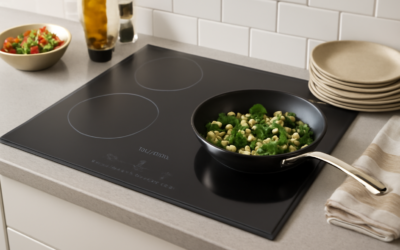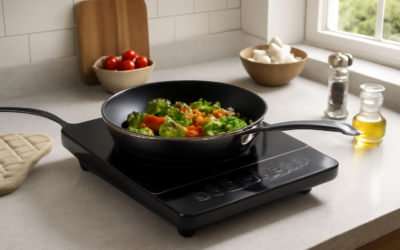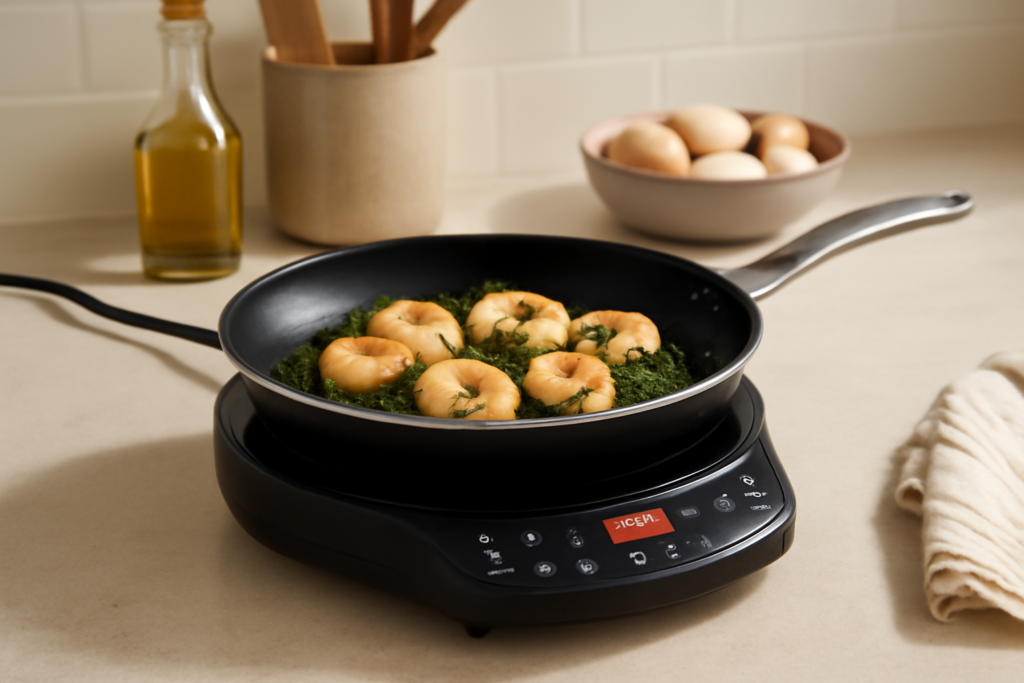
A NuWave induction cooktop is a portable, single-burner countertop unit that heats a magnetic pan directly with an electromagnetic field instead of a glowing coil or flame. If you have ever wanted precise, fast, plug-in cooking without renovating your kitchen, a NuWave induction cooktop is one of the cheapest ways in, usually $60 to $130 depending on the model.
- How Induction Works, Briefly
- The Cookware Rule You Cannot Skip
- The NuWave Lineup
- Wattage and What It Means at the Pan
- Temperature Control Versus Power Levels
- Real Advantages
- Honest Limitations
- Setup and First Use
- Care and Longevity
- NuWave Versus a Full Induction Range
- Common Problems and Fixes
- Who Should Buy One
How Induction Works, Briefly
Under the ceramic-glass top sits a copper coil. Run alternating current through it and it generates a rapidly shifting magnetic field. Set a magnetic pot on the surface and that field induces electrical eddy currents in the pan itself, and the pan’s own resistance turns those currents into heat. The glass stays relatively cool; the pan does the heating. That is why induction boils water faster than gas and why the surface is safe to touch minutes after you lift the pot.
The Cookware Rule You Cannot Skip
No magnetic pan, no heat. Test yours with a refrigerator magnet: if it snaps firmly to the bottom, it will work. Cast iron, carbon steel, enameled cast iron, and magnetic stainless steel all work. Aluminum, copper, glass, and most non-magnetic stainless (like some 18/10 with a non-ferrous base) will not. This is the single most common reason a new NuWave owner thinks their unit is broken. It is not. The pan is wrong.
The pan base should also be flat and at least a few inches across to couple with the coil. A tiny milk pot or a warped skillet will trigger the pan-detection sensor and the unit will beep and shut off.
The NuWave Lineup
NuWave markets several portable induction models, and the differences come down to wattage, temperature range, and the control panel.
NuWave PIC Gold
The PIC Gold is the workhorse. It draws up to 1,500 watts, offers a temperature range from about 100 to 575 degrees Fahrenheit in 10-degree steps, and includes 52 preset temperatures plus a programmable stage cooking function. It runs on a standard 120-volt household outlet and costs around $100. The Gold is the model most home cooks should look at first.
NuWave PIC Pro / Platinum
The PIC Pro pushes to 1,800 watts and extends the temperature ceiling to roughly 575 degrees with finer control, plus a wider low end near 100 degrees for gentle melting and holding. It is aimed at people who want faster boils and more headroom for searing. Expect $120 to $150.
NuWave PIC Flex and Compact Models
The Flex and smaller units run 1,300 watts and trade some power for a lighter, more portable body. They are fine for dorms, RVs, boats, and small apartments, but a 1,300-watt burner boils a large stockpot noticeably slower than the 1,800-watt Pro.
Wattage and What It Means at the Pan
Wattage is the ceiling on how fast the cooktop can move heat. A 1,800-watt NuWave will bring two quarts of water to a rolling boil in roughly four to six minutes; a 1,300-watt unit takes longer. Keep in mind a standard 15-amp, 120-volt circuit tops out near 1,800 watts of continuous draw, so these portable units are pushed right to the edge of a household outlet. Do not run one on the same circuit as a microwave or toaster oven or you will trip the breaker.
Temperature Control Versus Power Levels
Here is a nuance that trips people up. Many NuWave models control by temperature, not by a simple high-medium-low power dial. You set a target like 350 degrees and the unit cycles the coil on and off to hold roughly that pan temperature. On lower-end units this cycling can feel like pulsing rather than steady heat, which shows up when you are trying to keep a delicate sauce at a bare simmer. The higher-wattage Pro holds temperatures more smoothly because it can modulate over a wider range.
Real Advantages
- Speed: Water boils faster than on most gas or electric coil ranges.
- Efficiency: Roughly 85 to 90 percent of the energy reaches the food, versus about 40 percent for gas, because you are heating the pan and not the air.
- Safety: The glass surface never gets red hot; residual heat comes only from the pan. There is no open flame and no gas.
- Portability: Plug it in anywhere. It moves to the patio, the garage for canning, or a second stovetop during holiday cooking.
- Cleanup: Spills hit cool glass and wipe off. Nothing bakes on.
Honest Limitations
- It is a single burner. It supplements a range; it does not replace one for a family.
- The cooling fan runs whenever the unit is on and is audible, roughly the level of a quiet microwave.
- Cheap or thin magnetic pans can develop hot spots because induction heats only where the coil couples with the base.
- The 120-volt limit caps power. A built-in 240-volt induction range simply has more muscle.
Setup and First Use
Place the cooktop on a hard, flat, heat-tolerant surface with a few inches of clearance around the vents; the fan needs to breathe. Keep it off metal countertops and away from anything that could block the underside intake. Plug directly into a grounded wall outlet, not a lightweight extension cord or a power strip, because the 1,500-plus-watt draw can overheat undersized cords.
Set your magnetic pan on the center of the glass, power on, and select a temperature or preset. If the unit beeps and shows a pan error, the cookware is either non-magnetic, too small, or not centered.
Care and Longevity
Let the fan finish its post-cook cool-down cycle before unplugging; that cycle protects the internal electronics. Wipe the glass only after it has cooled, using a soft cloth and a ceramic-cooktop cleaner for stuck residue. Never slide a hot cast-iron pan across the glass, since it can scratch. Keep sugar and acidic spills off the surface while hot. Treated this way, a NuWave typically lasts several years of regular use.
NuWave Versus a Full Induction Range
People shopping portable induction often wonder whether to skip it and buy a built-in range. The math is simple. A NuWave costs $60 to $150 and plugs into any outlet. A built-in 240-volt induction range costs $1,500 to $3,000, needs a 40- or 50-amp circuit, and delivers 3.6 kW per boost burner versus the NuWave’s 1.8 kW ceiling. The portable unit is not trying to win that fight. It wins on price, flexibility, and the fact that you can put it away when you are done.
For renters who cannot modify wiring, a pair of NuWave burners on the counter effectively becomes a two-burner induction cooktop for under $250, no electrician required. That is the real use case: induction cooking without a renovation.
Common Problems and Fixes
- Unit beeps and shuts off: Pan is non-magnetic, too small, or off-center. Test with a magnet and re-center.
- Pulsing heat at low settings: Normal on lower-wattage models that cycle the coil. Use a heavier pan to buffer the swings.
- Error code E7 or similar: Usually overheating from blocked vents. Move the unit off soft surfaces and clear the intake.
- Fan keeps running after shutoff: Intentional cool-down. Let it finish before unplugging.
- Trips the breaker: Sharing a 15-amp circuit with another appliance. Give it its own outlet.
- Uneven heating: A warped or thin pan base is not coupling fully with the coil. Switch to a flat, heavier magnetic pan.
None of these point to a defective unit in most cases. Nine out of ten service complaints trace back to cookware or the outlet, not the electronics. Rule those out before you box it up for a return.
Who Should Buy One
A NuWave induction cooktop earns its place for apartment dwellers, RV and boat cooks, canners who need a powerful extra burner, and anyone testing whether induction cooking suits them before committing to a full 240-volt range. Match the wattage to your needs, buy magnetic cookware, give it a dedicated outlet, and this modest countertop unit delivers fast, precise, safe heat for the price of a nice dinner out.