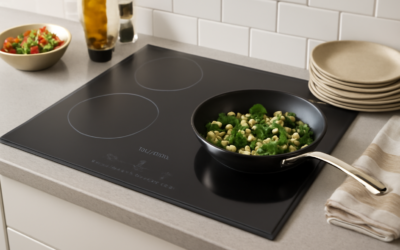
The duxtop induction cooktop is the portable countertop unit that turned a lot of skeptics into induction believers without asking them to remodel a kitchen. Duxtop (a brand of Secura) built its reputation on affordable, genuinely good single- and double-burner portable induction plates. I recommend them constantly for dorms, RVs, small kitchens, extra burners at the holidays, and outdoor cooking. Here is the full rundown.
What You Are Actually Buying
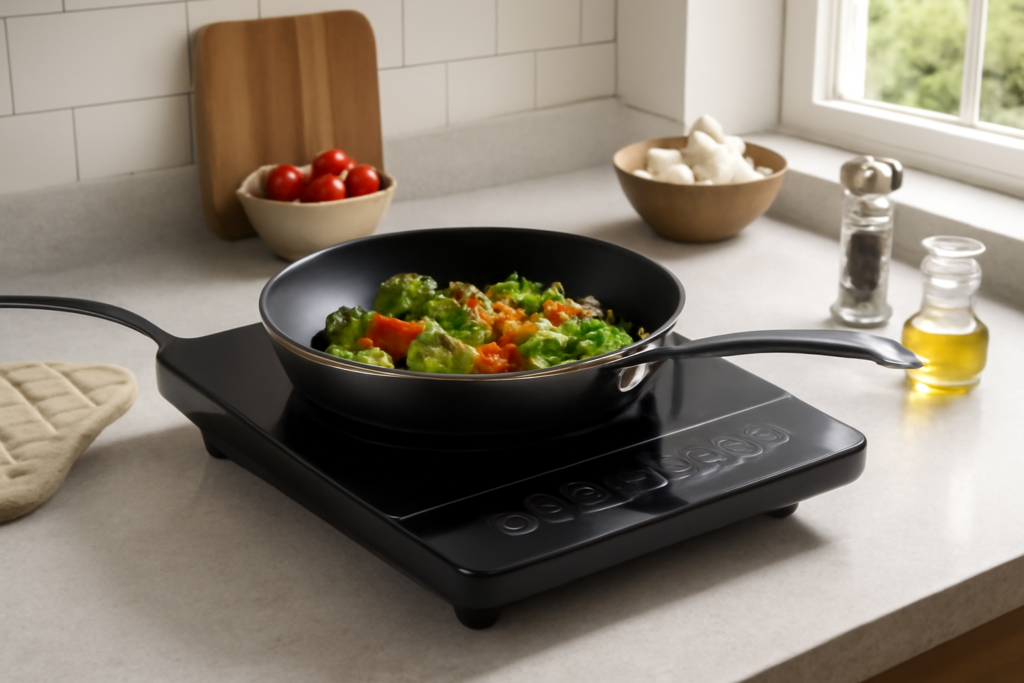
A Duxtop is a plug-in countertop induction burner. Set it on any surface, plug it into a standard 120-volt outlet, put a magnetic pan on the glass, and it heats the pan directly through a magnetic field. No open flame, no glowing coil, and the glass stays relatively cool because the pan does the heating. Most Duxtop portables are single-burner units; the company also sells a double-burner model and built-in style options.
Wattage and Power Levels
Power is what separates models, measured in watts:
- 1,800 watts: The standard for most Duxtop portables (the popular 8100MC, 9600LS, and 9100MC all run 1,800 watts). This is about the ceiling for a standard 15-amp household outlet — pull more and you trip breakers.
- Multiple power settings: Better Duxtop models offer 10 to 20 power levels and a separate temperature mode from roughly 100°F to 460°F in defined steps, plus a built-in countdown timer.
1,800 watts boils water fast — noticeably faster than a radiant electric coil — and gives you responsive, near-instant heat changes. Do not plug two 1,800-watt burners into the same circuit; you will overload it.
The Model Lineup
- Duxtop 8100MC / 9600LS: The bread-and-butter single burner. 1,800 watts, LCD display, 15 power and 15 temperature settings, timer. Runs about $60 to $80. The one I recommend most.
- Duxtop 9100MC: Similar single burner with sensor-touch controls.
- Duxtop Professional (P961LS / BT-180DZ): A step up in build with a stainless housing and low-standby-power features, around $80 to $100.
- Duxtop double-burner and built-in models: Two-zone portables and drop-in units for those wanting a semi-permanent setup.
Cookware: This Makes or Breaks It
Induction only works with magnetic (ferrous) cookware, and this is the number one reason people think their new burner is defective. Before anything, do the magnet test: stick a refrigerator magnet to the bottom of your pan. If it grabs firmly, it works; if not, it will not heat and the Duxtop will flash an error and beep.
- Works: Cast iron, carbon steel, enameled cast iron, and magnetic stainless steel.
- Does not work: Bare aluminum, copper, glass, and non-magnetic stainless.
Duxtop specs a minimum and maximum pan base diameter — roughly 5 to 8 inches on the single-burner units. A pan smaller than the minimum will not register, and the base must be flat for good contact with the glass.
Reading the Error Codes
Duxtop’s display shows fault codes, and knowing them saves a lot of frustration:
- E0: No pan detected, or the pan is non-magnetic / too small. Check your cookware with a magnet.
- E1: Internal fan or ventilation blocked / overheating. Make sure the intake and exhaust vents on the sides are clear and the unit is not on a soft surface that blocks airflow.
- E2: Abnormal voltage or overheating of the surface. Let it cool; check your outlet.
- E3 through E6 / EB: Sensor or temperature faults, often heat-related. Let the unit cool and ensure ventilation.
Most Duxtop “failures” are really an E0 (wrong pan) or an E1 (blocked cooling fan). Keep the side vents clear and use ferrous cookware and you will rarely see a code.
Portable vs Built-In
The portable Duxtop’s strengths are its price, its plug-anywhere flexibility, and easy replacement — if one dies after a few years, you are out $70, not $700. The trade-offs versus a full built-in induction range are the single 1,800-watt zone (limited by the household outlet) and the countertop footprint. For a permanent multi-burner cooking surface, a hardwired 240-volt built-in induction cooktop delivers far more total power. The Duxtop is the supplemental or small-space champion, not a replacement for a whole-kitchen range.
Who Should Buy One
- Small spaces: Apartments, dorms, tiny homes, RVs, and boats where a full range does not fit.
- Extra burner: Holiday cooking overflow, keeping a sauce warm, or canning without heating the main range.
- Outdoor and remote cooking: Patio, garage, or anywhere with an outlet.
- Induction test drive: The cheapest way to find out if you like induction before committing to a built-in.
Cooking Modes and How to Use Them
Most Duxtop portables give you two ways to cook, and knowing which to use makes a big difference:
- Power mode: You set a wattage level, and the burner pulses on and off to average that power. Use this for boiling, searing, and stir-frying where you want maximum, responsive heat. At the top settings water boils fast — noticeably quicker than an electric coil.
- Temperature mode: You set a target surface temperature (roughly 100°F to 460°F in steps), and the burner modulates to hold it. Use this for frying at a steady 350°F, melting chocolate gently, or simmering without scorching. It is not a precise thermostat like sous vide gear — it reads the plate, not the food — but it is close enough for most cooking.
A common beginner mistake is using temperature mode to boil water; power mode gets you there faster. And because induction pulses at lower settings, a very low simmer may cycle on and off visibly — that is normal, not a fault.
Safety Features Worth Knowing
Duxtop builds in several protections that make these safe for small spaces and households with kids:
- Auto pan detection: With no pan, or a non-magnetic pan, the unit will not heat and shuts off after a short beeping period — no wasted energy, no hot surface.
- Overheat protection: An internal sensor cuts power if the unit or pan gets too hot, throwing an error rather than continuing.
- Auto-shutoff timer: The unit powers down after a set idle period and supports a countdown timer up to several hours for unattended simmering.
- Cool surface: Because the pan heats and not the glass, the surface stays far cooler than a gas or electric burner — though residual heat transfers back from a hot pan, so it is not cold.
Care and Longevity
Wipe the glass when cool with a soft cloth, keep the side cooling vents clear of dust and clutter, and never block the fan by setting the unit on a towel or soft surface — overheating is the main killer. Do not slide heavy cast iron across the glass; lift it to avoid scratches. Treated well, a Duxtop portable typically lasts several years of regular use, and the cooling fan is the most common wear item.
Duxtop vs Other Portable Brands
The portable induction market has grown, and Duxtop holds up well against the alternatives. Against no-name budget units, Duxtop wins on build quality, sensible controls, and reliable error handling — the cheapest generics tend to have vague power levels and fail early. Against premium single-burner units from brands like Breville (the Control Freak) or Vollrath, Duxtop gives up precision temperature control and commercial-grade durability but costs a fraction of the price — the Control Freak runs several hundred dollars versus $60 to $100 for a Duxtop. For the vast majority of home users who want a fast, reliable extra burner, Duxtop hits the value sweet spot. Spend up only if you need laboratory-grade temperature accuracy for candy work or precise chocolate tempering.
Bottom Line
A duxtop induction cooktop is a genuinely good value — fast 1,800-watt heating, precise control, and a price that makes it a no-brainer for small spaces, extra-burner duty, or a low-risk first taste of induction. Use magnetic cookware, keep the vents clear, and understand the error codes, and this little burner will outperform your expectations for what $70 can do.