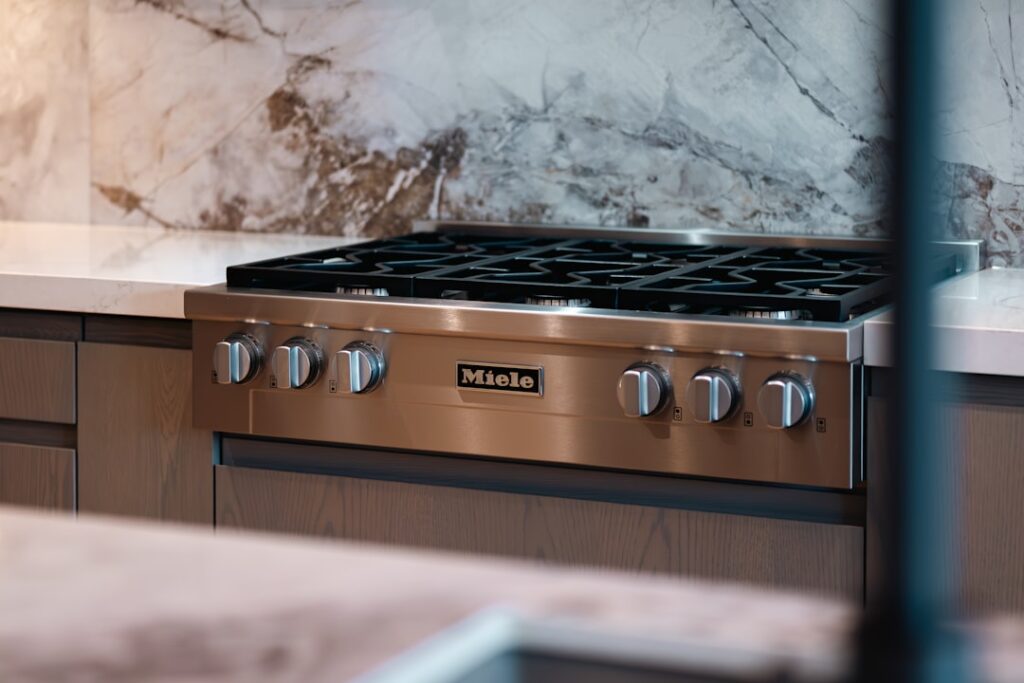
A Miele induction cooktop brings German engineering and a reputation for 20-year durability to one of the fastest, most precise cooking surfaces you can buy. Miele has long been the appliance brand people pass down rather than replace, and its induction cooktops carry that same over-built philosophy — along with genuinely clever features like full-surface flexible zones and automatic temperature control. The premium is real, but so is the case for it. Here’s what you’re actually buying.
Induction heats the pan directly through an electromagnetic field instead of heating a burner, giving you near-instant response, precise simmering, high efficiency, and a surface that stays cool enough to wipe clean. Miele takes that foundation and adds refinement most brands don’t touch.
What Sets Miele Induction Apart
Two feature families define the Miele induction experience. The first is PowerFlex — pairs of elements that combine into a single large, flexible cooking zone. Place a big roasting pan, a fish kettle, or a griddle anywhere across a PowerFlex area and it heats evenly, no fussing over exact burner placement. Higher-end Full Surface models take this further, turning nearly the entire cooktop into freely usable zones that detect your cookware and heat only where a pan sits.
The second is TempControl, a sensor-driven system that holds a set temperature at the pan for frying, searing, and melting — so your oil stays at the right heat and your chocolate doesn’t scorch. It’s the kind of automation that removes guesswork, and it’s characteristically Miele: engineered to make consistent results easy.
Sizes and Configurations
Miele offers induction cooktops across the standard widths and a few beyond. 30-inch models are the residential mainstay with four zones (typically arranged as two PowerFlex pairs). 36-inch and larger units add zones and full-surface flexibility for serious cooks. Compact and specialty widths exist for smaller kitchens or supplemental cooking stations.
Zone power is rated in watts, and Miele’s boost functions temporarily push extra power to a single zone for the fastest boil. Full Surface models forgo fixed burner rings entirely, letting you position multiple pans wherever they fit — a genuine convenience when you’re juggling several pots.
Downdraft and Integrated Ventilation Models
One of Miele’s most compelling offerings is its induction cooktop with integrated downdraft ventilation. These units build an exhaust vent directly into the center or rear of the cooktop, pulling steam and smoke down and out through ductwork below — eliminating the need for an overhead range hood entirely. For islands and open-plan kitchens where a hanging hood would block sightlines, this is a standout solution.
The integrated blower can be ducted outside (best performance) or set up to recirculate through filters where ducting isn’t possible. If you’re designing a clean, hood-free island, a Miele induction cooktop with downdraft is one of the strongest options on the market — just plan the under-counter duct path early.
Controls and Everyday Use
Miele cooktops use responsive touch controls, and higher models add features like a directly selectable power level, timers per zone, keep-warm settings, and a pot recognition system that won’t energize a zone unless compatible cookware sits on it. A “stop-and-go” function drops all zones to low with one touch when you need to step away, then restores your settings.
Everyday cleaning is effortless, as with all induction — the flat glass surface never bakes on spills because it doesn’t get hot enough, so a wipe handles most messes. The precision at the low end is where Miele shines in daily cooking: holding a true, gentle simmer that gas struggles to match.
Cookware Requirements
Like all induction, a Miele cooktop only works with magnetic (ferrous) cookware — cast iron, carbon steel, and magnetic stainless steel. Test any pan with a magnet; if it grips the bottom firmly, it’ll work. Aluminum, copper, and non-magnetic stainless won’t heat. Most modern quality cookware is induction-ready, so you likely already own compatible pieces, but confirm before you commit and budget for replacements if your set is old aluminum or pure copper. Flat, fully contacting bottoms perform best.
Installation and Electrical
A Miele induction cooktop requires a dedicated 240-volt circuit, commonly 40 or 50 amps depending on the model and whether it includes downdraft ventilation — always verify the exact amperage on the spec sheet and hire a licensed electrician for the circuit and breaker. These cooktops draw serious power, and downdraft models need additional space and ducting below.
The cooktop drops into a precise countertop cutout; flush-mount installations require the fabricator to route the counter for a seamless finish, so coordinate cutout dimensions before templating. Downdraft models need adequate cabinet depth and a clear duct route, ideally to the exterior. Plan the electrical rough-in, cutout, and any ductwork together during the remodel rather than after.
Pricing and Value
Miele induction cooktops typically run $2,000 to $5,000-plus, with downdraft and full-surface models at the top of that range. That’s a clear premium over mainstream induction from Bosch, GE, or Samsung ($1,200–$2,000), and comparable to Wolf and other luxury brands.
The value case rests on three things: legendary longevity — Miele engineers many products to a 20-year test standard — advanced features like PowerFlex, TempControl, and integrated downdraft that competitors don’t all match, and refined controls and build quality. What the premium doesn’t buy is fundamentally better basic cooking than a good mainstream induction unit, since the underlying physics are identical. If you want a cooktop that lasts decades, offers hood-free island venting, or anchors a high-end kitchen, Miele justifies its price. If you just want fast, precise induction on a budget, a mainstream model cooks the same food for far less.
Safety Features Worth Knowing
Induction is inherently safer than gas or radiant electric, and Miele layers on the protections you’d expect from German engineering. The glass heats only where a pan sits, warmed by the cookware itself rather than a glowing element, so there’s no flame and the surface cools fast once you remove the pot. Pot recognition prevents a zone from energizing without compatible cookware, an automatic safety shut-off cuts power if a pan boils dry or is left unattended too long, and residual-heat indicators warn you which zones are still warm from a pan.
A child lock disables the controls so curious hands can’t turn on a zone, and an overheat sensor protects the electronics. These features make a Miele induction cooktop one of the more family-friendly cooking surfaces available. As with any induction unit, expect a faint hum at high power with lighter pans and a brief post-cooking fan cycle — both normal — and those with older pacemakers should check with their doctor, though modern implants are generally unaffected.
Care and Longevity
Miele’s reputation rests on longevity, and the induction cooktops are built to reward basic care with decades of service. Cleaning is effortless: the glass never bakes on spills the way a radiant coil does, so most messes wipe off with a damp cloth once cool. For stubborn residue, use a ceramic-glass cleaner and a plastic scraper at a low angle, and keep abrasive pads, steel wool, and scouring powders away from the surface.
Wipe sugary spills quickly before they can pit warm glass, and keep pan bottoms free of grit that would scratch the surface over time. On downdraft models, clean the vent grille and grease filters regularly — many are dishwasher-safe — so the ventilation keeps pulling at full strength. Given that Miele engineers many products to a 20-year test standard, treating the cooktop well means it may genuinely outlast the kitchen it’s installed in. That durability is a core part of what the premium price buys.
The Bottom Line
A Miele induction cooktop is a long-term investment in speed, precision, and durability, with standout features — flexible full-surface zones, automatic TempControl, and integrated downdraft ventilation — that set it apart in the luxury tier. Size it to how you cook, decide whether downdraft venting fits your layout, confirm your cookware is magnetic, and budget for a dedicated 240-volt circuit installed by a pro. Buy it for the engineering, the features, and the decades of service — and it’ll be one of the last cooktops you ever need.