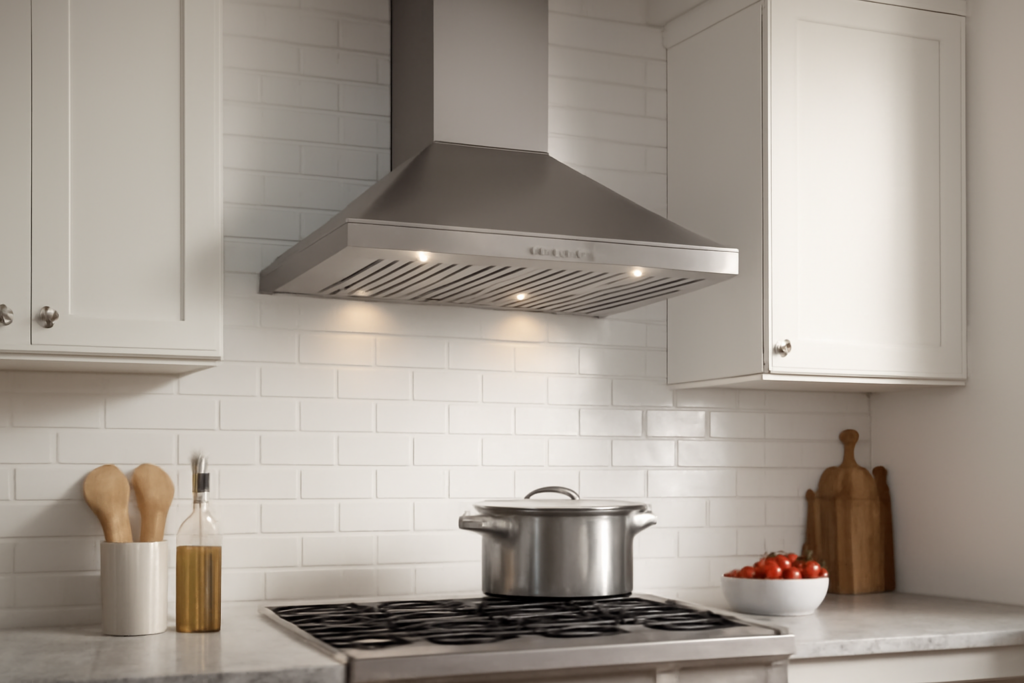
A Hauslane range hood has become a go-to for homeowners who want commercial-style venting without a commercial price tag. The brand built its reputation on strong airflow, quieter motors, and a design language that looks more expensive than it costs.
This guide walks through the model lines, the numbers that actually matter, and how to size and vent one correctly so it clears smoke and grease instead of just looking good.
Who Hauslane Is and What They Make
Hauslane is a US-based kitchen ventilation company focused almost entirely on range hoods. Rather than spreading across every appliance category, they refine hood designs, which shows up in details like touch controls, dishwasher-safe baffle filters, and LED lighting that comes standard across the lineup.
The catalog covers wall-mount, under-cabinet, island, and insert styles, so there is a form factor for nearly any kitchen layout. Most shoppers land on the Chef Series, which is the core range that balances price and performance.
The Main Model Lines
Knowing the series names makes shopping far easier.
- Chef Series (PS series): the flagship wall-mount and under-cabinet hoods. The popular PS18 and PS10 models pair strong airflow with a stainless body and touch or push-button controls.
- Chef Series WC and UC: WC denotes wall-chimney models with the tall flue cover; UC denotes under-cabinet units that tuck beneath your upper cabinets.
- Ductless-capable models: many Chef Series hoods can run ducted or convert to recirculating with a charcoal filter kit.
- Inserts and liners: for building the hood into a custom wood or plaster surround.
CFM: The Number That Matters Most
CFM, or cubic feet per minute, measures how much air the hood moves. Get this wrong and even a beautiful hood fails to clear your cooktop.
Hauslane rates most Chef Series hoods at 860 CFM on the high setting, with lower models around 450 to 600 CFM. The 860 figure is a peak rating, and real-world performance depends heavily on your ductwork, but it is genuinely strong output for a residential hood in the $300 to $600 class.
Size the CFM to your cooking. A common rule for electric cooktops is 100 CFM per linear foot of cooktop width, so a 30-inch range wants at least 250 CFM. Gas is rated by heat output: total your burner BTUs and divide by 100 to get a target CFM. A gas range totaling 60,000 BTU calls for roughly 600 CFM. Hauslane’s 860-CFM models give you comfortable headroom for most gas ranges, and you rarely need to run them wide open.
Sizing the Hood to Your Cooktop
The hood should be at least as wide as the cooktop, and ideally 3 inches wider on each side to capture rising smoke that drifts outward.
- 30-inch cooktop: a 30-inch hood works, a 36-inch hood captures more.
- 36-inch cooktop: use a 36-inch hood at minimum.
- Range or island: Hauslane offers 30, 36, and 48-inch widths to match.
Mounting height matters too. Set a wall or under-cabinet hood 28 to 36 inches above an electric cooktop, and 30 to 36 inches above gas. Too high and it loses capture; too low and it gets greasy and blocks your view.
Ducting It Correctly
A high-CFM hood is only as good as the duct behind it. Hauslane Chef Series hoods use a 6-inch round duct outlet, and you should keep that full diameter all the way outside. Do not neck a 6-inch hood down to a 4-inch dryer-style duct, because that choke can cut real airflow by half and make the motor loud for nothing.
Follow these ducting basics:
- Use smooth rigid metal duct, not flexible foil, since ridges create turbulence and drag.
- Keep the run as short and straight as possible; every 90-degree elbow adds resistance equal to several feet of straight pipe.
- Terminate at a wall or roof cap with a backdraft damper so cold air and pests stay out.
- For recirculating installs where no duct is possible, add the Hauslane charcoal filter kit and expect reduced heat and moisture removal.
Noise, Filters, and Lighting
Loud hoods get turned off, which defeats the purpose. Hauslane publishes noise figures in the range of 45 to 65 decibels depending on fan speed, and the multi-speed motors let you run a quiet low setting for simmering and save full power for searing. Sixty-five decibels at max is normal for an 860-CFM hood; the low and mid speeds are where you will spend most of your time.
Filtration uses stainless steel baffle filters that trap grease as air passes through the angled channels. They are dishwasher-safe, so pull them every 2 to 4 weeks and run them through a cycle. Baffles outlast the mesh filters found on cheaper hoods and do not need replacing.
LED lighting comes standard and is usually dimmable, giving you good task light over the cooktop without adding heat. Bulbs are low-wattage and last for years.
What a Hauslane Range Hood Costs
Pricing is the brand’s strong suit. Under-cabinet Chef Series models start around $200 to $300. Wall-mount chimney models in the popular 30 and 36-inch sizes run roughly $350 to $550. Island hoods, which need a taller flue and finished back, land around $500 to $800. Insert liners for custom hoods sit in the $250 to $450 range.
Installation of a wall or under-cabinet unit runs $150 to $400 if ducting exists, more if a new duct run to the exterior is needed. A straightforward replacement of an existing hood is a manageable DIY job for a confident homeowner, though the wiring should tie into a proper junction box.
Make-Up Air and Tight Homes
One thing high-CFM hoods share is the ability to pull more air out of the house than can leak back in. Run an 860-CFM hood in a modern, tightly sealed home and it can create enough negative pressure to backdraft a gas water heater or furnace, drawing combustion fumes into the living space. That is a real safety concern, not a theoretical one.
In practice most people rarely run a Hauslane hood at full 860 CFM, and homes with atmospheric leakage handle the airflow fine. But if your house is new and airtight, or you plan to vent at high speed often, look into a make-up air kit that opens a fresh-air damper when the hood runs. Some local codes require one above a certain CFM threshold, so check with your inspector before finalizing the install.
Is It the Right Hood for You?
Choose a Hauslane range hood if you want serious airflow, quiet low-speed operation, and easy-clean baffle filters at a mid-market price. The Chef Series in particular hits a sweet spot for gas-range kitchens that generate real smoke and heat. Just commit to a full-size 6-inch duct run, size the width to your cooktop, and set the mounting height correctly, and the hood will clear your air the way the CFM rating promises.
How It Compares to the Competition
Against big-box brands in the same price band, Hauslane usually wins on airflow-per-dollar and on the quality of the baffle filters and touch controls. A comparable 860-CFM stainless hood from a premium name often costs $200 to $400 more for similar real-world venting. Where the premium brands pull ahead is in warranty depth, dealer service networks, and heavy-gauge steel that feels more substantial.
For a homeowner doing a kitchen refresh who wants strong performance without paying designer prices, that positioning is exactly the appeal. Read the CFM rating, check that your duct can carry it, and the Hauslane range hood delivers commercial-style capture at a builder-grade cost. Register the unit after install so the warranty is on file, keep those baffle filters clean, and it will handle years of daily cooking without complaint. Pair it with a well-planned duct route and correct mounting height, and you get a hood that performs like gear costing far more than you paid for it, which is exactly why the brand has built such a loyal following among remodeling homeowners.