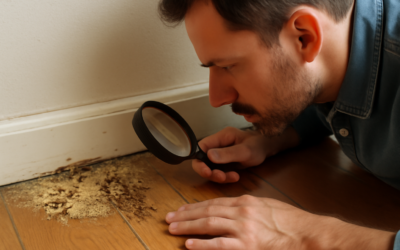
Termites cause an estimated $5 billion in property damage across the United States every year, and homeowner’s insurance almost never covers it. The most frustrating part is that colonies can feed on a home’s structural wood for years before anyone notices. Recognizing the early warning signs of termites gives you a chance to catch an infestation while damage is still minor and treatment costs remain manageable.
Mud Tubes on Foundation Walls
Subterranean termites — the most destructive species in the US — build pencil-width tubes made of soil, saliva, and fecal matter along foundation walls, crawl space piers, and anywhere they need to travel between their underground colony and the wood they are eating. These mud tubes maintain the humid, dark environment termites need to survive.
Check your foundation walls inside and out, especially where concrete meets wood framing. Tubes typically appear as brown, roughly cylindrical lines running vertically up walls. Break open a section — if you see small, white, ant-like insects moving inside, the colony is active. Even empty tubes indicate a previous or nearby colony that could reactivate.
Discarded Wings Near Windows and Doors
Once a year, usually in spring, mature termite colonies produce winged reproductive termites called swarmers (alates). These swarmers leave the colony to mate and start new colonies. After landing, they shed their wings. Piles of small, translucent, equal-length wings near windowsills, door frames, or light fixtures are one of the most recognizable early warning signs of termites.
Swarmers are often confused with flying ants. Key differences: termite swarmers have straight antennae (ants have elbowed antennae), equal-length wings (ants have longer front wings), and a thick, straight waist (ants have a pinched waist). If you see swarmers inside your home, the colony is likely already established within the structure.
Frass (Drywood Termite Droppings)
Drywood termites, common in Southern California, the Gulf Coast, and Hawaii, push their fecal pellets out of tiny holes in the wood they inhabit. These pellets, called frass, look like small piles of sand or sawdust, often with a slightly hexagonal shape visible under magnification. Colors range from tan to dark brown depending on the wood being consumed.
Finding frass piles on windowsills, beneath baseboards, or in attic spaces points directly to a drywood termite colony overhead. Unlike subterranean termites, drywood species do not need soil contact — they live entirely within the wood itself, making them harder to detect until frass appears.
Hollow-Sounding or Damaged Wood
Termites eat wood from the inside out, leaving a thin outer shell intact. Tap along baseboards, door frames, window trim, and exposed structural members with the handle of a screwdriver. Solid wood produces a firm, dense sound. Infested wood sounds hollow or papery.
More advanced damage shows as bubbling or peeling paint, wood that crumbles easily when probed, and visible maze-like galleries if you cut into affected lumber. Floor joists, sill plates (the lowest piece of wood framing sitting on the foundation), and any wood in contact with soil are the highest-risk areas.
Tight-Fitting Doors and Windows
As termites consume wood around door and window frames, the structural members warp from moisture the insects introduce. Doors and windows that suddenly stick, jam, or will not close properly — without any other explanation like seasonal humidity changes — can indicate termite damage to the surrounding framing.
This symptom alone does not confirm termites, but combined with any of the other signs on this list, it should prompt an immediate professional inspection.
Blistering or Buckling Floors
Subterranean termites sometimes damage wood flooring from below, causing sections to blister, buckle, or feel spongy underfoot. Laminate and hardwood floors over a crawl space are especially vulnerable. The damage pattern can resemble water damage, which leads many homeowners to look for plumbing leaks instead of inspecting for termites.
If floor damage appears near exterior walls or in areas close to the ground (first floor over a crawl space), have a termite inspection done alongside any leak investigation.
What to Do If You Spot Warning Signs
Do not panic, but do not wait either. Termite colonies consume wood slowly — a typical subterranean colony eats about 1/5 of an ounce of wood per day, which translates to roughly a linear foot of 2×4 per year. You have time to make an informed decision, but not time to ignore the problem for months.
- Schedule a professional inspection. Most pest control companies offer free termite inspections. Get at least two opinions. A thorough inspection takes 1-2 hours and covers the crawl space, attic, foundation perimeter, and all accessible wood
- Get a treatment quote. Liquid barrier treatments (Termidor, Taurus SC) cost $1,500-$3,000 for an average home. Bait station systems (Sentricon, Trelona) run $1,200-$3,500 installed plus $200-$400 per year for monitoring. Spot treatments for drywood termites start at $500-$1,000
- Document damage with photos and keep inspection reports. If you sell the home later, buyers and their lenders will ask about termite history
- Address moisture issues that attract termites — fix leaky faucets, improve crawl space ventilation, grade soil away from the foundation, and eliminate wood-to-soil contact around the perimeter
Preventing Future Infestations
After treatment, reduce your home’s attractiveness to termites with these long-term measures. Keep mulch at least 6 inches from the foundation. Store firewood at least 20 feet from the house and 5 inches off the ground. Maintain gutters to prevent water from saturating the soil near the foundation. Seal cracks in the foundation with concrete patch. Remove dead trees and stumps from the yard.
Annual termite inspections ($75-$150 if not bundled with a treatment warranty) are worth every dollar, particularly in high-risk zones across the Southeast, Gulf Coast, and California. Catching early warning signs of termites before structural damage occurs is the difference between a $1,500 treatment and a $15,000 repair.