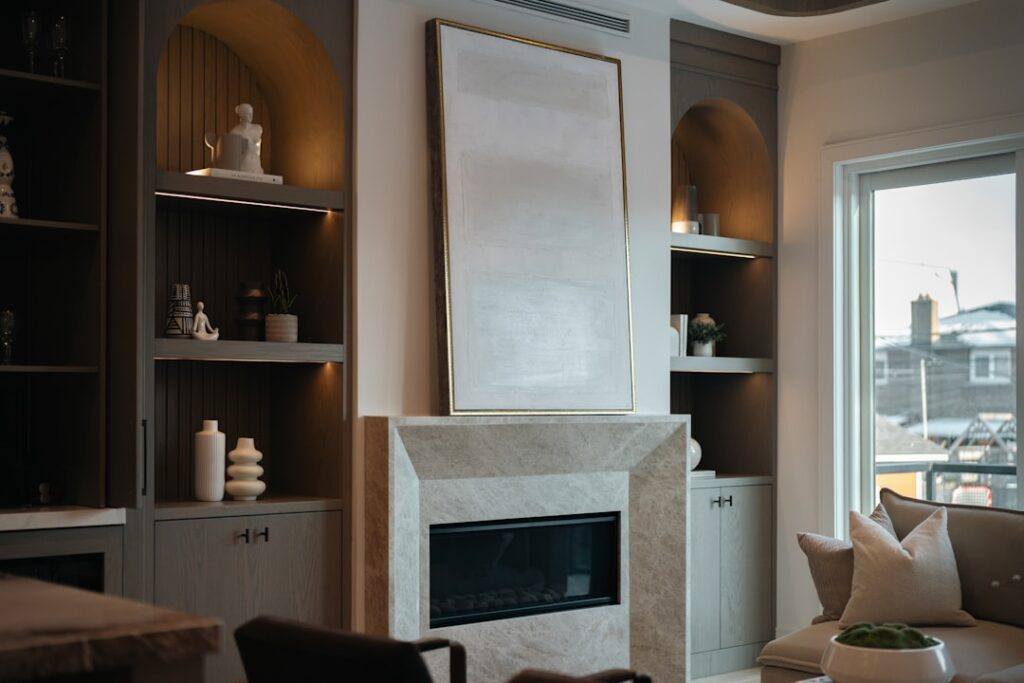
Walk into any home improvement store and electric fireplaces line an entire aisle, all promising “supplemental heat” and “real flame look.” What the labels don’t tell you is that a typical 1,500-watt unit costs about $0.18 per hour to run on average US electricity rates — which adds up fast if you leave it on all evening. An energy efficient electric fireplace isn’t just one with a high efficiency rating (they’re all 99% efficient at converting electricity to heat). It’s one with smart controls, accurate thermostats, and zone-heating features that let you stop heating empty rooms.
- Understanding Real Efficiency vs Marketing Efficiency
- Wattage Ratings and What You Need
- Top Energy-Efficient Models Worth Considering
- Infrared Quartz vs Forced Air Coil
- Running Cost Math by Region
- Smart Features That Actually Save Money
- Installation Options and Their Trade-Offs
- Combining With Existing Heat Sources
- Ambience Without the Heat Bill
Understanding Real Efficiency vs Marketing Efficiency
Every electric heater converts virtually 100% of its electricity into heat. There’s no flue, no combustion loss, nothing wasted. So when manufacturers claim “99% efficient,” they’re technically correct but practically meaningless — every electric fireplace on the market hits the same number.
The real efficiency story is in three other places: the accuracy of the built-in thermostat (cheap units overshoot by 4°F or more), the responsiveness of the controls (units without proportional control cycle on full blast then off, wasting energy), and the heat distribution (forced-air models heat faster but spread better than radiant models). These are what separate a $200 inefficient unit from a $600 model that actually saves money.
Wattage Ratings and What You Need
Most plug-in electric fireplaces run on standard 120V circuits and are limited to 1,500 watts (about 5,000 BTUs). That heats roughly 400 square feet effectively in a well-insulated room. For larger spaces, look at 240V hardwired models that deliver 5,000 watts and 17,000 BTUs.
- Up to 400 sq ft: standard 1,500W plug-in
- 400 to 800 sq ft: 240V hardwired 4,000W to 5,000W
- 800+ sq ft: dual-zone or paired units, or supplement with a different heat source
Buying a unit too small forces it to run constantly and rarely reach setpoint, wasting more energy than a properly sized larger model running intermittently.
Top Energy-Efficient Models Worth Considering
These models pair accurate thermostats with smart features that minimize wasted energy.
- Dimplex Revillusion 30-inch — about $1,200. Best-in-class flame realism, accurate thermostat, and a separate fan-only mode for summer ambience without heat. The premium pick that actually justifies the price.
- Touchstone Sideline Elite 50-inch — $700. Wall-mount design with multi-color flames, infrared remote, and a thermostat that holds within 1°F of setpoint.
- Duraflame DFI-5010-01 — $200. The budget pick that doesn’t waste energy. Stove-style insert with infrared quartz heating, accurate thermostat, and 4,600 BTU output.
- R.W. Flame 50-inch Recessed — $400. Smart-home compatible, integrates with Alexa for scheduling, and the timer functions actually work as advertised.
Infrared Quartz vs Forced Air Coil
The two main heating technologies serve different rooms. Infrared quartz heaters warm objects and people directly without heating the air first, which feels warmer faster and works well in poorly insulated spaces or rooms with high ceilings. Forced air coil heaters warm the air and circulate it with a fan, distributing heat more evenly across larger rooms.
For energy efficiency in zone heating (heating just the room you’re in), infrared wins. For heating an entire open floor plan or large family room, forced air distributes better. Some premium models like the Dimplex Opti-myst combine both — infrared for fast warm-up and a fan for distribution.
Running Cost Math by Region
A 1,500-watt fireplace running 4 hours a day for 6 months consumes 1,080 kWh per heating season. Multiply by your local rate to estimate seasonal cost:
- Texas at $0.12/kWh: roughly $130 per season
- National average at $0.16/kWh: $173 per season
- California at $0.30/kWh: $324 per season
- Northeast at $0.22/kWh: $238 per season
Compare that to running central heat to warm the whole house when you’re only using one room. For zone heating in a home with a high-ceiling family room, the electric fireplace often saves $30 to $80 per month over central heating alone.
Smart Features That Actually Save Money
Programmable thermostats, smart-home integration, and motion sensors transform an electric fireplace from a heater into an efficient zone-heating system. Look for models with:
- Schedulable on/off times tied to your daily routine
- Eco mode that cycles the heating elements rather than running full blast
- Motion or occupancy sensing to shut off when you leave the room
- Open-window detection that pauses operation when temperatures drop suddenly
- WiFi connectivity for remote control and energy usage tracking
These features add $100 to $300 to the price but typically pay back within two heating seasons through reduced runtime.
Installation Options and Their Trade-Offs
Plug-in freestanding units are the simplest — unbox, plug in, and go. They draw 12.5 amps on a standard 15-amp circuit, so don’t share the outlet with anything else. Wall-mount and recessed models look more polished but require a dedicated outlet behind the unit and proper framing for support.
Hardwired 240V models need an electrician and a dedicated 20-amp double-pole breaker. Installation runs $200 to $600 depending on panel access. The trade-off is double the heat output without overloading household circuits, which matters in larger rooms.
Combining With Existing Heat Sources
The smartest energy strategy is using an electric fireplace to supplement, not replace, your central heating. Drop the central thermostat by 4°F to 6°F and use the electric fireplace to maintain comfort in the room you’re actually using. Total energy use drops 10% to 25% in most homes during shoulder seasons.
For deep winter in cold climates, electric resistance heat is one of the most expensive ways to warm a house. A heat pump (mini-split or whole-house) costs roughly one-third as much per BTU. The electric fireplace remains valuable for ambience, supplemental heat in specific rooms, and shoulder seasons when running the whole heating system isn’t justified — but it’s not a substitute for primary heating in a cold-climate home.
Ambience Without the Heat Bill
The killer feature of modern electric fireplaces is the flame-only mode. Most units let you run the visual flames without the heating elements, drawing roughly 15 to 50 watts — about the same as an LED light bulb. That’s a couple of pennies per evening for the cozy fireplace look without any heating cost.
Use this feature aggressively in milder weather and save the heat function for when you actually need supplemental warmth. The result is the fireplace experience year-round at a fraction of the running cost most owners assume they’re locked into.