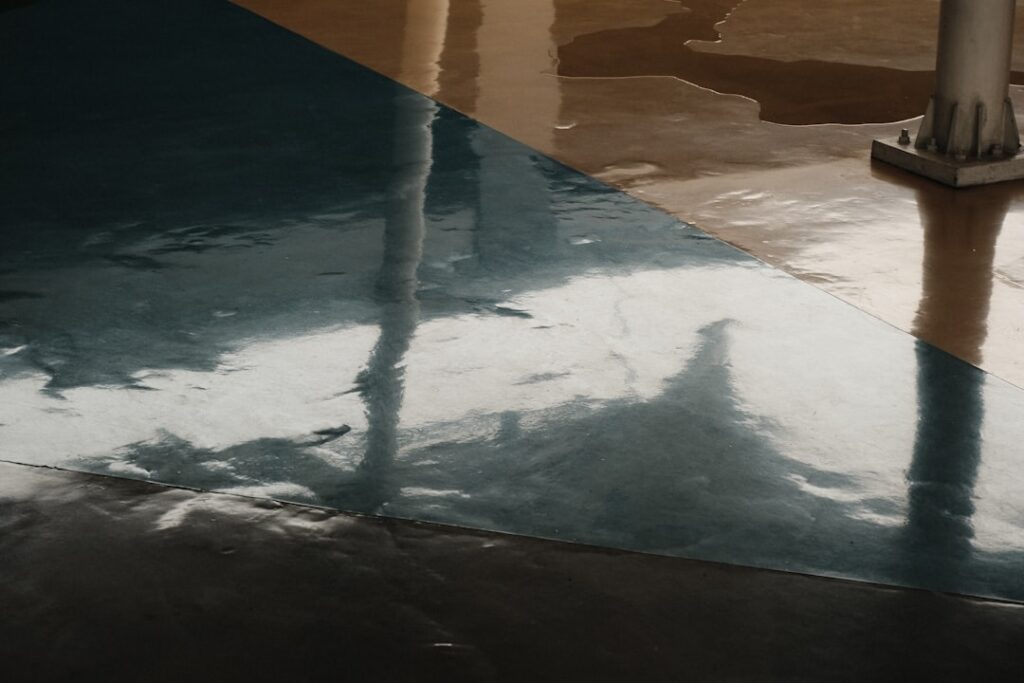
Most homeowners hear “epoxy garage floor” and picture that glossy showroom finish for $3 a square foot. Real-world numbers tell a different story. Weighing the epoxy flooring pros and cons means looking past the marketing photos to grout-line prep work, moisture testing, and a 5- to 15-year service life that depends almost entirely on what happens before the resin ever hits the slab.
What Epoxy Flooring Actually Is
Epoxy is a two-part thermosetting resin — Part A (resin) and Part B (hardener) — that cures into a rigid plastic film bonded to concrete. Coatings range from 3-mil DIY kits at Home Depot ($120 for a 250 sq ft garage) to 100% solids commercial systems poured 1/8 to 1/4 inch thick at $7 to $12 per sq ft installed.
Polyaspartic and polyurea topcoats often get sold under the same “epoxy” umbrella. They cure faster (1-day install vs. 3-day cure) and resist UV yellowing better, but the underlying chemistry differs. Confirm what you’re actually buying before signing a quote.
The Pros: Where Epoxy Earns Its Reputation
A correctly installed system handles abuse most coatings can’t touch. Forklift traffic, hot tire pickup, dropped wrenches, brake fluid, gasoline — all of it wipes off a cured 100% solids epoxy without staining or etching the surface.
- Chemical resistance: Withstands battery acid, motor oil, antifreeze, and most household solvents
- Compressive strength: 10,000+ PSI rating, stronger than the concrete underneath
- Seamless surface: No grout lines, no cracks for dirt or moisture to hide in
- Light reflectivity: A glossy white epoxy can boost garage brightness 200%, cutting your need for added LED fixtures
- Customization: Color flakes, metallic pigments, anti-slip aggregates, and quartz blends let you match any aesthetic
For commercial kitchens, auto shops, and breweries, epoxy is often the only flooring that meets USDA and FDA cleanability standards while surviving daily chemical exposure.
The Cons: Where Epoxy Disappoints
Anyone running through epoxy flooring pros and cons needs to hear the failure modes. Adhesion problems cause roughly 80% of epoxy callbacks, and almost all of them trace back to the slab.
Concrete with a moisture vapor emission rate above 3 lbs per 1,000 sq ft per 24 hours will lift epoxy off the surface in sheets within 6 to 18 months. Most basement slabs and any garage on a high water table fall in this danger zone. A calcium chloride test ($30 kit) before you start saves a $4,000 do-over later.
Other realities:
- UV yellowing: Standard epoxies amber visibly within 12 months of direct sun exposure — exterior patios need polyaspartic instead
- Hardness equals brittleness: Drop a heavy toolbox on a corner and you can chip the coating down to concrete
- Slick when wet: Without aluminum oxide or silica grit broadcast into the topcoat, wet epoxy is dangerously slippery
- Repair visibility: Patches almost never blend invisibly — the coating ages and patched spots look obvious
- Surface prep is non-negotiable: Diamond grinding to a CSP 2-3 profile is required, not just etching with muriatic acid
Real Cost Breakdown
Pricing depends on system thickness and prep complexity. For a typical 500 sq ft two-car garage:
- DIY roll-on kit (Rust-Oleum EpoxyShield, Quikrete): $200-$350 in materials, 12-hour weekend job, 3-5 year lifespan
- Pro-installed water-based epoxy: $3-$5 per sq ft, 5-7 year lifespan
- 100% solids epoxy with flakes and polyaspartic topcoat: $7-$12 per sq ft, 15-20 year lifespan
- Decorative metallic or quartz broadcast systems: $10-$15 per sq ft installed
Crack repair, oil-stain remediation, and joint filling add $1-$3 per sq ft. Skipping these to save money is the single fastest route to coating failure.
When Epoxy Is the Right Call
Garages with dry slabs, commercial spaces, workshop floors, and basements with proven moisture barriers all benefit from epoxy. So do homeowners who want a poured, seamless, easy-to-clean surface and plan to stay in the house long enough to amortize the install cost over 10+ years.
When to Pick Something Else
Skip epoxy if your slab tests wet, if the room sees direct sunlight through windows, or if the space might convert to living area later. Polished concrete ($3-$8 per sq ft), interlocking polypropylene tiles ($2-$4 per sq ft, no prep), or rubber roll-out matting all perform better in those scenarios. Sheet vinyl over cushion-back underlayment also handles moist basements where epoxy will lift.
Maintenance Reality
Sweep weekly. Mop monthly with a pH-neutral cleaner — never use vinegar or citrus-based products, which slowly etch the topcoat. Recoat the wear layer every 5-7 years for $1-$2 per sq ft to extend system life indefinitely. Hot tire pickup (where soft summer rubber sticks to the floor and pulls coating off) signals undercured epoxy or a failed primer — call the installer back under warranty.
Frequently Asked Questions
How long does epoxy flooring really last?
A pro-installed 100% solids system on properly prepped concrete lasts 15-20 years. DIY kits average 3-5 years before the topcoat dulls and needs recoating.
Can I install epoxy over old paint or sealer?
No. Existing coatings must be ground off mechanically. Any contamination — paint, curing compound, oil — destroys adhesion. Diamond grinding to bare concrete with a 2-3 CSP profile is the only acceptable prep.
Is epoxy worth it in a basement?
Only after a moisture vapor test confirms readings under 3 lbs/1,000 sq ft/24 hr. Otherwise, hydrostatic pressure will delaminate the coating within 18 months regardless of brand or system thickness.
Does epoxy crack like concrete?
Epoxy itself doesn’t crack from impact, but it telegraphs every concrete crack underneath. Static cracks need flexible joint filler before coating; active cracks require crack-bridging membranes or the coating will split along the same line.