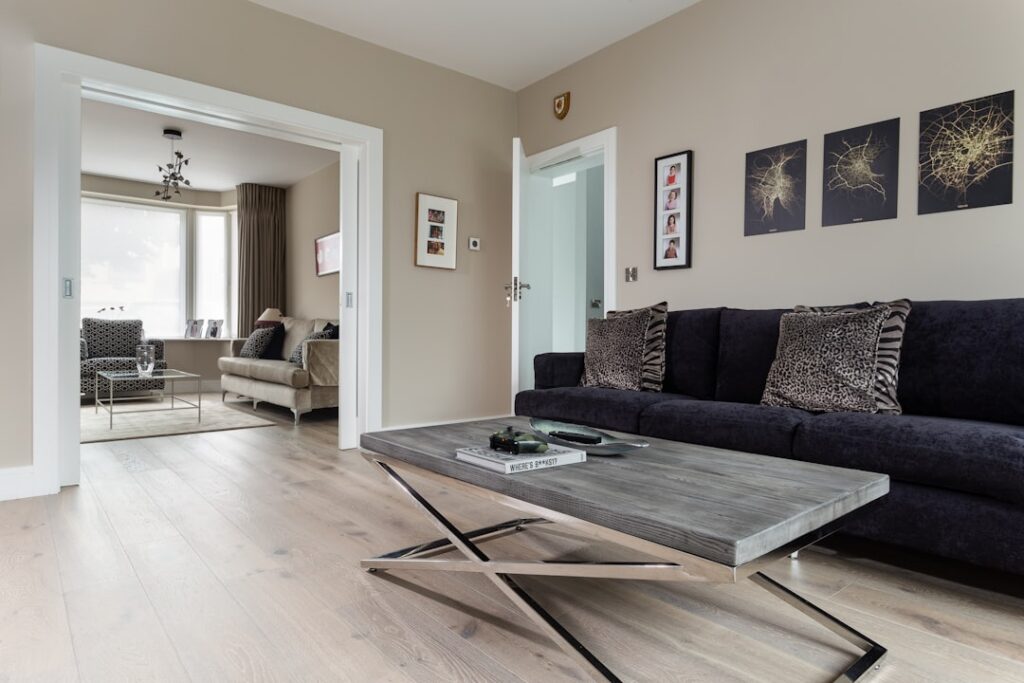
Standard laminate planks measure 48 inches long. Walk into a high-end showroom in 2026 and you will see something different: extra long laminate flooring in 60-, 72-, and even 84-inch lengths that mimic the proportions of real sawn hardwood. The longer plank reduces visible end joints by 30-40 percent across a room, creates a more authentic wood-look appearance, and eliminates the choppy “rectangle parade” effect that gives short laminate away as fake. The trade-off comes in price, install complexity, and waste factor.
Why Plank Length Matters Visually
The eye reads pattern repetition quickly. A 200-square-foot room covered in 48-inch laminate planks shows roughly 60-80 visible end joints depending on plank width. The same room in 72-inch planks shows 40-50 end joints, and 84-inch planks drop that further to 35-45. Fewer joints make the floor read as larger wooden boards rather than as small interlocking tiles. From a distance, the difference between 48-inch and 72-inch length is the difference between obvious laminate and convincing wood-look.
Plank length also affects how the floor handles long sight lines. Open-concept living spaces, hallways longer than 20 feet, and great rooms benefit most from extra-long planks because the eye tracks plank seams down the length of the floor. Short planks emphasize horizontal banding; long planks emphasize directional flow.
Standard vs Extra Long Laminate Dimensions
- Standard laminate — 47-48 inches long, 5-6 inches wide
- Long-format laminate — 50-60 inches long, 6-7 inches wide
- Extra-long laminate — 60-72 inches long, 7-9 inches wide
- Premium extra-long — 72-84 inches long, 9-12 inches wide
Anything in the 72-inch-plus range is typically marketed as “manor plank,” “estate plank,” or “extra-long” depending on manufacturer. The 84-inch SKUs are usually European imports, particularly from Belgian and German mills that have used long-format milling for decades.
Top Extra Long Laminate Brands
- Pergo Outlast+ Extra Long — 72-inch planks, 7.48-inch wide, AC4 rating, $2.99-$3.79 per sq ft
- Mohawk RevWood Plus Manor — 60-inch planks, 7-inch wide, WetProtect waterproof, $3.99-$4.99 per sq ft
- Quick-Step Majestic — 84-inch planks, 9.5-inch wide, Belgian-engineered, $4.99-$6.99 per sq ft
- Mannington Restoration Wide+ — 72-inch planks, 7-inch wide, 12mm AC4, $3.49-$4.49 per sq ft
- Shaw Repel Plus Extended — 72-inch planks, 7.5-inch wide, $3.49-$4.49 per sq ft
Quick-Step Majestic remains the visual benchmark for extra-long laminate, with 84-inch planks that approach the proportions of real planked hardwood and registered embossing that matches the printed grain pattern.
Brand Spotlight: Quick-Step Majestic
Quick-Step is the laminate brand of Belgian flooring giant Unilin, which invented the modern click-lock laminate joint system. The Majestic line is its premium extra-long format, with planks measuring 84 inches long and 9.5 inches wide on a 9.5mm core. The visual library includes Woodland Oak, Desert Brushed Oak, Magnificent Light Brown Oak, and others, all printed with EIR (embossed-in-register) texture that matches grain to embossing exactly. AC4 abrasion rating handles residential and light commercial traffic. The UNICLIC angle-tap click system locks with a single drop motion, faster than traditional fold-down click joints. Installation is floating over standard underlayment with 1/4-inch expansion gaps. Pricing in 2026 lands at $4.99-$6.99 per square foot for material, with full installation reaching $7.99-$10.99 per square foot in most US markets. Compared to engineered hardwood at similar visual quality, Majestic costs roughly 40 percent less for similar appearance with better waterproofing.
Installation Considerations for Long Planks
Extra-long laminate handles differently from standard 48-inch planks. The added length makes single-person install harder because tapping in 72-inch boards requires careful angle management across the entire length. Two-person crews work much faster with long-format planks. Use a longer tapping block (12 inches minimum) to distribute taps evenly across the plank edge during install.
Subfloor flatness becomes more critical with longer planks. Standard laminate tolerates subfloor variation up to 3/16-inch over 10 feet. Extra-long planks require flatness to 1/8-inch over 10 feet because the longer board lever-arms over any low spots, creating hollow zones that telegraph through the floor underfoot. Verify subfloor flatness with a 10-foot straightedge before install and feather any low spots with self-leveling compound.
Waste Factor and Cost Math
Long-format planks have higher cutting waste than standard. Normal laminate install runs 8-10 percent waste; extra-long planks run 12-15 percent. The math works because longer boards mean each cut piece is more likely to be usable as a starter or end board in another row. Plan for 12 percent overage on rooms with simple rectangular shapes and 15 percent for rooms with angles, alcoves, or multiple doorways.
- Material cost premium over standard: 15-30 percent
- Labor cost premium over standard: 10-15 percent
- Waste factor premium: 4-6 percent additional
- Total installed premium for extra-long: 20-35 percent
Where Extra-Long Laminate Works Best
Long-format laminate provides the biggest visual benefit in open-concept spaces over 800 square feet, long hallways, and great rooms with sight lines longer than 20 feet. Smaller bedrooms and bathrooms under 150 square feet do not benefit much; the visual advantage of fewer end joints is lost in spaces where short sight lines dominate. For tight spaces with lots of doorway transitions, standard 48-inch laminate is actually easier to install and creates less waste.
Climate and Acclimation
Extra-long planks require longer acclimation than standard laminate. Allow 72-96 hours minimum at the home’s normal operating temperature and humidity. Long planks expand and contract more dramatically across their length than short planks, so installation moisture content needs to match the home’s seasonal average rather than the moment-of-install reading. In dry climates like Phoenix, Denver, or Salt Lake City, extend acclimation to 7 days and consider running a humidifier to push interior RH to 40-50 percent during install. Expansion gaps at perimeter walls should be 3/8-inch for 84-inch planks rather than the standard 1/4-inch, since each plank moves nearly twice as much across its length under temperature swings.
Prefer to explore on your own?
See how new flooring looks in your actual room in seconds — free, no signup.
Try the free Floor Studio →