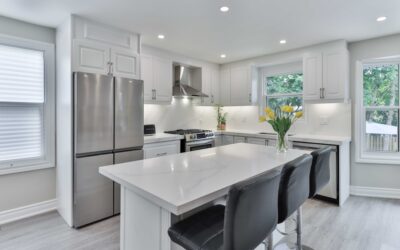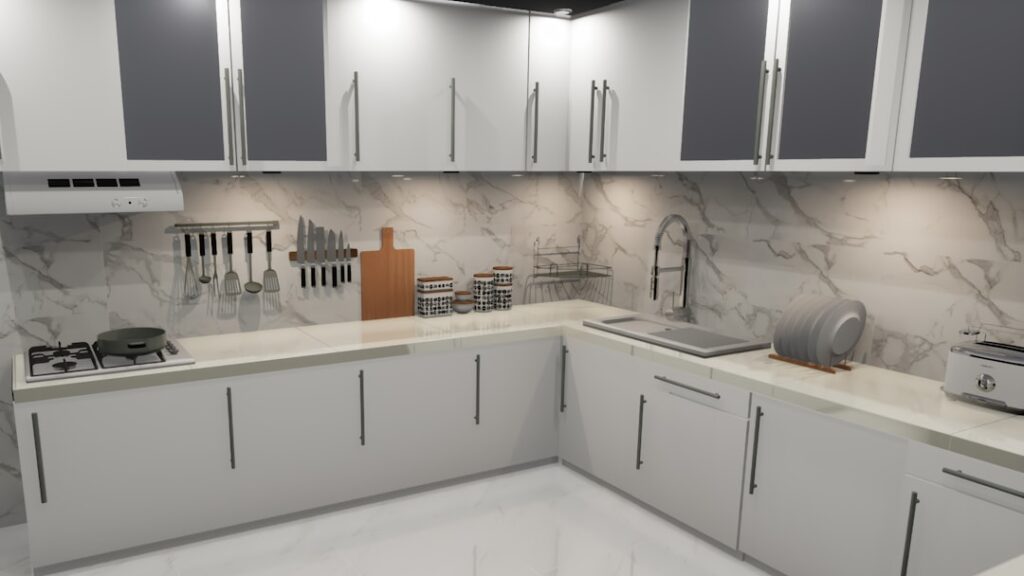
Walk into the kitchen of a 1942 four-square in rural Indiana and you find a different world. Painted beadboard wainscoting up to chair-rail height. A cast-iron drainboard sink mounted on porcelain-enameled steel legs. A pull-chain pendant over the breakfast table. A farmhouse 1940s kitchen celebrates utility, durable materials, and the soft palette of WWII-era America: butter yellow, jadeite green, cabbage rose wallpaper. Done right, it reads as warm and lived-in instead of a stage set.
Part of our Kitchen Remodeling guide — explore the full guide →
This guide covers the architectural details that define the look, the appliances that work for a working kitchen today, and where to source authentic or reproduction pieces without busting the budget.
Layout: The U-Shape Before Open Concept
The post-war kitchen triangle (sink, stove, refrigerator) came out of the Cornell Kitchen Studies in 1948. Before that, 1940s kitchens followed a U-shape or galley plan with the sink centered under a window so the cook could watch the yard. Open-concept did not exist. The kitchen was a working room, separate from the dining area by a swinging door or pass-through.
Recreating the period faithfully usually means keeping or restoring the original room boundaries. If you have already opened the wall to a great room, you can still nail the look with the right cabinets, hardware, and finishes. A typical 1940s kitchen ran 10 by 12 feet with linoleum on the floor, painted plaster walls, and 9-foot ceilings.
Cabinets: Inset Doors and Painted Finishes
Period cabinets were almost always site-built by carpenters using 3/4-inch poplar or pine, with inset doors (flush to the face frame, not overlay). Drawers used wood runners, not metal slides. Hardware was nickel-plated steel: bin pulls on drawers, latches on doors, hinges left exposed.
For a remodel, true reproduction is expensive. Inset cabinetry from Wood-Mode or Plain & Fancy runs $700 to $1,200 per linear foot installed. Mid-range alternatives include:
- KraftMaid Vantage inset line: $400 to $700 per linear foot
- Semihandmade Shaker fronts on IKEA Sektion boxes: $300 to $500 per linear foot
- Custom local cabinet shop using paint-grade maple: $500 to $900 per linear foot
Paint colors that read 1940s: Sherwin-Williams Naval (deep navy), Benjamin Moore Hawthorne Yellow, Farrow & Ball Lichen, and the classic creamy Behr Swiss Coffee. Avoid pure white (too modern) and gray (too 2015).
Countertops: Wood, Tile, or Enameled Steel
Period-correct countertops fell into three buckets. Maple butcher block sealed with mineral oil, 4 by 4 inch ceramic tile with rounded edge trim, or porcelain-enameled steel as a single piece with integrated backsplash. Stone was rare in residential kitchens before the 1960s outside of high-end builds.
Butcher block is the easiest to source today. John Boos and Hardwood Reflections both sell 1.5-inch maple in 72-inch lengths for $200 to $400 at Lumber Liquidators or Home Depot. Tile countertops cost $5 to $15 per square foot in materials but require precise grout maintenance. For enameled steel, look to Big Chill or vintage salvage from Bauer Brothers, expect $100 to $200 per linear foot used.
Appliances: Vintage Look, Modern Function
True 1940s appliances draw collectors, but a working refrigerator from 1947 uses 4 times the energy of a modern one. The smart compromise is a retro-styled appliance with modern guts. Quick options:
- Big Chill Retropolitan refrigerator: 22 cu ft, Energy Star, $4,000 to $5,500 in colors like Buttercup Yellow, Beach Blue
- Smeg FAB30 refrigerator: rounded 1950s shape, $2,500 to $3,500
- Elmira Stove Works Northstar 1955: gas or induction, $5,000 to $9,000
- Hallman Bonanno 36-inch dual fuel: vintage feel under $4,000
- GE Profile microwave drawer hidden in base cabinet: keeps the period look upper
A genuine restoration of a Wedgewood or Magic Chef stove from a shop like Antique Stoves runs $3,000 to $8,000 plus shipping, takes 6 to 12 months, and rewards the patient.
Sink and Faucet
The defining piece of any 1940s kitchen is the apron-front or drainboard sink. Cast iron with a porcelain finish was standard. Single-bowl with attached drainboards on one or both sides held washed produce and dishes. Kohler still makes the Whitehaven and Vintage farm sinks, $400 to $1,200. American Standard offers cast-iron utility sinks under $500. For a real drainboard sink, salvage yards and Etsy sellers list originals for $300 to $900 plus shipping (heavy, plan for freight).
Faucets should be wall-mounted, not deck-mounted, with cross-handles. Moen Weymouth and Delta Cassidy lines both make wall-mount widespread sets around $200 to $400 that pass for period without sourcing antiques. Skip pull-down sprayers, single-handle levers, and touch-activated electronics if you want the look.
Flooring: Linoleum, Not Vinyl
Linoleum predates vinyl by nearly a century. Made from linseed oil, pine resin, wood flour, and jute, it gives a slightly soft underfoot feel modern LVP cannot match. Forbo Marmoleum sells dozens of colors in sheet and click form, $5 to $8 per square foot installed by an experienced flooring contractor. Patterns include solid colors, checkerboard, and marble swirls reminiscent of the 1940s palette.
Alternatives that read period-appropriate: 1-inch hex penny tile in unglazed porcelain (Daltile Octagon, $5 to $8 per sq ft), 4-inch square ceramic floor tile, or solid-color sheet vinyl from Armstrong Strongbond ($2 to $4 per sq ft).
Lighting, Hardware, and Final Details
Hang a single pendant or schoolhouse fixture over the table or sink, 60 to 66 inches above the floor. Hudson Valley, Rejuvenation, and Schoolhouse Electric all reproduce period fixtures from $200 to $600. Skip recessed cans entirely; they read 1990s. Under-cabinet lighting did not exist in the 1940s either, but adding hidden LED strips behind the face frame keeps the period look while giving you working light.
Small details push the room over the finish line. A wall-mounted Hoosier-style flour bin or a vintage spice rack. A push-button electrical switch (Classic Accents reproductions, about $25 each). Bakelite drawer pulls. Glass cabinet knobs in milk-white or amber. A cloth-cord pendant over the sink with an Edison-style bulb (Cree T-shape LED, 60W equivalent, dimmable, around $12).
Total project cost for a faithful farmhouse 1940s kitchen remodel typically lands $40,000 to $90,000 in a 150 sq ft room, depending on whether appliances are reproduction or restored vintage. Going semi-period with retro appliances and IKEA-base cabinets can bring that down to $18,000 to $30,000.