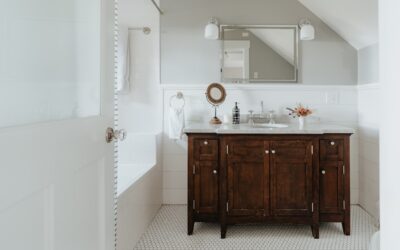
Farmhouse bathroom vanity lights bring the warmth of rustic design together with the practical, shadow-free illumination you need for grooming. Whether your style leans modern farmhouse or classic country, the right farmhouse bathroom vanity lights balance charm and function, using materials like matte black metal, aged brass, and clear glass shades to frame the mirror. This guide covers styles, sizing, bulb choices, and placement so you get both the look and the light right.
Part of our Bathroom Remodeling & Flooring guide — explore the full guide →
Lighting is where many bathroom updates fall short. A beautiful fixture that casts harsh shadows makes shaving and makeup application frustrating, while good lighting in a well-chosen fixture transforms the whole room. Here is how to choose the fixture that does both.
What Defines the Farmhouse Look
Farmhouse lighting draws on rural, utilitarian roots: exposed hardware, honest materials, and simple silhouettes. In the bathroom, that translates to fixtures in matte black, oil-rubbed bronze, or aged brass, often paired with clear seeded glass, milk glass, or metal shades. Barn-style, schoolhouse, and cage designs all fit comfortably under the farmhouse umbrella.
Modern farmhouse leans cleaner, with straight lines and black-and-white contrast, while traditional farmhouse embraces warmer metals and vintage-inspired Edison bulbs. Pick the branch that matches your cabinetry and hardware finishes so the room reads as intentional rather than mismatched.
Common Fixture Styles
Farmhouse vanity lighting comes in several formats, each suited to different mirror setups.
- Bar or linear fixtures: a horizontal bar with two to four exposed bulbs, mounted above the mirror for even wash
- Multi-light vanity strips: individual shaded lights on a single backplate, spreading illumination across a wide vanity
- Wall sconces: mounted in pairs on either side of the mirror, the best setup for shadow-free face lighting
- Caged and schoolhouse fixtures: add rustic character with metal cages or rounded glass globes
For a single mirror, an overhead bar light is simplest. For the flattering, professional-quality light stylists prefer, flank the mirror with a pair of sconces at eye level instead. If your budget and wiring allow, the gold-standard setup combines both: a pair of sconces beside the mirror for shadow-free face lighting plus a discreet overhead or recessed source for general room light. This layered approach eliminates the harsh under-eye shadows that plague single-source overhead lighting.
Shade material shapes the mood as much as the metal finish. Clear seeded glass shades scatter warm light and show off decorative filament bulbs, giving that quintessential farmhouse glow. Milk glass and white opal shades diffuse the light more softly and hide the bulb entirely, which some people prefer for a cleaner look. Open metal cages let the most light through but expose the bulb, so pair them with attractive Edison-style LEDs since the bulb becomes part of the design.
Sizing the Fixture to Your Vanity
Proportion matters. A common guideline is to choose an overhead vanity light roughly 75 percent the width of the mirror, so a 30-inch mirror pairs well with a fixture around 22 to 24 inches wide. Undersized fixtures look lost above a large vanity, and oversized ones overwhelm a petite one.
For a double vanity, either run one long fixture centered over both sinks or install two smaller fixtures, one above each mirror. Sconces should be spaced about 28 to 40 inches apart when flanking a single mirror, roughly at the outer edges of the glass. Always confirm the fixture’s dimensions and required wall space against your vanity before ordering.
Placement for Flattering Light
Where you mount the fixture determines how well it lights your face. An overhead bar should sit about 75 to 80 inches from the floor, or roughly 3 to 6 inches above the top of the mirror, so it casts light down onto the vanity. Mounting it too high creates harsh shadows under the eyes and chin.
Sconces work best mounted at about 60 to 66 inches from the floor, near eye level, so they light the face from the sides and eliminate the downward shadows overhead lights create. If you can only do one setup, side sconces give the most even, flattering result for grooming and makeup.
Choosing the Right Bulbs
The fixture is only half the equation; bulbs make or break the light quality. For a bathroom, aim for bulbs in the 2700K to 3000K range for a warm white that flatters skin, or step up to 3500K for a slightly crisper, more neutral light if you prefer accuracy for makeup.
Look for a color rendering index (CRI) of 90 or higher so colors appear true, which matters when matching foundation or checking hair color. For total brightness, a vanity generally wants 1,600 to 4,000 lumens depending on room size, spread across the fixture’s bulbs. Put the fixture on a dimmer so you can soften the light for a relaxing bath and brighten it for detailed grooming.
- Color temperature: 2700K to 3000K warm white, or up to 3500K for crisper light
- CRI: 90 or higher for accurate skin tones
- Brightness: 1,600 to 4,000 lumens total across the fixture
- Bulb style: Edison-style filament LEDs suit exposed farmhouse fixtures
Safety and Damp-Location Ratings
Bathrooms are humid, so fixtures should carry at least a damp-location rating, and any light installed near a tub or shower spray zone needs a wet-location rating. Check the label before buying, especially for fixtures with fabric or paper shades that would not survive constant moisture.
Wiring a hardwired vanity light means working with your home’s electrical system. If you are simply swapping a like-for-like fixture, a careful DIYer can handle it after shutting off the breaker and verifying the circuit is dead. Adding new fixtures, moving a junction box, or any work where you are unsure should go to a licensed electrician, since bathroom circuits and GFCI protection must meet code.
Matching Finishes Across the Room
Pull the whole bathroom together by coordinating your light finish with faucets, cabinet hardware, and towel bars. Matte black lighting pairs crisply with black or brushed-nickel fixtures, while aged brass or bronze complements warmer wood tones and antique-inspired hardware. You do not have to match every metal perfectly, but keeping to two complementary finishes looks more polished than a jumble of five.
Consider the mirror frame too. A black metal-framed mirror echoes matte black sconces beautifully, reinforcing the farmhouse theme without extra effort. Wood-framed or barn-wood mirrors pull in the rustic side of the style and pair naturally with aged brass or bronze lighting for a warmer palette.
Think about scale relative to the whole wall, not just the vanity. In a powder room with a single small sink, a modest two-light fixture or a single dramatic sconce keeps the proportions right, while a long double vanity in a primary bath can carry a substantial four- or five-light bar without looking heavy. Leave breathing room between the fixture and the ceiling or a wall cabinet so the light does not feel crammed into the space. When a fixture will hang in front of a mirror rather than above it, choose one that looks intentional from both sides, since the mirror doubles its visual presence.
Farmhouse vanity lighting spans a wide price range, and knowing where the money goes helps you spend wisely. A simple two- or three-light bar fixture in matte black or bronze often runs $60 to $150, while designer sconces, hand-finished brass, or artisan pieces can climb to $200 to $600 or more per fixture. For most bathrooms, a mid-range fixture with a solid metal body and quality glass shades hits the sweet spot of durability and looks without overpaying.
Where it pays to invest is in the parts you interact with daily. Good bulbs with high CRI, a quality dimmer switch, and a fixture with a sturdy mounting and easy bulb access all improve the everyday experience more than an extra-expensive shade. If your budget is tight, put your dollars into a pair of well-placed sconces and better bulbs rather than one showy oversized fixture, since placement and light quality do more for a bathroom than sheer fixture cost. Watch for sales at lighting retailers and home centers, where farmhouse styles are widely stocked and frequently discounted.
Bringing It All Together
Great farmhouse vanity lighting starts with a fixture style that matches your finishes, sized to about three-quarters of your mirror width, and placed for flattering, shadow-free light. Choose warm, high-CRI LED bulbs on a dimmer, confirm the fixture is rated for damp locations, and coordinate the finish with your other hardware. Get those pieces right and your bathroom will have both the rustic charm and the practical, welcoming light that make farmhouse style so enduringly popular.