There’s a moment on every job where you’re standing over a fresh repair wondering how long you’ll have to babysit it before real work can continue. That’s exactly the problem fast cure epoxy was built to solve. Instead of the 24 to 72 hours a standard epoxy needs to reach full strength, these accelerated formulas can be handled in as little as an hour and fully cured overnight. The speed is a genuine advantage on the job site, but it comes with tradeoffs in working time and heat that catch a lot of first-time users off guard.
What Makes an Epoxy “Fast Cure”
All epoxy is a two-part system: a resin and a hardener that react chemically when mixed. Fast cure versions use a more reactive hardener, sometimes paired with an accelerator, so the crosslinking reaction that turns liquid into solid happens much faster. The result is a shorter pot life, a quicker set, and often a noticeable spike in heat during curing. It’s the same fundamental chemistry as slow epoxy, just running at a higher gear.
You’ll see these products marketed as “5-minute epoxy,” “rapid set,” or “fast setting” on the label. The number usually refers to the working time, not full cure. A 5-minute epoxy stays workable for about five minutes, becomes handleable in 15 to 60 minutes, and reaches full mechanical strength in roughly 16 to 24 hours.
Typical Cure Times at a Glance
Cure speed varies by brand and temperature, but these ranges hold for most consumer fast cure products at 70°F to 77°F:
- Pot life / working time: 4 to 6 minutes for 5-minute formulas; 20 to 30 minutes for “fast” flooring and coating grades.
- Handling strength: 15 minutes to 1 hour, enough to remove clamps or resume light work.
- Functional cure: 4 to 8 hours for a repair to bear moderate load.
- Full cure: 16 to 24 hours, versus 3 to 7 days for standard epoxy.
Temperature is the biggest lever. Every 18°F drop can roughly double cure time, so a garage in the 50s will cure far slower than a heated shop. Above 85°F the reaction races and pot life can shrink to under two minutes on 5-minute products.
Where Fast Cure Epoxy Shines
Speed makes this the right choice whenever downtime costs you. I reach for fast cure epoxy on small structural repairs, bonding metal or wood brackets, anchoring bolts, filling cracks in concrete that need to be walked on the same day, and quick fixes where clamping for three days simply isn’t practical. For flooring, fast-set patch and crack repair products let you prep a garage or basement slab in the morning and coat it that afternoon.
It’s also the go-to for vertical repairs and overhead work where a slow, runny epoxy would sag before it sets. The rapid thickening actually helps the material stay put.
When to Choose a Slower Formula Instead
Fast is not always better. Standard or slow-cure epoxy is the smarter pick for large pours, deep fills, and anything requiring a long, bubble-free working window. When you flood-coat a countertop or pour a thick bar top, you need time for air bubbles to rise and for the surface to self-level. A fast epoxy would gel before it settles, trapping bubbles and leaving ripples.
Slow epoxy also runs cooler and stronger in thick sections. Fast cure formulas generate significant exothermic heat, and a deep pour can overheat, yellow, crack, or even smoke. As a rule, keep fast cure fills under about a quarter inch per layer and let each layer cool before adding the next.
Getting a Strong Bond: Application Tips
The bond is only as good as your prep. Sand or abrade both surfaces to give the epoxy tooth, then clean with acetone or denatured alcohol to remove oils. Skipping this step is the number one reason a fast epoxy repair peels later.
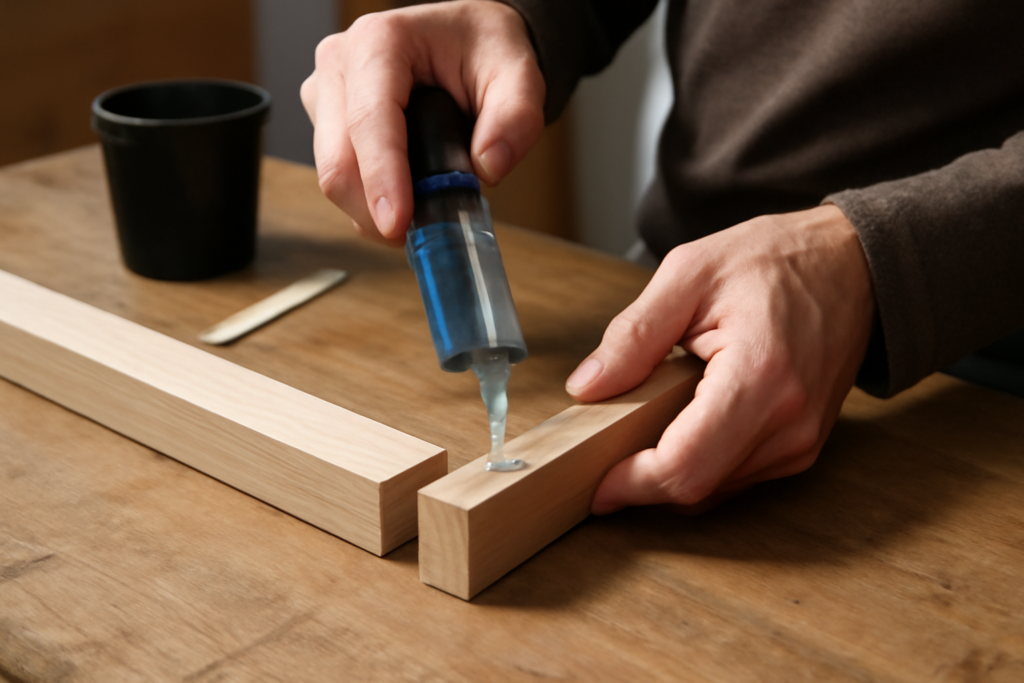
Mix precisely to the ratio on the label, usually 1:1 by volume for 5-minute syringes. Off-ratio mixing leaves the joint soft or brittle. Stir thoroughly for 20 to 30 seconds; a common error is rushing the mix because the clock is ticking, which leaves unmixed streaks that never harden. Work in small batches you can use before the pot life expires, and have your clamps, gloves, and cleanup rags staged before you start mixing.
Temperature, Safety, and Storage
Work in a space between 70°F and 80°F for predictable results. If your shop is cold, warm the parts and the epoxy bottles to room temperature first; cold resin turns thick and cures unevenly. Because these products cure hot, never mix a large pot and leave it in the cup, where the concentrated mass can reach 150°F or more and off-gas.
Wear nitrile gloves and work with ventilation, since uncured epoxy is a skin sensitizer. Store the resin and hardener tightly capped at room temperature, and expect a shelf life of about one to two years. Crystallized resin can often be restored by warming the bottle in hot water.
Troubleshooting Common Fast Cure Problems
When a fast epoxy repair goes wrong, the cause is almost always one of a handful of usual suspects. A joint that stays tacky or rubbery days later points to off-ratio mixing or incomplete stirring; there’s no rescue for it, so scrape it out and redo the joint with a careful 1:1 measure. A bond that pops loose under light stress means the surface wasn’t abraded and degreased, letting the epoxy sit on oils instead of biting into the material.
Bubbles and a cloudy, uneven surface usually come from mixing too vigorously or from a pour that gelled before the air escaped. On the next batch, stir with a folding motion rather than whipping, and keep fast-cure fills shallow. If the cured epoxy turns yellow or cracks, you likely poured too thick and the exothermic heat ran away; build up deep repairs in thin passes and let each cool to the touch first.
Fast Cure vs. Standard Epoxy: Quick Decision Guide
When you’re standing in the adhesive aisle deciding, this shorthand covers most situations:
- Reach for fast cure when you need to keep working the same day, are bonding small parts, working vertically or overhead, or filling a crack you’ll walk on within hours.
- Reach for standard or slow cure for deep pours, countertops and bar tops, large surface coats, or any job where a bubble-free, self-leveling finish matters more than speed.
Many pros keep both on the shelf: a 5-minute syringe for tacking things in place and a slower structural or coating epoxy for the finish work. They’re not competitors so much as two tools for two different jobs.
Choosing the Right Product for the Job
For household repairs, a dual-syringe 5-minute epoxy in the $5 to $12 range handles most bonding tasks. For flooring cracks and anchoring, look for a rapid-set structural epoxy sold in cartridges or quart kits, typically $25 to $60. Match the working time to your task honestly: give yourself margin. If you’re new to epoxy, a “fast” 20 to 30 minute formula is far more forgiving than a true 5-minute product, and the extra working window is worth the modest wait. Used within its limits, fast cure epoxy delivers a tough, permanent bond and gets you back to work the same day.