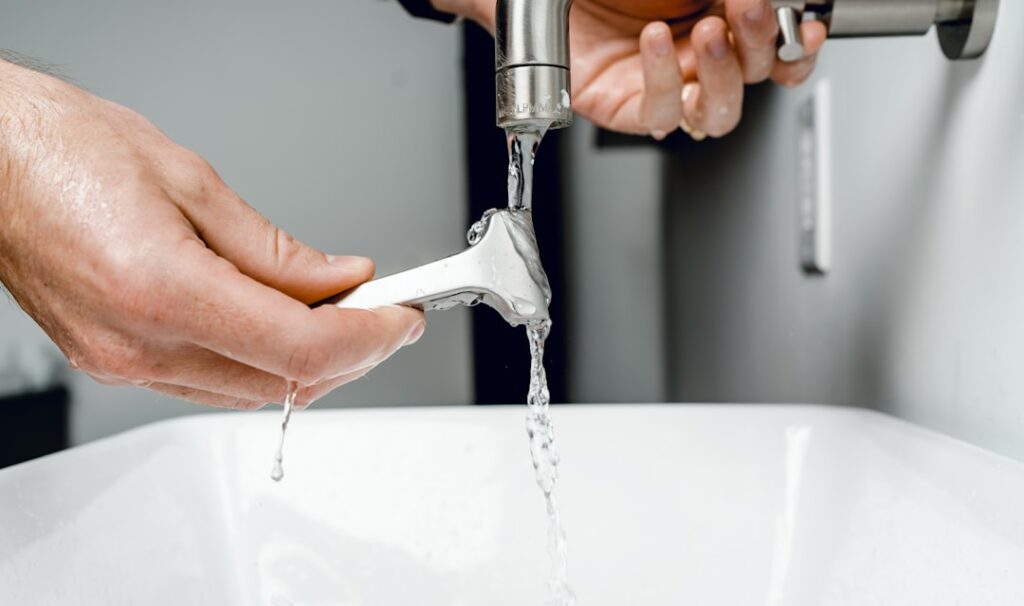
Watch a three-year-old strain on tiptoe toward a stream of water two inches beyond their fingertips and you understand why this $8 accessory exists. A faucet extender redirects or lengthens a faucet’s water stream — or its handles — so that someone or something can reach it: toddlers learning to wash hands, wheelchair users at a deep vanity, a stockpot that will not fit under a short spout. The category actually covers three distinct products that share one name, and buying the wrong type for your problem is the most common mistake. This guide sorts the types, the fit rules, and the picks that actually stay on the faucet.
Type 1: Spout Extenders for Kids
The version most parents know is the soft plastic or silicone trough that clips over the end of a bathroom spout and carries the water stream 3 to 5 inches closer to the sink edge. Combined with a step stool, it turns hand-washing from a lift-the-kid chore into something a two-year-old does solo — which matters more than convenience, because independent hand-washing is one of the earliest self-care habits toddlers can own. Aqueduck is the brand that defined the category (about $10-$13, food-grade silicone-like plastic), and Prince Lionheart’s Faucet Extender adds an adjustable strap for odd spout shapes. Most fit conventional rounded bathroom spouts between roughly 1.5 and 2.5 inches wide.
Fit is the whole game here. These extenders grip by friction, and three faucet styles defeat them: square or waterfall-style designer spouts, pull-down kitchen heads, and very short powder-room spouts with barely any barrel to grip. Measure the spout and check the product’s fit range before ordering, and expect to reseat the extender every few weeks as small hands knock it around. Wash it in the top dishwasher rack monthly — the inside channel grows the same pink biofilm as a shower drain.
Type 2: Aerator Extension Arms
The second family threads into the faucet where the aerator normally sits, adding a jointed or flexible arm — usually 4 to 8 inches — with the aerator relocated to its tip. Sold as swivel extenders, mechanical-arm extenders, or splash-filter heads ($8-$25), they solve adult problems: reaching a stream into both bowls of a double kitchen sink, filling a bucket that will not fit in the basin, directing water around a filled dish rack, or rinsing the basin walls after cleaning. Most rotate 360 degrees at one or two ball joints and offer a stream-or-spray toggle, effectively giving a fixed-spout faucet half the utility of a pull-down for a tenth of a pull-down’s price. Renters should pay attention — this is the best faucet upgrade you can install and take with you.
Thread matching is the only technical step. US faucet aerators come in two standards: regular male (15/16-inch thread outside the spout) and regular female (55/64-inch thread inside the spout). Unscrew your aerator and take it to the store, or buy an extender that ships with both adapters. Cheap extenders fail at the joints — read reviews specifically for drips at the swivel after a few months, and favor brass-bodied units over all-plastic ones.
Type 3: Handle and Reach Extensions for Accessibility
The third type addresses the handles rather than the spout. Lever extension kits slip over existing faucet handles to lengthen them, reducing the grip strength and wrist rotation needed to operate them — the difference between independence and assistance for many people with arthritis, limited grip, or limited reach from a seated position. ADA guidance for accessible design points the same direction: faucets should be operable with one hand, without tight grasping, pinching, or wrist twisting, and with no more than 5 pounds of force. Wand-style extenders and spout extensions also help wheelchair users at vanities where the counter depth puts a standard spout beyond comfortable reach.
For a permanent accessibility solution, an extender is the stopgap and a fixture swap is the fix: single-lever faucets with long blade handles, or touch and motion-activated models, remove the problem at the source. But at $10-$30 versus $200-plus and a plumbing visit, extension kits earn their place, especially in rentals and temporary care situations.
What to Look For on the Package
A minute of label reading separates the keepers from the drawer clutter. For kids’ spout extenders, check for BPA-free and phthalate-free material claims and a stated fit range in inches — vague “fits most faucets” wording is how mismatches happen. For aerator arms, look for a brass body or at least brass threads, an explicit flow rating (1.5 or 2.2 gpm), and included dual-thread adapters; a bag of extra washers in the package is a good sign the maker understands where these fail. For handle extensions, favor kits listing compatible handle shapes by name. Across all three types, a 90-day or one-year warranty printed on the card is worth more than a dollar saved on the no-name alternative hanging beside it.
Matching the Product to the Problem
- Toddler can’t reach the stream: silicone spout extender (Aqueduck) plus a step stool
- Double sink, fixed spout: 360-degree swivel aerator extension arm
- Filling buckets and pots: flexible extension arm, or a faucet-to-hose adapter for outdoor-style filling
- Weak grip or seated reach: lever handle extensions now, single-lever or touch faucet at the next remodel
- Bathing a baby in a sink: spout extender to soften and redirect flow away from the drain flat
Prices at a Glance
Nothing in this category strains a budget: silicone kid extenders run $8-$13, basic swivel aerator arms $8-$15, articulated mechanical-arm extenders $15-$25, and handle extension kits $10-$30 depending on material. Two-packs of the toddler extenders are common and worth it for multi-bath households. The only spend-up advice that matters is favoring brass-bodied aerator arms over all-plastic at the $5 difference, and buying the name-brand kid extender whose plastic is documented food-grade rather than the mystery-material clone.
Installation and the Five-Minute Reality
Nothing in this category needs a plumber. Clip-on extenders press over the spout by hand. Aerator arms install with the same motion as cleaning an aerator: unscrew the old aerator (a rubber jar gripper beats pliers and spares the finish), seat the included washer, and thread the extender on hand-tight plus a gentle snug. If it drips at the thread, the washer is missing or doubled — never crank plastic threads. Handle extensions strap or screw over existing levers per the kit. The only genuine failure mode across all three types is forcing a mismatch: a spout too square, a thread adapter skipped, a handle shape the kit was never molded for. Check fit first and every one of these products is a five-minute win.
What Extenders Cannot Fix
Knowing the limits saves a return trip. No clip-on extender solves water that simply arrives too far back on the deck — a faucet whose spout terminates over the rear third of the basin needs a longer-reach faucet, not an accessory. Extension arms cannot raise pressure; if the stream is weak, the fix is a clogged aerator or a supply-valve issue, and adding six inches of arm only makes weak flow look weaker. Temperature control is also outside the category: toddlers reaching water independently means toddlers reaching hot water independently, so pair any kid-focused extender with a water heater set at 120°F and teach the cold-first habit. And on pull-down kitchen faucets, skip the category entirely — the wand already does everything an extender promises, and clip-ons interfere with docking.
Durability expectations should stay modest as well. These are $10 plastic accessories in a splash zone: silicone spout extenders fade and stiffen in about one to two years of daily use, and plastic swivel joints eventually seep. Treat them as consumables that cost less than a single plumber visit, not permanent plumbing.
The Bottom Line
A faucet extender is one of the highest-value accessories in the plumbing aisle — a few dollars that buys a toddler independence, a renter a pseudo-pull-down, or a family member usable handles. Identify which of the three types your problem actually calls for, verify the fit or thread standard, and spend the extra $5 for the brand with a track record. Small product, outsized daily payoff.