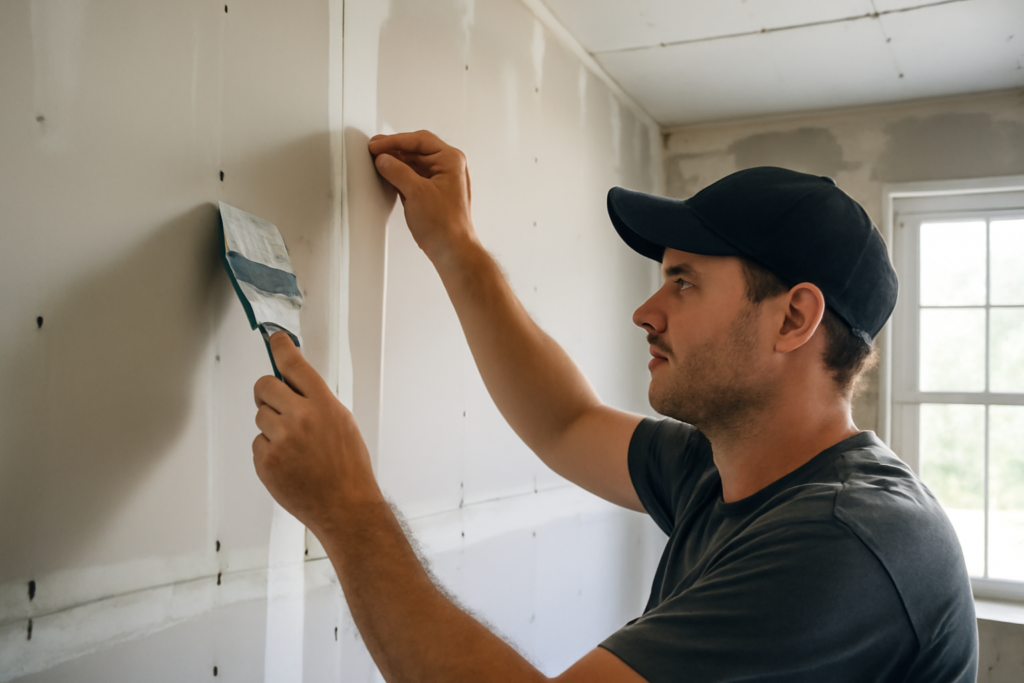
A garage wall can pass a fire inspection while looking rough, streaky and unsanded. That surprises a lot of homeowners, but it is exactly what fire taping drywall is meant to produce: a single coat of joint compound with paper tape embedded in every seam, plus compound over the fastener heads, on walls and ceilings that are part of a fire-resistance-rated assembly. The goal is to close the gaps between sheets so flame and hot gases cannot slip through the joints, not to make the surface pretty.
Part of our Paint & Walls guide — explore the full guide →
You will see fire tape most often in attached garages, attics, mechanical rooms, furnace closets and commercial back-of-house spaces. It is allowed wherever the wall needs fire protection but nobody needs a paint-ready finish. If a wall will be painted, lived with or looked at closely, you will want a full finish instead, and that full finish still counts as fire protection because it includes everything a fire tape coat does and more.
- What Fire Taping Drywall Actually Means
- Where Code Requires Fire Tape and Where It Does Not
- Tools and Materials
- How to Fire Tape Drywall Step by Step
- What Inspectors Look For
- Safety Considerations
- Common Mistakes and Troubleshooting
- Cost to Fire Tape Drywall
- When to Call a Professional
- Frequently Asked Questions
The details matter, though. A rated wall only performs if the right board, the right fasteners and the right joint treatment all show up together. Skip the tape on one seam or leave a gap at the ceiling line, and the inspector can fail the whole wall.
What Fire Taping Drywall Actually Means
Drywall finishers describe finish quality in levels, from zero (board hung, nothing else) up to five (a full skim coat for critical lighting). Fire taping sits at the bottom end of that scale. In trade terms it lines up with a Level 1 finish: tape set in compound at all joints and interior angles, with the surface left free of excess compound but not sanded or smoothed. Some specifications ask for a little more, roughly a Level 2, where the tape gets a thin skim right away and fastener heads get one coat.
People often mix up fire tape with fire-rated drywall, but they are two separate pieces of the system. Fire-rated board (commonly sold as Type X, with a denser gypsum core and glass fibers) is what slows heat transfer through the wall. Fire taping is the joint treatment that keeps the seams between those boards from becoming weak spots. You need both. Regular half-inch board with perfect fire tape is not a rated assembly, and Type X board with open, untaped joints is not one either.
A “fire resistant drywall tape” is not a special product in most cases. Standard paper joint tape bedded in setting-type or all-purpose compound is what most tested assemblies call for. Some fiberglass mesh tapes are approved for certain systems when paired with setting compound, so check the assembly listing or the board maker’s installation instructions before swapping tape types.
Where Code Requires Fire Tape and Where It Does Not
Residential codes in the US require separation between an attached garage and the house. Typically that means at least half-inch gypsum board on the garage side of the shared wall, and five-eighths-inch Type X on the garage ceiling when there is living space above. Those boards must have taped joints to count as a separation, which is why many builders fire tape the entire garage.
Other common spots include:
- Mechanical and furnace rooms where a local rule or the appliance instructions call for rated enclosure.
- Attics and soffits above rated ceilings, where the board is out of sight but still has to perform.
- Multifamily walls and ceilings between units, where rated assemblies are the norm.
- Commercial corridors, stairwells and shaft walls above dropped ceilings, where the drywall is hidden but still rated.
Fire tape is generally not required on non-rated interior partitions, such as a wall between two bedrooms. It is also not what you want on any living-space wall, because the finish is visibly rough. Rules vary by jurisdiction and by assembly, so the plans, the permit set or your local building department is the final word. When in doubt, ask the inspector before you hang the board, not after.
Tools and Materials
The kit is short. A basic drywall taping knife set (a 6-inch knife for bedding tape, a 10- or 12-inch knife for wider passes, and an inside corner tool) covers almost every situation. A good set of knives is the one tool worth spending on, because a flexible, straight blade presses tape flat and squeezes out air pockets far better than a bent hardware-store blade.
- Paper joint tape (or approved mesh with setting compound)
- Setting-type compound (45- or 90-minute) or all-purpose premixed compound
- Mud pan and mixing paddle for powdered compound
- Utility knife and a rasp for trimming butt edges
- Fire-rated caulk or sealant for gaps at penetrations
- Safety glasses, gloves and an N95 or P100 respirator for any cutting or sanding
Setting-type compound is a favorite for fire tape because it hardens chemically, shrinks less and holds up well in cold or damp garages. Premixed all-purpose compound works too, but it needs warm, dry conditions to cure.
How to Fire Tape Drywall Step by Step
- Check the board and fasteners first. Confirm the board type and thickness match the plans, and that screws are spaced as the assembly listing requires. Sink any proud screw heads just below the paper without tearing it.
- Fill wide gaps. Any gap wider than about one-quarter inch should be pre-filled with setting compound and allowed to stiffen before taping. Gaps at the floor and ceiling lines need attention too.
- Bed the tape. Spread a band of compound about 4 inches wide over the seam, center the tape, and pull your 6-inch knife along it at a low angle to press the tape flat and squeeze out excess. You want a thin layer under the tape with no dry spots or bubbles.
- Tape inside corners. Fold the paper tape along its center crease, set it into compound on both faces, and run the corner tool down the length.
- Cover fasteners. Swipe one coat of compound over each screw head. Many inspectors look for this, even though the finish stays rough.
- Treat penetrations. Seal around electrical boxes, pipes and ducts with compound or fire-rated sealant as the assembly requires. Gaps around a dryer vent or a hose bib are a common fail point.
- Scrape off ridges and stop. Knock down heavy ridges and drips so they do not crack later. Do not sand, and do not add finish coats unless you plan to paint.
On an average two-car garage, one experienced person can fire tape the walls and ceiling in a day. A first-timer should plan on two days, mostly because overhead seams go slowly.
What Inspectors Look For
Inspectors are not grading smoothness. They walk the room looking for continuity. Every horizontal and vertical joint should be taped, every inside corner closed, and the tape should be fully embedded with no loose edges you can peel back. Exposed screw heads, open butt joints and big unfilled gaps around penetrations are the usual reasons for a correction notice.
They also check that the right board is where the plans say it is. Type X board is printed on the back and often on the edges, so leave those markings visible until inspection if you can. On the garage ceiling, a missing strip of drywall over a beam or above a garage door header can fail the whole separation.
Many jurisdictions want the fire tape inspection done before insulation is covered or before the ceiling is closed up in attic areas. Schedule it the same way you would a framing or insulation check, and keep the area clear so the inspector can see the seams.
Safety Considerations
Fire taping is about fire protection, so treat the whole space with the same care. Keep the garage wall and ceiling continuous around any attic access hatch and use a hatch built to match the rating. Seal around a dryer duct with fire-rated material, and do not route heat sources, light fixtures or extension cords through gaps in a rated wall. If you add work lights or a power strip while taping, use listed equipment sized for the load and keep cords from being covered or pinched.
Cutting and sanding gypsum and joint compound releases fine dust that can contain crystalline silica. Score and snap the board where you can, cut with a sharp knife instead of a saw, and wear an N95 or P100 respirator for any dusty step. Wet-wipe surfaces and clean up with a HEPA-filter vacuum rather than sweeping. Since fire tape skips sanding, it is one of the less dusty drywall jobs, which is a nice side benefit.
Common Mistakes and Troubleshooting
Bubbles or loose tape. This usually means the compound under the tape was too thin or too dry before the tape went on. Cut out the loose section with a utility knife and re-bed a fresh piece.
Cracks along butt joints. Butt ends lack the tapered edge, so tape there tends to sit proud. Use setting compound, keep the band wider, and make sure the joint lands on framing.
Missing tape above the ceiling line. In garages and attics, it is easy to tape the visible portion and forget the joint where the wall meets the ceiling. That joint has to be closed too.
Using a fire tape finish where a painted finish was expected. If you later decide to paint a fire taped wall, it will need at least two more coats and sanding to look decent. Plan the finish level before you start so you do not pay for it twice.
Cost to Fire Tape Drywall
Because fire taping drywall skips the finish coats and sanding, it costs a fraction of a full finish. Contractors in many US markets charge roughly 50 cents to a little over 1 dollar per square foot of board for fire tape, compared with 1.50 to 3 dollars per square foot or more for a smooth, paint-ready finish. Material cost for a DIY job is low: a few rolls of tape and a couple of bags or buckets of compound will handle most garages. Hanging the Type X board itself is a separate line item and is usually the bigger expense.
When to Call a Professional
Hire a drywall contractor when the assembly is part of a multifamily separation, a shaft wall, a commercial corridor or any wall with a published fire-resistance listing that must be followed exactly. Those systems often require specific board layers, stagger patterns and fastener schedules that are easy to get wrong. A pro also makes sense for high garage ceilings, where scaffolding and overhead work slow down a DIYer.
Pull a permit when your local rules require one for garage finishing or a new mechanical room. The inspection is your proof that the separation is complete, and that record can matter when you sell the house or file an insurance claim.
Frequently Asked Questions
Is fire tape the same as fire-rated drywall?
No. Fire-rated drywall is the board itself, usually Type X with a reinforced gypsum core. Fire tape is the joint treatment that seals the seams between boards. A rated wall needs the correct board and taped joints together.
Do I need to sand fire taped drywall?
No. A fire tape finish is left unsanded. You only scrape off large ridges so they do not crack or snag. Sanding is only needed if you decide to bring the wall up to a paintable finish.
Can I use mesh tape for fire taping?
Sometimes. Paper tape is the safe default for most tested assemblies. Some systems allow fiberglass mesh when it is bedded in setting-type compound, so check the board maker’s instructions or the assembly listing first.
Does a garage ceiling need fire tape?
If there is living space above the garage, the ceiling is usually part of the required separation and needs Type X board with taped joints. Your local building department can confirm the exact requirement.
Do screw heads need compound in a fire tape finish?
Most inspectors expect one coat of compound over fastener heads. It takes only a few minutes per wall and avoids a correction notice.