Lighting a home in the Sunshine State is nothing like lighting one in Ohio. Florida outdoor lighting has to withstand relentless salt air, near-constant humidity, driving rain, hurricane-force winds, and in many coastal counties, strict sea-turtle protection ordinances that dictate exactly what color and direction your lights can shine. A fixture that lasts a decade in a dry climate can corrode into junk in eighteen months on a Gulf-coast lanai if you buy the wrong materials.
Part of our Windows & Doors guide — explore the full guide →
This guide covers the material and ratings choices that survive the tropics, the turtle and dark-sky rules unique to Florida, and the installation practices that keep your lights working through storm season.
- Why Florida Punishes Ordinary Fixtures
- Choosing Corrosion-Proof Materials
- Reading IP and Wet-Location Ratings
- Sea-Turtle and Dark-Sky Rules
- Smart Design for the Florida Landscape
- Installation and Storm-Season Practices
- Lighting the Lanai and Pool Area
- Handling Heat and UV Exposure
- Working With Florida's Rules and HOAs
- Maintenance in a Corrosive Climate
Why Florida Punishes Ordinary Fixtures
Three forces gang up on outdoor lighting here. Salt air carries corrosive chloride that eats aluminum, pits chrome, and rusts steel screws, especially within a few miles of either coast. High humidity keeps everything perpetually damp, breeding corrosion inside fixtures and feeding mold on lenses. And the afternoon thunderstorms and hurricane season deliver wind-driven rain that finds any gap in a gasket.
The practical upshot is that Florida buyers should ignore the bargain-bin fixtures that work fine up north. What matters here is the material the fixture is made from and its ingress-protection rating, not its price or looks alone.
Choosing Corrosion-Proof Materials
Material selection is the single most important decision for coastal durability. Rank your options from best to worst for a salt environment:
- Marine-grade brass and copper: the gold standard; they develop a protective patina and can last decades near salt water.
- 316 stainless steel: the marine grade of stainless, far more corrosion-resistant than common 304.
- Powder-coated cast aluminum: acceptable inland or a few miles back from the coast, but the coating must be intact.
- Plastic and composite: immune to rust but can grow brittle under Florida’s intense UV over time.
Avoid raw aluminum, chrome plating, and standard-steel hardware near the coast. Even on a good fixture, check that the screws and mounting hardware are stainless or brass, because one rusting screw can seize a fixture permanently.
Reading IP and Wet-Location Ratings
Every exterior fixture carries a rating that tells you how well it resists water, and in Florida you want the top tier. Look for the UL “Wet Location” listing rather than the lesser “Damp Location,” which is only meant for covered spots like a porch ceiling. Wet Location fixtures are sealed to take direct rain and sprinkler spray.
For a numerical measure, check the IP (Ingress Protection) code. IP65 resists water jets from any direction and is a solid minimum for open-yard use. IP66 or IP67 handles heavier spray and brief submersion, worth it for well lights and in-grade fixtures that sit in puddles after a downpour. Pair any fixture with LED lamps rated for the humidity and heat, and make sure the driver is potted or sealed against moisture.
Sea-Turtle and Dark-Sky Rules
Florida’s coastal counties enforce sea-turtle lighting ordinances from roughly May through October, and violations carry real fines. Hatchlings navigate by the natural glow of the horizon over the water, and bright artificial light disorients them, drawing them inland to die. The rules generally require three things, often summarized as “keep it low, keep it long, keep it shielded.”
- Long wavelength: use amber or red LEDs (roughly 560 nanometers and longer), not white or blue light, in beachfront zones.
- Low mounting: keep fixtures as low as practical and out of sight of the beach.
- Shielded: fully cut-off fixtures that cast light downward, never spilling toward the water.
Even away from the beach, many Florida communities embrace dark-sky principles to cut light pollution. Choose fully shielded, downward-facing fixtures and warm color temperatures, which also happen to look more elegant on a home.
Smart Design for the Florida Landscape
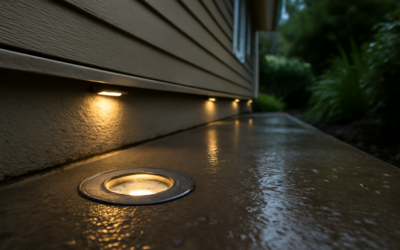
Beyond survival, good design works with the tropical setting. Uplighting royal palms and live oaks with well lights creates dramatic silhouettes that suit the landscape. Path lights along paver walkways guide guests around pools and lanais, where wet surfaces make safety lighting essential. Down-lighting from soffits or tree canopies mimics moonlight and avoids the harsh glare that attracts every bug in the county.
Speaking of bugs, warm 2700K LEDs attract far fewer insects than cool white or the old mercury-vapor lights, a real quality-of-life gain on a Florida evening. Position fixtures to light the ground and features, not to blast light outward where it draws mosquitoes to your seating areas.
Installation and Storm-Season Practices
Wire it right and it will survive the weather. Use only low-voltage systems with a transformer rated for outdoor use, or line-voltage runs in proper conduit installed by a licensed electrician. Every connection below grade must use waterproof, gel-filled connectors, because Florida’s high water table and daily rain will find an unsealed splice within weeks.
Before hurricane season, walk your lighting and secure or remove anything that could become a projectile, such as tall path lights in exposed beds. After a storm, inspect fixtures for standing water intrusion and check that GFCI outlets serving the lights still trip and reset properly. Salt spray from a storm surge should be rinsed off brass and stainless with fresh water to slow corrosion.
Lighting the Lanai and Pool Area
The lanai and pool are the heart of a Florida home, and they demand lighting chosen for wet, humid, chlorinated conditions. Screen-enclosure lighting is popular: linear LED strips or puck lights mounted along the screen frame or under the roofline wash the space with even glow and attract fewer bugs than a single bright source. Choose wet-rated, corrosion-resistant fixtures, since pool chemicals and humidity are brutal on hardware.
Around the pool deck itself, low path lights and recessed step lights guide bare feet safely on surfaces that are often wet. Any fixture near the water must be installed to code with proper GFCI protection and, for lights within a set distance of the pool, low-voltage systems are strongly preferred for safety. Underwater and in-pool lighting is a specialized job best left to a pool professional, but the surrounding deck and landscape lighting is well within a careful homeowner’s reach when the right wet-rated, low-voltage gear is used.
Handling Heat and UV Exposure
Florida’s intensity is not just about water; the sun itself is a destroyer. Ultraviolet radiation breaks down plastics and cheap coatings, fading and embrittling fixtures that would last for years in a milder climate. This is why plastic and composite fixtures, though rust-proof, can crack and yellow after a few Florida summers, and why UV-stabilized materials and metal fixtures earn their higher price here.
Heat also stresses the electronics inside LED fixtures. LEDs themselves run cool, but their drivers and capacitors degrade faster at high ambient temperatures, so choose fixtures with good heat dissipation and quality sealed drivers rather than the cheapest units. Position transformers and drivers in shaded, ventilated spots rather than in direct sun against a hot wall. Fixtures rated for high operating temperatures will simply last longer in an environment where afternoon surfaces can exceed 130°F.
Working With Florida’s Rules and HOAs
Beyond turtle ordinances, many Florida communities layer on their own requirements, so check before you install. Homeowners associations frequently regulate fixture styles, brightness, and color to keep neighborhoods cohesive, and some coastal municipalities enforce dark-sky rules year-round, not just in turtle season. A quick call to your city or county building department and a look at your HOA covenants can save you from a fine or a mandatory redo.
- Permits: line-voltage exterior work usually requires a permit and a licensed electrician; low-voltage often does not, but confirm locally.
- Turtle zones: beachfront properties must use amber or red long-wavelength light, shielded and mounted low, from roughly May through October.
- HOA approval: submit your fixture plan for approval where required before buying.
- Flood and wind codes: in flood-prone areas, mount transformers and connections above expected water lines.
Following the rules is not just about avoiding penalties; the shielded, warm, low-mounted lighting these codes require also happens to look more elegant and produce less glare than the harsh, unshielded floods they discourage.
Maintenance in a Corrosive Climate
Florida lighting needs more upkeep than northern systems, but the routine is simple. Rinse coastal fixtures with fresh water every month or two to wash away salt. Wipe lenses to clear the mold and mineral film that dull output in humid air. Inspect gaskets and reseal or replace any that have hardened, since a failed gasket lets moisture into the fixture body.
Check connections and transformers each spring for corrosion, and replace stainless or brass hardware at the first sign of a seized screw rather than fighting it later. With the right materials and this modest attention, quality Florida outdoor lighting will illuminate your home safely and beautifully through salt, storms, and turtle season, year after year, instead of rusting away by next summer.