
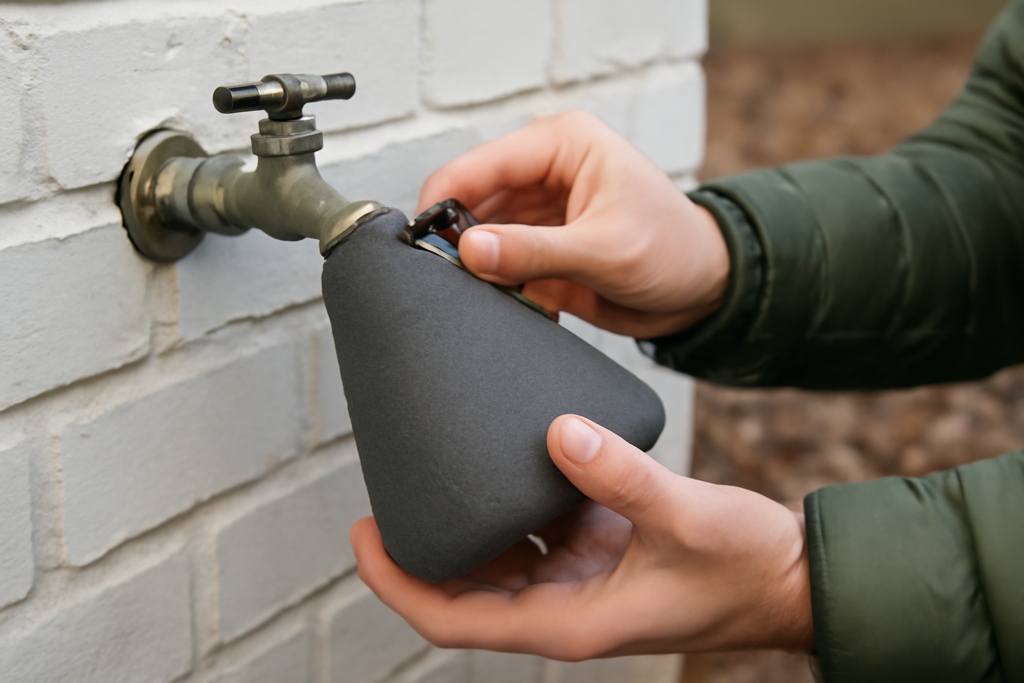
A burst outdoor spigot rarely announces itself — the pipe splits quietly inside the wall during a January night, and you discover it in March when the first hose hookup floods the rim joist. The Freeze Miser faucet protector takes a different approach to preventing that than the familiar foam dome: instead of insulating the faucet, it screws onto the hose threads and automatically releases a tiny trickle of water only when the water inside approaches freezing. It is the old “let the faucet drip” trick, automated and metered. At roughly $20 to $25 per unit, it has become a favorite among ranchers, RV owners, and homeowners in freeze-prone states. After running the product through hard freezes and edge cases, here is how it performs and where it fits.
How the Freeze Miser Works
The device is a compact brass-and-polymer valve, about the size of a stubby hose quick-connect, that threads onto any standard 3/4-inch garden hose thread. Inside sits a thermal actuator — a temperature-sensitive mechanism that holds the valve closed under normal conditions. When the temperature of the water sitting in the faucet drops to around 37°F, the actuator begins to open and the unit releases a slow drip to trickle. Moving water resists freezing, and the continuous exchange pulls slightly warmer water from the supply line through the faucet body. As temperatures rise back above the threshold, the valve closes itself. No batteries, no electricity, no smart-home app — pure mechanical thermostatics.
The critical detail people miss: the Freeze Miser responds to water temperature, not air temperature. Air can hit 25°F while the water in a wall-mounted faucet, fed by warmer supply lines from inside, still reads in the 40s — so the unit correctly stays closed. That design keeps water waste far below a manually dripped faucet, which runs all night whether needed or not. The manufacturer positions this as protection down to double-digit-below-zero conditions when used correctly, and cold-country users report it holding through single-digit nights on exposed hydrants that previously froze annually.
Installation: Thirty Seconds, One Rule
Setup could not be simpler: remove the hose, hand-tighten the Freeze Miser onto the spigot’s threads, then open the faucet handle fully and leave it open all winter. That last step is the entire operating principle and the number-one user error. The faucet valve must stay open so the Freeze Miser controls the water column; a closed faucet leaves the device dry and useless while water sits trapped and freezable in the pipe. Point the unit’s discharge downward so drips fall clear, and give it a splash zone that will not glaze a walkway — route drips onto gravel or a flower bed, never a paved path that becomes an ice sheet.
Compatibility covers standard hose bibs, frost-free sillcocks, yard hydrants, and RV park spigots — anything with hose threads. On anti-siphon and vacuum-breaker faucets, check that the breaker hardware does not interfere with a full-open handle position. For genuinely exposed plumbing like a freestanding yard hydrant, the manufacturer and experienced users pair the Freeze Miser with pipe insulation on the riser: the device protects the water column, insulation slows heat loss, and together they cover nights that either alone might lose.
Cold-Weather Performance
In real use, the device does exactly what the mechanism promises. Through a typical Southern or mid-Atlantic freeze event — nights in the 20s, days above freezing — the Freeze Miser sits closed most of the time, weeps briefly in the pre-dawn hours, and the faucet never freezes. Water use is dramatically lower than a manual drip: a faucet left running at the traditional “pencil lead” stream wastes on the order of 50 to 100-plus gallons per night, while the Freeze Miser’s on-demand trickle typically releases a small fraction of that, only during the coldest hours.
Deep-cold performance depends on the installation matching the threat. On a wall-mounted bib backed by a heated basement, users report protection through sub-zero snaps. On a freestanding hydrant fed by shallow lines in open pasture — the hardest case — the unit plus foam pipe wrap has held through single digits; without insulation, extreme wind chill on fully exposed steel can outrun the trickle. That is not a design flaw so much as physics, and the product’s honest ceiling: it protects the faucet and water column it controls, not fifty feet of shallow, uninsulated supply line.
Strengths and Weaknesses
- Strengths: True set-and-forget automation with no power required; water savings versus manual dripping; fits any hose-thread fixture; useful for faucets that cannot take a foam cover (hydrants, tight corners, RV posts); roughly $20 each with multi-packs cheaper per unit; and it keeps the faucet usable all winter — unscrew nothing, just connect a hose on a warm day and reinstall after.
- Weaknesses: It cannot protect a faucet whose handle someone closed — household members must understand the open-valve rule; the drip zone can ice up hardscape if you ignore placement; it does nothing for interior pipes or the supply line upstream; sediment-heavy well water can foul any small valve over time (an occasional flush clears it); and in climates with months of severe cold, a frost-free sillcock properly installed — or full winterization — remains the more permanent engineering answer.
Freeze Miser vs. Foam Covers vs. Frost-Free Sillcocks
The $3 foam faucet cover is the Freeze Miser’s obvious rival, and the comparison is genuinely situational. A cover traps ground- and house-heat around the faucet and works well on wall bibs in moderate climates — but it is passive, blows off in wind, cannot be used while a hose is connected, and does nothing for a freestanding hydrant with no wall behind it. The Freeze Miser is active protection that adapts to conditions, and it wins decisively on hydrants, RV connections, and livestock waterlines where covers are useless. Belt-and-suspenders homeowners in hard-freeze zones use both on wall bibs: cover for insulation, Miser for insurance.
A frost-free (freeze-proof) sillcock, which moves the shutoff valve 8 to 12 inches inside the heated wall, is the permanent solution for house bibs — but retrofitting one runs $150 to $400 per faucet installed, and even frost-free units burst when a hose is left attached. At one-tenth the cost with zero plumbing work, the Freeze Miser is the rational choice for renters, for supplementing older standard bibs, and for every fixture a sillcock cannot replace.
Verdict: Cheap Insurance That Actually Works
Score the Freeze Miser 4.5 out of 5 for what it is: a $20 mechanical device that reliably prevents a $500-to-$5,000 repair, wastes minimal water doing it, and installs in under a minute. Buy it if you have hose bibs, yard hydrants, or RV spigots in any climate that sees hard freezes a few times a year — and especially for outbuildings, barns, and rentals where nobody is home to drip faucets manually. Skip it only where months of continuous deep cold argue for full winterization, or where a modern frost-free sillcock already protects the line (though even then, it is smart protection for the season you forget to disconnect the hose). Buy a multi-pack, tape a note by the door about leaving handles open, and cross frozen spigots off the winter worry list.
Seasonal Routine: Getting the Most From It
Treat the Freeze Miser as part of a five-minute fall ritual. When the first hard frost hits the forecast, disconnect and drain all hoses — a hose left attached traps water in any faucet, Miser or not, and is the single biggest cause of split hose bibs nationwide. Thread the unit on, open the handle fully, and give the device a quick function check by confirming water reaches it (a brief crack of flow at installation proves the column is live). Through the winter, glance at it after ice storms to make sure the discharge is not sealed under a glaze; a dangling icicle off the tip is normal and harmless, but a unit encased solid should be cleared. In spring, remove it, let it dry, and store it indoors — ultraviolet exposure and summer heat add nothing to its life, and the annual off-season is a good time to flush any sediment by running water through it briefly. Well-water households should add a quick internal rinse to that routine. Users following that cycle report units performing identically in their fourth and fifth winters, which turns a $20 gadget into roughly $4 a year of insurance against one of plumbing’s most expensive quiet failures.


