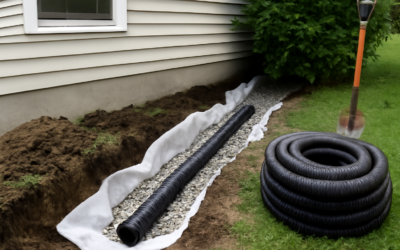
If water keeps pooling against your foundation or your basement smells like a damp cave after every storm, someone has probably told you to install a French drain. Here’s the french drain explained in plain terms: it’s a gravel-filled trench with a perforated pipe at the bottom that collects groundwater and carries it away from where it’s causing problems. No fancy pumps required for the basic version, just gravity, gravel, and pitch.
Despite the name, there’s nothing French about it. The system is named after Henry French, a 19th-century Massachusetts farmer and judge who popularized it in a book about farm drainage. I’ve dug and installed dozens of these, and once you understand the mechanics, the whole thing stops feeling like plumbing wizardry.
How a French Drain Actually Works
The principle is dead simple: water follows the path of least resistance. A French drain gives it an easy path made of open space. You dig a trench, line it with landscape fabric, drop in a few inches of gravel, lay a perforated pipe on top, then bury the pipe in more gravel and fold the fabric over the top.
When groundwater rises or rain saturates the soil, it seeps through the gravel far faster than through packed dirt. Once it reaches the perforated pipe, it drips through the holes and flows downhill inside the pipe to a discharge point, a lower spot in the yard, a dry well, or a storm drain. The gravel keeps the pipe from clogging with soil, and the fabric keeps fine silt from migrating in and choking the system over time.
The Anatomy: Gravel and Perforated Pipe
Every effective French drain shares the same parts. Get any one wrong and the system underperforms:
- The trench: Typically 6 inches wide by 18 to 24 inches deep, sloped at least 1 inch of drop for every 8 feet of run so water keeps moving.
- Landscape fabric: A permeable geotextile that lines the trench and wraps the gravel, blocking silt while letting water pass.
- Washed drainage gravel: Rounded 3/4-inch stone, not crushed fines, so there’s plenty of open space between stones.
- Perforated pipe: Usually 4-inch corrugated or rigid PVC drilled with holes. The holes face down so water enters from below where it collects.
- A discharge point: Where the collected water finally exits, ideally daylighting to a lower grade or feeding a dry well.
People argue about hole orientation constantly. Holes down is correct for a drain meant to lower the water table, because water enters the pipe and gets carried off before it ever rises to the surface.
When You Actually Need One
A French drain solves specific problems, and it’s overkill for others. You’re a good candidate if you see any of these:
- A soggy, spongy lawn that stays wet days after rain.
- Water pooling against the foundation or seeping into the basement.
- A retaining wall bulging from hydrostatic pressure behind it.
- A downhill neighbor’s runoff sheeting across your property.
If your only issue is roof runoff dumping next to the house, sometimes just extending your gutter downspouts 6 to 10 feet solves it for $40. Try the cheap fix first. A French drain is the right tool when the water is coming from the soil itself, not just off the roof.
Interior vs. Exterior French Drains
This is the distinction that trips up most homeowners, because the two systems solve the same symptom from opposite sides.
Exterior French Drain
An exterior drain, often called a footing drain, is installed outside the foundation, ideally alongside the footing during construction. Retrofitting one means excavating all the way down to the footing, which is labor-intensive and expensive but stops water before it ever touches the foundation wall. This is the gold standard for a chronically wet basement, but excavating an existing house can run $10,000 to $25,000-plus.
Interior French Drain
An interior system is installed inside the basement. A crew cuts a channel in the concrete floor around the perimeter, lays perforated pipe in gravel, and routes it to a sump pit where a pump ejects the water. It doesn’t stop water from reaching the wall, but it captures it the moment it enters and pumps it out. Because there’s no exterior excavation, it’s less disruptive and usually cheaper, in the $50 to $100 per linear foot range plus the sump pump.
Cost Per Linear Foot
Pricing swings with access, depth, and whether you hit rock or roots. As a working range:
- DIY yard drain: $10 to $20 per linear foot in materials (pipe, gravel, fabric).
- Professional exterior yard drain: $25 to $60 per linear foot installed.
- Interior basement French drain: $50 to $100 per linear foot, plus $500 to $1,200 for the sump pump.
- Full exterior foundation footing drain: $80 to $200 per linear foot due to deep excavation.
For a typical 100-foot yard run, budget somewhere between $2,500 and $6,000 for professional installation. A basement perimeter of 120 feet with a sump can land anywhere from $8,000 to $15,000.
Common Mistakes That Ruin a French Drain
I’ve been called out to fix more failed French drains than I’ve installed from scratch, and the failures almost always trace to the same handful of errors. Skipping the landscape fabric is the biggest one, silt migrates into the gravel within a year or two, clogs the voids, and the drain simply stops draining. Using crushed stone with lots of fines instead of clean washed gravel does the same thing, packing tight and choking off the water paths.
Insufficient slope is the second killer. Water needs a continuous downhill run of at least an inch every eight feet; a dead-flat or reverse-pitched trench turns your drain into an underground bathtub. Other frequent blunders include running the pipe with the holes facing up, discharging the water somewhere that just funnels it back toward the house, and burying the outlet so it can’t daylight. Get the slope, the gravel, the fabric, and the discharge point right, and the system will run silently for decades.
Maintaining Your French Drain
A well-built French drain is close to maintenance-free, but “close” isn’t “zero.” Once a year, walk the discharge end and clear any leaves, mulch, or sediment blocking the outlet, a plugged exit backs water up the whole line. If you installed cleanout risers or a catch basin, pop the lid and flush it with a garden hose to move any accumulated grit through the pipe.
Keep an eye on the surface above the trench too. If you notice pooling returning after a few years, it usually signals silt intrusion, and a plumber can often clear a rigid PVC line with a drain snake or a jetter. Avoid planting trees or shrubs with aggressive roots near the drain line, because roots seek out that reliable moisture and can eventually infiltrate the pipe.
DIY vs. Hiring a Pro
A straightforward yard drain in soft soil is one of the more achievable weekend projects, if you’re willing to move a lot of gravel. Rent a trencher for about $150 a day, call 811 to locate utilities before you dig, maintain your slope with a string line and a level, and don’t skimp on fabric. That job is squarely DIY-able.
Interior and exterior foundation drains are a different animal. Cutting a concrete floor, tying into a sump, or excavating to a footing involves structural risk, waterproofing detail, and permits. Get that wrong and you can trap water against the wall or undermine the foundation. For anything touching the foundation, hire a licensed basement waterproofing contractor and get two or three quotes.
Now that you’ve got the french drain explained end to end, you can diagnose your own water problem, tell an exterior fix from an interior one, and walk into any contractor conversation knowing whether their quote and their slope actually make sense.