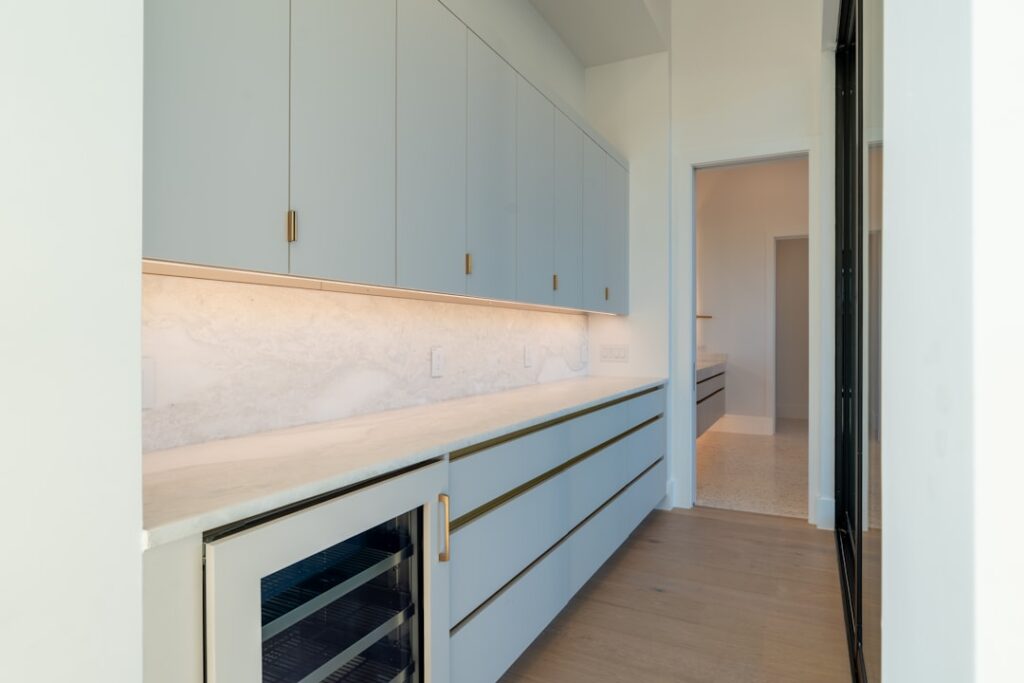
The way a cabinet door sits on its box shapes the entire look of a kitchen. Full overlay cabinet doors cover nearly the whole face frame, leaving only thin gaps between doors for a clean, contemporary appearance that has become the default in modern design. This guide explains how they compare to other overlays, what they cost, and how to install them.
- Understanding Overlay Types
- What Makes Full Overlay Distinct
- Full Overlay vs. Partial Overlay
- Full Overlay vs. Inset
- The Look and Feel
- Hinge Requirements
- Cost Considerations
- Best Cabinet Styles for Full Overlay
- Installation and Alignment
- Maintenance and Adjustments
- Mistakes to Avoid
- Frequently Asked Questions
- Reveal Consistency and Why It Matters
- Full Overlay on Framed Cabinets
- Best Door Materials for the Look
- Planning a Full Overlay Kitchen
- Final Thoughts
Understanding Overlay Types
Overlay describes how much of the cabinet face frame a door covers. There are three main types: partial (standard) overlay, full overlay, and inset. Partial overlay leaves a wide band of frame visible between doors. Full overlay covers almost the entire frame, revealing just a sliver. Inset doors sit flush inside the frame. Full overlay strikes a balance between the economy of partial overlay and the refined look of inset.
What Makes Full Overlay Distinct
With full overlay, doors and drawer fronts are sized larger so they nearly touch, typically leaving reveals of just 1/8 to 1/4 inch between them. The result hides most of the face frame and reads almost frameless, giving a sleek, continuous run of doors. On frameless (European) cabinets, full overlay is standard because there is no face frame at all, only the box edge to cover.
Full Overlay vs. Partial Overlay
Partial overlay is the traditional, budget-friendly choice, with doors covering only part of the frame and leaving 1 to 2 inches of exposed frame between them. It hides minor alignment imperfections and costs less. Full overlay looks more modern and upscale but demands larger doors and tighter tolerances. If your priority is a clean contemporary look, full overlay wins; if budget is tight and you don’t mind visible frame, partial overlay works fine.
Full Overlay vs. Inset
Inset doors sit flush within the face frame for the most refined, furniture-quality look, but they are the most expensive and demand exacting craftsmanship, since any seasonal wood movement can cause sticking. Full overlay delivers a similarly clean face for less money and with more forgiving tolerances, because the doors sit on top of the frame rather than fitting precisely inside it. For most homeowners, full overlay offers the best value-to-look ratio.
The Look and Feel
Full overlay doors create long, uninterrupted vertical and horizontal lines, which make a kitchen feel more expansive and modern. Paired with slab or Shaker doors, the effect is crisp and minimal. Paired with raised panels, full overlay can still feel traditional but tidy. The thin, consistent reveals are key to the look, so quality installation and alignment matter more than with partial overlay.
Hinge Requirements
Full overlay doors require hinges designed for the overlay amount, typically concealed European cup hinges with a low overlay crank. These six-way adjustable hinges let an installer fine-tune the door position in three dimensions to keep those thin reveals consistent. Because the doors sit close together, precise hinge adjustment is essential to prevent doors from rubbing against each other when they open and close.
Cost Considerations
Full overlay costs more than partial overlay because the doors and drawer fronts use more material, being larger to cover the frame. The upcharge is generally modest, often 5 to 15 percent over partial overlay within the same cabinet line. It remains significantly cheaper than inset construction, which can add 15 to 30 percent or more due to the precision fitting required. For the upscale look it delivers, full overlay is cost-effective.
Best Cabinet Styles for Full Overlay
Full overlay pairs beautifully with contemporary and transitional kitchens. Flat slab doors in full overlay give a true minimalist, European feel. Shaker doors in full overlay bridge modern and traditional and are enormously popular. Even in more traditional kitchens, full overlay keeps a busy door style looking organized. It works across nearly every design except strictly historic period kitchens, where inset is more authentic.
Installation and Alignment
Because reveals are so narrow, installation precision is critical. Cabinets must be hung level and plumb, and hinges adjusted so every gap is uniform. Uneven reveals are far more noticeable on full overlay than on partial overlay, where the wide frame hides small errors. Budget for a skilled installer, and expect them to spend time dialing in each door and drawer front so the whole run looks seamless.
Maintenance and Adjustments
Over time, doors may shift slightly as the house settles or seasons change. With adjustable European hinges, realigning a door takes seconds using a screwdriver to tweak the height, depth, and side positioning. Check reveals annually and adjust any door that begins to rub its neighbor. Keeping the gaps consistent preserves the clean look that makes full overlay worth choosing.
Mistakes to Avoid
Don’t choose full overlay if you’re installing cabinets yourself without the patience for precise leveling and hinge adjustment, since sloppy reveals undermine the whole look. Avoid mixing overlay types within one visible run. And confirm your hinges match the overlay specification, because the wrong hinge crank will throw off the door spacing and cause interference between adjacent doors.
Frequently Asked Questions
Do full overlay doors work on framed cabinets? Yes, framed cabinets can use full overlay doors sized to cover the frame. Are they harder to keep aligned? They show misalignment more, but adjustable hinges make correction easy. Do they cost much more than partial overlay? Only modestly, and far less than inset, making them a value upgrade.
Reveal Consistency and Why It Matters
The narrow reveal, the small gap between adjacent doors and drawer fronts, is the visual signature of full overlay. Typically 1/8 to 1/4 inch, this gap must stay uniform across the entire run for the look to succeed. Uneven reveals draw the eye immediately and make an installation look amateur. Because there’s no wide frame to disguise variation, achieving consistent reveals requires precise cabinet leveling and careful hinge adjustment, which is why professional installation pays off on full overlay projects.
Full Overlay on Framed Cabinets
While full overlay is standard on frameless European cabinets, it also works on traditional framed cabinets. On a framed cabinet, the doors are simply sized larger to cover nearly all of the face frame, leaving only thin reveals. This gives you the clean full overlay look while retaining the added rigidity of a face frame. The trade-off is slightly less interior access than a true frameless box, since the frame narrows the opening, but many homeowners prefer the sturdiness a frame provides.
Best Door Materials for the Look
Full overlay flatters both painted and stained doors. Painted MDF slab or Shaker doors give a seamless modern look with crisp edges and stable, crack-resistant surfaces. Stained wood doors in full overlay show off grain across long, uninterrupted runs. For a true minimalist European aesthetic, high-gloss or matte laminate slab doors in full overlay create an almost monolithic wall of cabinetry. Choose the material to match your desired style, since full overlay itself works across nearly all of them.
Planning a Full Overlay Kitchen
When designing a full overlay kitchen, plan for consistent door and drawer sizing so the reveals line up cleanly across the whole space. Coordinate with your designer on filler strips at walls and appliances, since these need careful sizing to preserve the uniform look. Confirm the hinge specification matches the overlay before ordering, and budget for the slightly larger doors and the skilled installation the style demands. Thoughtful planning up front ensures the finished kitchen delivers the seamless, upscale appearance full overlay promises.
Final Thoughts
Full overlay cabinet doors deliver the clean, modern look most of today’s kitchens aim for, covering the face frame for a nearly seamless run at a reasonable upcharge over partial overlay. Pair them with slab or Shaker fronts, invest in a careful installation with adjustable hinges, and keep the reveals consistent. The result is a crisp, contemporary kitchen that feels upscale without the cost and fussiness of true inset construction.