A cabinet with doors is one of the most useful pieces of storage in any home, hiding clutter behind a clean front while keeping contents dust-free and organized. From garage utility units to elegant living-room consoles, the right cabinet with doors depends on the room, the materials, the door style, and the hardware. This guide walks through every choice so you buy or build storage that lasts and looks right.
- Why Doors Beat Open Shelving
- Common Types and Where They Go
- Materials: What They’re Made Of
- Door Styles
- Door Operation: Hinged, Sliding, and More
- Hinges and Hardware
- Sizes and Configurations
- What Cabinets with Doors Cost
- Buying vs. Building
- Framed vs. Frameless Construction
- Door Overlay: Full, Partial, and Inset
- Interior Storage Solutions
- Installation and Care Tips
- Finishes and Matching Your Room
- The Bottom Line
Why Doors Beat Open Shelving
Open shelves show off decor but collect dust and look messy when packed. A cabinet with doors keeps contents concealed, protected from dust and sunlight, and visually tidy, which is why they dominate kitchens, bathrooms, garages, and offices. Doors also add security for items you’d rather keep out of reach, and they let you store mismatched or utilitarian goods without cluttering the room’s appearance.
Common Types and Where They Go
Cabinets with doors come in many forms tailored to different rooms and uses.
- Kitchen cabinets: base and wall units for cookware, food, and dishes.
- Bathroom vanities and linen cabinets: moisture-resistant storage for toiletries and towels.
- Storage/utility cabinets: tall metal or MDF units for garages, laundry rooms, and offices.
- Accent and media cabinets: living-room consoles and sideboards that double as furniture.
- Wardrobes and armoires: freestanding closets for clothing.
Materials: What They’re Made Of
The material determines durability, weight, moisture resistance, and price.
- Solid wood: strongest and most attractive, but heaviest and most expensive. Great for furniture-grade pieces.
- Plywood: strong, stable, and moisture-resistant; common in quality cabinet boxes.
- MDF (medium-density fiberboard): smooth, affordable, paints well, but heavier and less water-tolerant.
- Particleboard/melamine: cheapest, used in flat-pack furniture; lighter duty and vulnerable to moisture.
- Steel: durable and secure, ideal for garage and industrial utility cabinets.
For damp areas like bathrooms and garages, choose plywood, steel, or moisture-resistant MDF over plain particleboard, which swells if it gets wet.
Door Styles
The door itself sets the look and function. Key styles include:
- Shaker: a recessed flat panel with a simple frame; timeless and versatile.
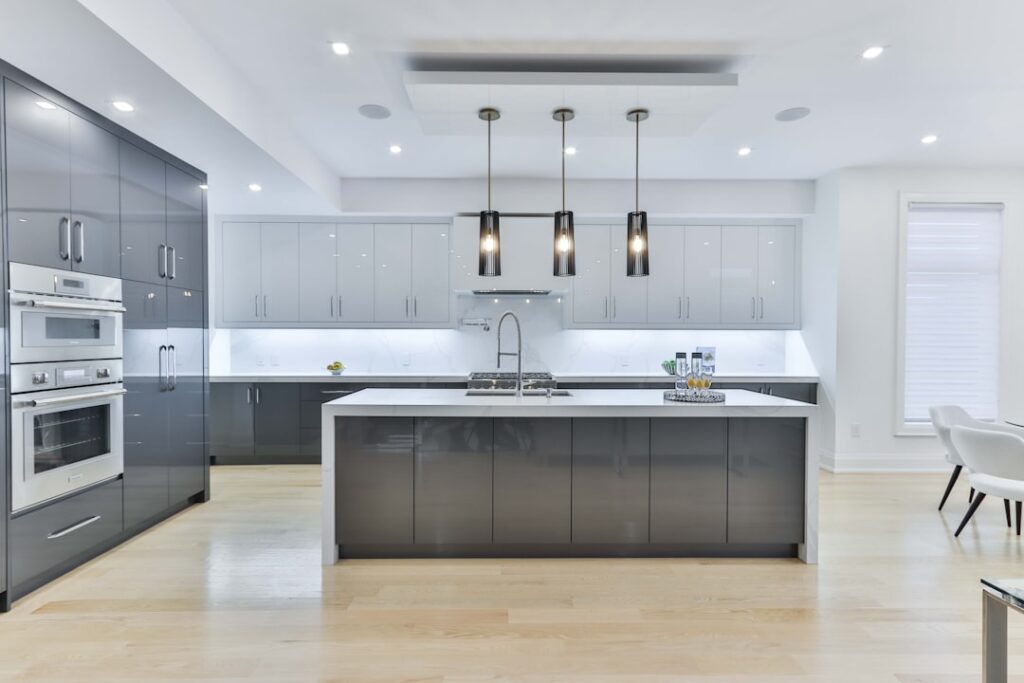
- Flat/slab: a plain smooth front; modern and easy to clean.
- Raised panel: a traditional, more ornate profile.
- Glass-front: shows contents while keeping dust out; good for display.
- Louvered: slatted doors that allow airflow, useful for utility or laundry cabinets.
Door Operation: Hinged, Sliding, and More
How the door opens matters for tight spaces. Standard hinged doors swing out and need clearance in front. Sliding (bypass) doors save space by moving sideways, ideal for narrow rooms. Bi-fold doors fold back for wide access, and lift-up or flap doors work well on upper media cabinets. In small rooms, sliding or bi-fold doors avoid the swing-clearance problem of a standard hinged front.
Hinges and Hardware
Quality hardware is the difference between a cabinet that feels solid and one that sags. Concealed European (cup) hinges are the standard on modern cabinets, adjustable in three directions for perfect alignment and hidden from view. Look for soft-close hinges that stop the door from slamming, a feature now common even on mid-range units. For doors and drawers, soft-close mechanisms greatly improve the feel and longevity. Choose knobs and pulls that match the room’s style and are comfortable to grip.
Sizes and Configurations
Cabinets come in standard and custom sizes. Kitchen base cabinets are typically 24 inches deep and 34.5 inches tall (36 with countertop), in widths from 9 to 48 inches. Wall cabinets run 12 to 15 inches deep. Tall utility and pantry cabinets reach 84 to 96 inches. Freestanding storage cabinets vary widely. Measure your space carefully, including door-swing clearance, before buying, and consider adjustable interior shelves for flexible storage.
What Cabinets with Doors Cost
Prices span an enormous range depending on material, size, and quality.
- Flat-pack storage cabinets (particleboard/MDF): $80 to $300.
- Steel garage/utility cabinets: $150 to $600.
- Stock kitchen cabinets: $100 to $400 per unit.
- Semi-custom and solid-wood furniture cabinets: $400 to $2,000-plus.
- Custom built-ins: priced per project, often thousands.
Buying vs. Building
Ready-made cabinets are convenient and come in every style and budget. Flat-pack units save money but require assembly and are less durable. Building your own from plywood lets you get exact dimensions and better materials, and it’s a satisfying weekend project if you have basic tools. For built-ins or a precise fit, custom or semi-custom cabinets are worth the cost. Match the approach to your skills, budget, and how long you need it to last.
Framed vs. Frameless Construction
Cabinet boxes come in two construction styles that affect how the doors sit and how much you can store. Framed (American-style) cabinets have a face frame of solid wood around the front of the box, to which the doors and hinges attach. This is traditional, sturdy, and forgiving of slight wall irregularities, but the frame slightly reduces the opening size. Frameless (European-style) cabinets skip the face frame; doors mount directly to the box sides, giving a sleek modern look and a larger, unobstructed opening for easier access and a bit more storage. Frameless designs pair naturally with full-overlay slab doors, while framed cabinets suit inset and partial-overlay traditional styles. Neither is universally better; choose based on the look you want and how much interior access matters.
Door Overlay: Full, Partial, and Inset
How the door sits relative to the cabinet face changes the entire appearance. Full-overlay doors cover almost the whole cabinet front with thin gaps between them, the modern default. Partial-overlay doors leave more of the frame visible between doors, a common and economical traditional look. Inset doors sit flush inside the frame, level with the cabinet face, which is the most refined and expensive style, demanding precise construction and quality hinges to stay aligned. Overlay choice affects both aesthetics and price, so factor it in when comparing cabinets or planning a build.
Interior Storage Solutions
The value of a cabinet with doors comes as much from what’s inside as the box itself. Adjustable shelves let you reconfigure for tall or short items. Pull-out shelves and drawers bring the back of a deep cabinet to you, so nothing gets lost in the dark. Lazy Susans make blind corner cabinets usable, and door-mounted racks add storage on the inside of the doors for spices, cleaning supplies, or lids. Dividers keep trays and cutting boards upright. When buying or building, consider how you’ll organize the interior, because good internal fittings often matter more day to day than the door style.
Installation and Care Tips
Wall-mounted cabinets must be anchored into studs to hold their load safely; use a stud finder and appropriate screws, and never rely on drywall anchors alone for a loaded cabinet. Tall freestanding cabinets should be anti-tip anchored to the wall to prevent tipping, especially in homes with children. Adjust the hinges after installation so doors sit flush and even. Clean wood cabinets with a mild cleaner, wipe up spills promptly on MDF and particleboard, and periodically tighten hinge and handle screws, which loosen with use.
Finishes and Matching Your Room
The finish sets the mood and durability of a cabinet with doors. Painted finishes offer any color and hide MDF or particleboard well, but can chip on high-use edges. Stained wood shows off natural grain and touches up more easily. Thermofoil, a vinyl heat-sealed over MDF, gives a smooth, wipeable surface at a low price, though it can peel near heat sources. Laminate and melamine are durable, budget-friendly, and available in wood-look and solid colors. For garages and utility spaces, powder-coated steel resists moisture and abuse best. Match the finish to both the room’s style and how much wear the cabinet will take, since a beautiful finish in the wrong spot won’t hold up.
The Bottom Line
A cabinet with doors is a versatile storage workhorse for every room, keeping belongings concealed, protected, and organized. Choose the material for the room’s demands (plywood or steel for damp or heavy-duty spaces, solid wood or MDF for furniture pieces), pick a door style and operation that fit your space and taste, and insist on quality soft-close hinges. Measure carefully, anchor tall or wall-mounted units for safety, and you’ll have durable, good-looking storage that serves for many years.