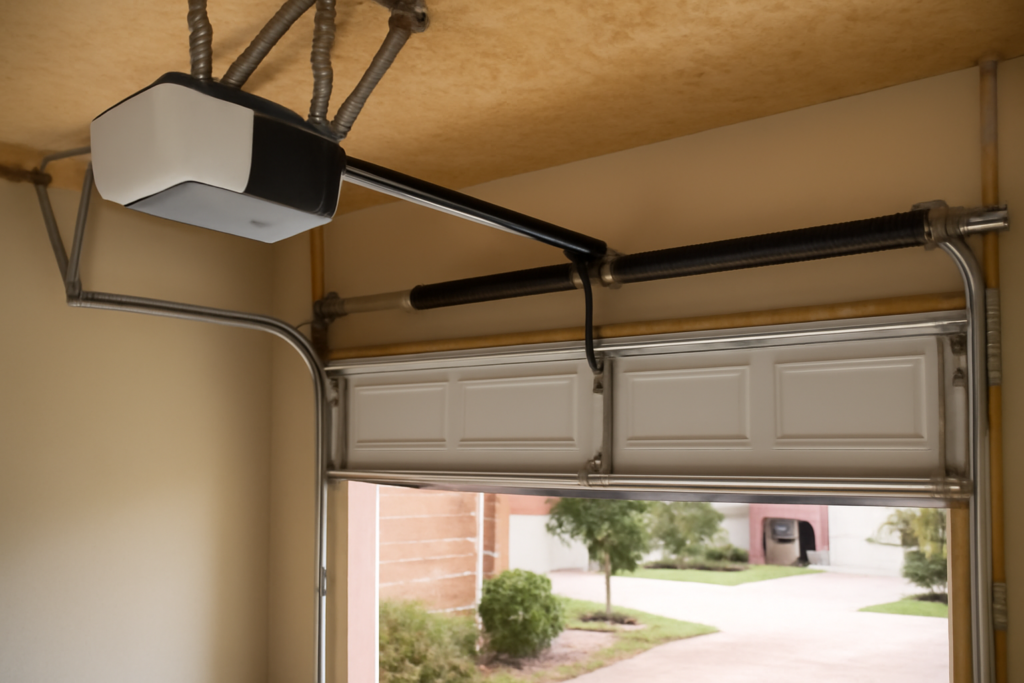
Here’s a fact that surprises most homeowners: your garage door opener motor barely does any lifting. The real muscle is the garage door opener spring, a tightly wound coil holding hundreds of pounds of stored energy that counterbalances a door weighing 150 pounds or more. The motor just nudges an already-balanced door. When that spring breaks — and every spring eventually does — the opener strains, the door won’t lift, and you suddenly understand why springs are the single most important safety component in the whole system.
Part of our Garage Doors guide — explore the full guide →
Understanding how these springs work, how to spot a failing one, and why professionals handle the replacement will save you money and possibly a trip to the emergency room. Let’s break it down.
- What the Spring Actually Does
- Torsion vs. Extension Springs
- How Long a Spring Lasts
- Warning Signs of a Failing Spring
- Why You Shouldn't DIY Spring Replacement
- What Replacement Costs
- Extending Spring Life
- One Spring vs. Two: Which Setup Is Better
- What Affects How Fast a Spring Wears Out
- The Bottom Line
What the Spring Actually Does
A garage door spring stores mechanical energy. When the door closes, the spring winds tight and loads up; when the door opens, that energy releases and does the lifting the motor can’t. This counterbalance is why you can raise a properly tuned door with one hand even though it weighs as much as a refrigerator.
The opener itself provides only the automation and a small push. If your spring fails, the opener will try, grind, and give up — or worse, force the door and burn out its gears. That’s why a “broken opener” is so often actually a broken spring.
Torsion vs. Extension Springs
There are two systems, and knowing which you have matters for repair and cost.
- Torsion springs mount horizontally on a metal shaft above the door opening. They wind and unwind as the door moves, are far more durable, and offer smoother, more balanced operation. Most modern and heavier doors use them.
- Extension springs run parallel to the horizontal tracks on each side and stretch to store energy. They’re common on older and lighter doors, cost less, but wear faster and are more likely to launch a part when they snap.
Extension springs should always have a safety cable threaded through them. If yours don’t, add them — that cable is the only thing stopping a broken spring from becoming a projectile.
How Long a Spring Lasts
Springs are rated in cycles, where one cycle is a full open-and-close. A standard spring is rated for about 10,000 cycles. If you open your door four times a day, that’s roughly seven years. High-cycle springs rated for 20,000 or even 30,000 cycles cost a bit more upfront but can double the lifespan — worth it if your garage is the main entrance to the house.
Cold climates shorten spring life because metal grows brittle in freezing temperatures. That’s why so many springs snap on a January morning when the door is put under load in the cold.
Warning Signs of a Failing Spring
Springs rarely die without warning. Watch and listen for these red flags:
- A loud bang from the garage, often mistaken for a gunshot — that’s usually a spring snapping.
- The door won’t open or only lifts a few inches before stopping.
- A visible gap in the torsion spring coil, where the two broken ends have separated.
- The door slams shut or feels far heavier than usual by hand.
- Jerky, crooked movement or the opener straining and struggling.
Test the balance yourself: pull the red emergency release and lift the door manually to about waist height. A healthy spring holds it in place. If it drops or feels like dead weight, the spring is worn out and needs replacement soon.
Why You Shouldn’t DIY Spring Replacement
I’ll be blunt: torsion spring replacement is the one garage repair I tell homeowners to leave alone. A wound torsion spring holds enough stored energy to break fingers, wrists, and teeth. The winding process requires proper winding bars — never screwdrivers — and a slip can send those bars flying with tremendous force.
Emergency rooms see these injuries every year, almost always from someone trying to save a service call. Springs also come in specific wire gauges, lengths, and inside diameters matched to your exact door weight. Guess wrong and the door won’t balance, which strains the opener and wears the new spring out prematurely.
What Replacement Costs
Professional spring replacement typically runs $200 to $350 for a single torsion spring including parts and labor, or $300 to $500 for a two-spring system. Extension spring jobs tend to fall between $150 and $250. The springs themselves are cheap — $30 to $100 — so most of the cost is skilled, dangerous labor.
Here’s a money-saving tip: if you have a two-spring system and one breaks, replace both. They wear at the same rate, so the second is likely weeks from failing. Doing both in one visit saves a second service charge and keeps the door balanced.
Extending Spring Life
A little maintenance stretches the years between replacements:
- Lubricate the springs twice a year with a garage-door-specific silicone or lithium spray — never WD-40, which is a solvent, not a lubricant.
- Keep the door balanced and have any binding rollers or tracks addressed promptly.
- Upgrade to high-cycle springs if you use the door heavily.
- Don’t force a struggling door; a strained opener accelerates spring wear.
Twice-yearly lubrication takes five minutes and noticeably reduces the metal fatigue that causes snaps.
One Spring vs. Two: Which Setup Is Better
Homeowners often ask whether they should run a single torsion spring or a two-spring system. For lighter doors, a single spring is standard and works fine. But on heavier doors — insulated steel, solid wood, or double-wide doors — a two-spring system is worth the extra cost for several reasons:
- Balance and safety: if one spring breaks in a two-spring setup, the second still supports much of the load, so the door doesn’t come crashing down.
- Smoother operation and less strain on the opener, cables, and rollers.
- Longer life, since the load is shared across two springs instead of overworking one.
If your door currently uses a single heavy-duty spring and it keeps failing early, upgrading to a balanced two-spring system during your next replacement is money well spent. It’s the kind of change a good garage-door tech will recommend for a door that’s clearly too heavy for its current spring.
What Affects How Fast a Spring Wears Out
Two identical doors can wear their springs at very different rates depending on conditions. Usage is the biggest factor — a door cycled a dozen times a day burns through its cycle rating far faster than one used twice. Beyond that:
- Cold weather makes steel brittle and is why snaps cluster on freezing mornings.
- Poor lubrication lets the coils grind against themselves, accelerating metal fatigue.
- An unbalanced door or binding rollers force the spring to work harder than designed.
- Rust, especially in humid or coastal climates, weakens the metal over time.
- The wrong spring — undersized for the door weight — fails prematurely no matter how well you care for it.
You can’t do much about your climate, but you can control lubrication, balance, and correct sizing. Address those and you’ll get the full rated life, or close to it, out of every spring you install.
The Bottom Line
Your garage door opener spring is the hardest-working and most dangerous part of the system, and it’s a wear item that will eventually fail no matter how good your opener is. Learn to recognize the warning signs, test your door’s balance a couple times a year, and when a spring breaks, call a professional with the right winding bars and correctly sized parts. It’s one of the few home repairs where the smart, frugal move is to pay someone else — the cost of a service call is a bargain compared to a hospital bill.
When you do call a technician, ask two questions that separate a good service from a mediocre one: what cycle rating are the replacement springs, and will they check and adjust the door’s overall balance after installing them. A quality tech installs correctly sized springs, tests that the door holds at the halfway point, and lubricates the new springs before leaving. That balance check is what protects your opener’s motor and gears from the strain that killed the last spring early. Get those things right and your new spring should quietly do its job for years, so you can go back to opening the door without a second thought.