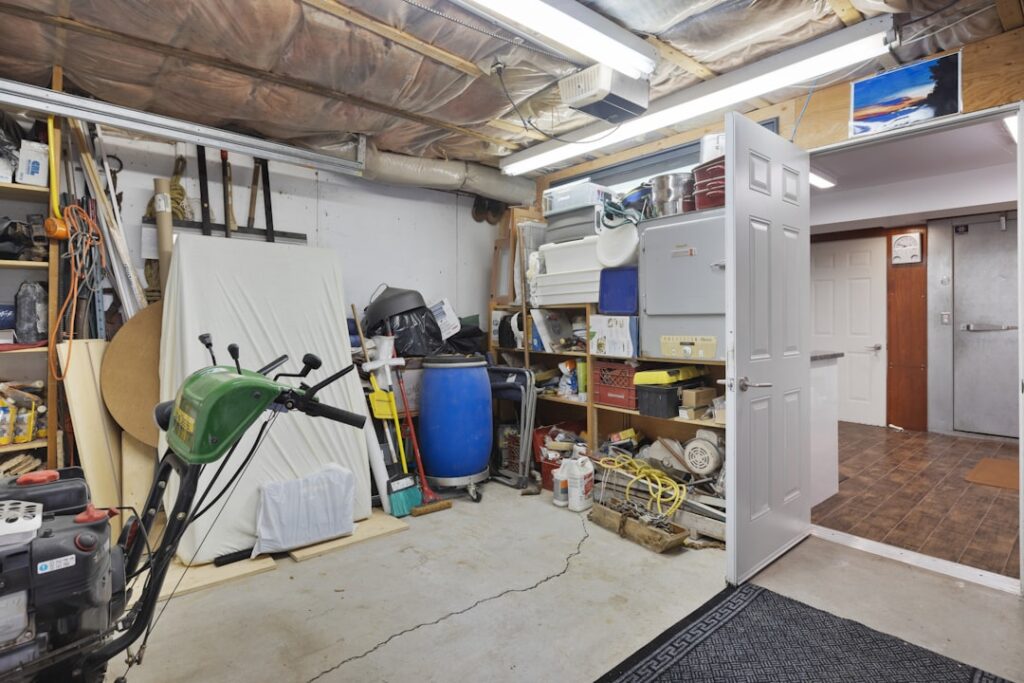
The most wasted real estate in any home is the empty space above your car. A garage storage lift reclaims those unused cubic feet by hoisting heavy bins, seasonal gear, and bulky equipment up to the ceiling with a hand crank or a motor. Installing a garage storage lift can free up a chunk of floor and wall space that shelving alone never touches, and it keeps rarely used items overhead but accessible. This guide covers lift types, weight limits, installation, and safety.
How Garage Storage Lifts Work
A storage lift is essentially a platform or set of straps suspended from your garage ceiling by cables running through pulleys. You load the platform at floor or waist height, then crank or press a button to raise the whole thing up near the ceiling, locking it in place.
The mechanism spreads the load across ceiling joists, so a single lift can hold hundreds of pounds. When you need the contents, you lower it back down, unload, and send it up again. It’s the same principle as a boat lift, adapted to garage rafters.
Manual vs. Motorized Lifts
Lifts split into two camps, and the right one depends on how much weight and how often you’ll use it.
- Manual crank lifts: a hand crank and gear reduction let you raise 200 to 600 pounds by hand. Affordable at $100 to $300, no wiring needed. Brands like Racor and HeavyLift dominate here.
- Motorized lifts: an electric motor does the work at the push of a button, handling 400 to 800 pounds. They run $600 to $1,800 and need a nearby outlet. The Garage Gator and Auxx-Lift are popular.
If you’re storing a couple of tubs of holiday decorations, a manual lift is plenty. If you’re hoisting a loaded cargo box, kayaks, or a spare set of wheels regularly, the motor is worth every dollar.
Matching Capacity to Your Needs
Don’t guess on weight. Overloading a lift is how ceilings and platforms fail. Figure out what you’ll store and add a margin.
- Seasonal bins and camping gear: 200 to 400 pounds, a basic manual lift handles it
- Bikes, kayaks, and ladders: platform or strap lifts rated 300 to 500 pounds
- Rooftop cargo boxes and truck bed covers: motorized lifts in the 400 to 600 pound range
- Multiple heavy tubs or a spare tire set: choose 600 pounds or more and confirm joist strength
Always buy a lift rated above your heaviest expected load. A 600-pound lift used at 350 pounds runs cooler, wears slower, and gives you a safety buffer.
Checking Your Ceiling First
Before buying anything, confirm your garage can carry the load. Lifts mount to the ceiling joists or trusses, and not every garage is up to it.
Measure your ceiling height; you need enough clearance that raised items sit above your car and door tracks. Most lifts need at least 9 to 10 feet, and taller garages are ideal. Then identify your framing: solid dimensional joists (2×6 or larger) handle heavy lifts, while engineered trusses have load limits that a manufacturer or engineer should verify before you hang hundreds of pounds. Never mount a heavy lift to drywall or to trusses not rated for point loads.
Installing a Storage Lift
A manual lift is a weekend DIY job for a confident homeowner; a heavy motorized unit may warrant help.
- Locate and mark your ceiling joists with a stud finder, confirming direction and spacing.
- Mount the pulley brackets by driving the supplied lag bolts directly into the center of solid joists, never into the gaps.
- Route the cables through the pulleys exactly per the diagram; a mis-routed cable binds and can snap.
- Attach the platform or straps and test with zero load, then a light load, checking that it raises level.
- Verify the locking mechanism engages fully at the top before trusting it with weight.
Use the hardware that ships with the lift. Substituting undersized lag bolts is the most common installer mistake and the most dangerous.
Safety You Cannot Skip
A loaded lift overhead is a serious safety matter. Treat it like the heavy machinery it is.
- Never park where a falling load could hit your car until you trust the install completely.
- Distribute weight evenly on the platform so it rises level and the cables share the load.
- Confirm the mechanical lock, not just the cable, holds the platform up. Cables and motors can fail; a positive lock is your backstop.
- Inspect cables for fraying every few months and replace at the first sign of wear.
- Keep kids away during operation and never stand directly under a raised load.
Motorized lifts with an auto-stop and a secondary safety strap add real peace of mind.
Comparing Lifts to Other Storage Options
A lift isn’t your only overhead option, and understanding the alternatives helps you spend wisely. Fixed overhead racks, like the FLEXIMOUNTS or SafeRacks 4×8 platforms, bolt permanently to the ceiling and hold 400 to 600 pounds, but you need a ladder to load and unload them.
Here’s how the choices stack up:
- Fixed overhead rack: cheapest at $100 to $250, huge capacity, but requires a ladder every time
- Motorized storage lift: brings the load down to you, best for heavy or frequently accessed items, $600 to $1,800
- Manual crank lift: a middle ground, lowers to you without a motor, $100 to $300
- Wall shelving: best for items you grab weekly, keeps the ceiling free
The rule of thumb: use fixed racks for light, rarely touched bins, and reserve a lift for heavy gear you actually want to bring down without climbing.
Best Uses for a Garage Lift
Certain items are practically made for a storage lift. Anything bulky, heavy, and seasonal is a perfect candidate because you avoid wrestling it up a ladder.
- Rooftop cargo boxes and car-top carriers between road trips
- Kayaks, canoes, and stand-up paddleboards
- Bicycles for the off-season
- Holiday decoration tubs, especially the heavy artificial tree box
- Truck bed covers and tonneau panels
- Extra tires and wheels for seasonal swaps
A motorized platform lift shines with a loaded cargo box: you drive home, pull into the garage, and lower the box straight onto your roof rack without a soul helping you lift it. That single use case sells a lot of motorized lifts.
Maintenance and Inspection
A storage lift is a mechanical system that carries a load over your head, so periodic checks matter. Set a reminder to inspect it every three to six months and before any heavy seasonal load.
Look over the cables inch by inch for fraying, kinks, or rust; a single broken strand is your cue to replace the cable immediately. Check that the mounting lag bolts remain tight in the joists, since vibration and load cycling can loosen them slightly over time. On motorized units, listen for grinding in the gearbox and confirm the auto-stop and any secondary safety strap function. Keep the pulleys clean and lightly lubricated per the manufacturer’s guidance. A few minutes of inspection prevents the rare but serious failure of a load coming down unexpectedly.
Getting the Most From Your Lift
Store items in matching, stackable bins so the load sits stable and square on the platform. Label the bins facing down or outward so you can identify contents from the floor. Reserve the lift for genuinely seasonal or rarely used gear; things you reach for weekly belong on wall shelves.
A single well-placed garage storage lift over the hood of a parked car can hold six to eight large tubs that would otherwise eat an entire wall of shelving. For the cost of a couple hundred dollars and an afternoon, you convert dead ceiling space into serious storage and finally park both cars inside. Just respect the weight rating, mount into solid framing, and check the cables, and a good lift will serve you for years.