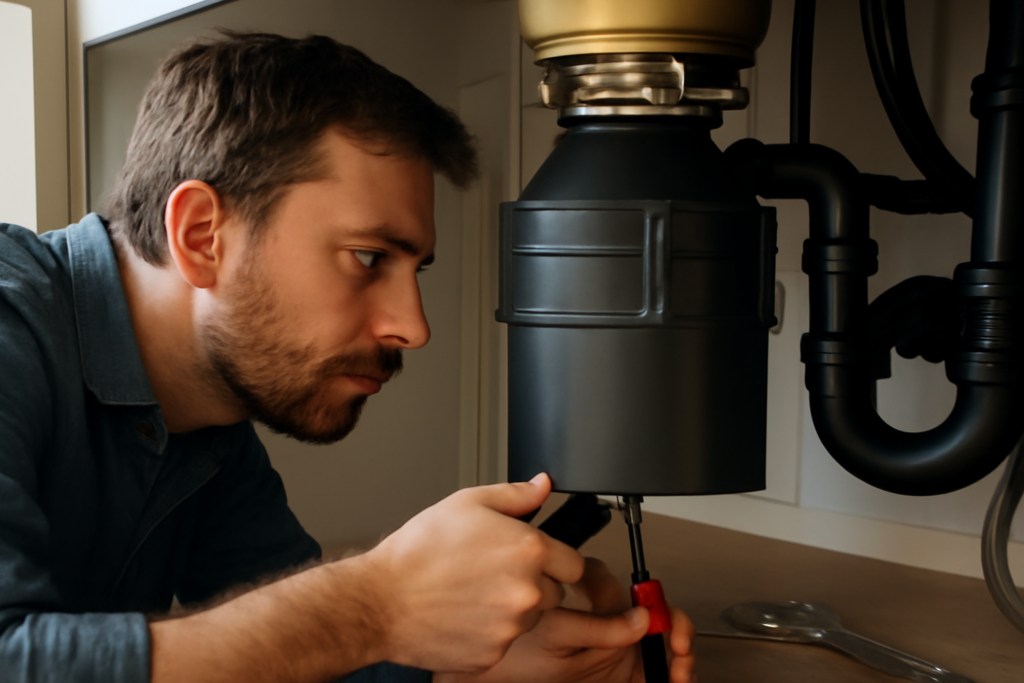
That angry humming sound with no grinding is one of the most common kitchen appliance failures, and it is also one of the easiest to fix yourself. A garbage disposal buzzing but not turning almost always means the flywheel is jammed, and the motor is straining against something stuck inside. The good news is you can usually clear it in five minutes with a hex wrench, and no plumber visit required.
What the Buzzing Actually Means
When your disposal hums or buzzes without the familiar grinding, the motor is getting power but the impellers cannot rotate. Something is physically blocking the flywheel, or the motor bearings have seized. That strain is exactly why the unit buzzes instead of running normally.
This matters because a buzzing disposal left running will overheat and trip its internal breaker within seconds. Never keep flipping the switch on repeatedly, since that can burn out the motor for good. Turn it off and diagnose before you do damage.
Safety First: Cut the Power
Before you reach anywhere near the disposal, kill its power completely. Flip the wall switch off and, for real safety, unplug the unit under the sink or switch off its breaker in the panel. The blades inside are not sharp like a knife, but they can still injure you, and an accidental start with your hand inside is a serious hazard.
Never put your hand down into the disposal, even with the power off. Use tools from above and reach the motor from below the unit instead.
The Most Common Cause: A Jam
The usual culprit is a hard object wedged against the impellers. Bones, fruit pits, silverware, bottle caps, and glass are frequent offenders, along with fibrous foods like celery strings and potato peels that wrap around the mechanism.
- Shine a flashlight into the disposal from above and look for anything visible lodged around the grinding chamber.
- If you see the object, remove it with tongs or needle-nose pliers, never your fingers.
- Fibrous clogs may need to be teased out in pieces.
Clearing the visible obstruction alone sometimes frees the flywheel entirely.
Freeing the Flywheel With the Hex Wrench
Most disposals include a hex (Allen) wrench for exactly this problem, and there is a matching hex socket in the center of the unit’s underside. This is the fix that solves the majority of buzzing disposals.
- With power off, find the hex-shaped hole in the bottom center of the disposal.
- Insert the hex wrench (a 1/4-inch Allen key works if you lost the original).
- Turn it back and forth in both directions, working it until it spins freely.
- That rotation manually breaks the flywheel loose from whatever jammed it.
If you cannot free it from below, insert a broom handle or a wooden spoon from above, push against an impeller, and lever it to rotate the flywheel. Never use your hand.
Hit the Reset Button
After clearing the jam, the disposal may still be dead because its overload protector tripped. Look for a small red or black reset button on the bottom of the unit. Press it firmly until it clicks and stays in.
Restore power, run cold water, and briefly test the switch. If it grinds normally, you are done. If it buzzes again, there is still an obstruction or a deeper problem, so cut power and inspect once more before repeating.
When Buzzing Means Something Worse
Not every buzz is a simple jam. If you have cleared any obstruction, freed the flywheel, and hit reset but the unit still hums without turning, the motor bearings may have seized or the internal windings may have failed. A disposal that repeatedly jams on nothing, leaks from the body, or is more than ten years old is usually telling you its time is up.
A standard replacement disposal costs about $80 to $250, plus installation if you hire out. Swapping one is a manageable DIY job for anyone comfortable disconnecting the drain and the electrical whip, roughly an hour of work.
What the Sound Is Telling You
Learning to read the noise speeds up any diagnosis. A steady buzz or hum with no rotation is the classic jam, meaning power is reaching a stuck flywheel. Complete silence when you flip the switch usually points to a tripped reset button, a dead outlet, or a wiring fault rather than a jam.
A rattling or grinding clatter that does not sound like normal operation often means a hard object like a bottle cap or bone is loose in the chamber, bouncing against the impellers. And a slow, laboring whir that struggles to spin up can indicate a motor on its way out. Matching the sound to the cause tells you whether to reach for the hex wrench or the reset button first.
Tools You Should Keep on Hand
Because buzzing disposals are so common, it pays to keep a small kit within reach so you are not scrambling mid-problem. A basic set covers nearly every jam you will encounter:
- The 1/4-inch hex wrench that came with the unit, or a spare taped inside the sink cabinet.
- A flashlight or headlamp to see into the chamber clearly.
- Needle-nose pliers or long tongs for pulling out debris.
- A wooden spoon or short broom handle to lever the flywheel from above.
With those four items and the power safely off, the vast majority of buzzing episodes are a five-minute fix that never requires a service call.
Preventing Future Jams
Most buzzing episodes trace back to what went down the drain. Keep your disposal healthy with a few habits:
- Always run a strong stream of cold water before, during, and after grinding.
- Feed waste in gradually rather than packing the chamber full.
- Never put bones, pits, glass, metal, grease, or fibrous vegetables like celery and corn husks down it.
- Grind a few ice cubes and citrus peels periodically to clean the chamber and freshen the smell.
Treat the unit gently and a garbage disposal buzzing will be a rare event, and when it does happen, you now have the five-minute fix to handle it yourself.