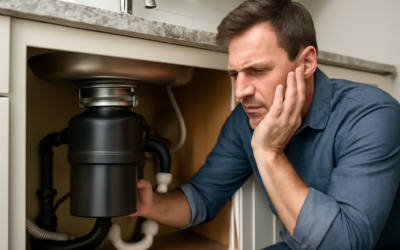
That low hum with no grinding is your disposal’s way of telling you the motor has power but the blades are stuck, and if you leave it running you’ll burn out the motor in under a minute. A garbage disposal humming but not turning is one of the most common and most fixable kitchen problems, usually caused by a jam you can clear yourself in ten minutes with no plumber and no new unit. This guide explains why it happens, how to fix it safely, and how to prevent it from recurring.
What the Humming Actually Means
When you flip the switch and hear a hum but the grinding plate, called the flywheel, doesn’t spin, the motor is receiving electricity but something is physically blocking the impellers from rotating. The disposal’s internal overload protector is designed to trip and cut power before the jammed motor overheats, but a jam left running will still cook the windings. That’s why the first rule is simple: turn it off immediately.
Do not keep flipping the switch hoping it frees itself. Each attempt heats the stalled motor and risks permanent damage.
Safety First
Before you touch anything inside the disposal, cut the power completely. Turn off the switch, then shut off the breaker to the disposal or unplug it under the sink. Never, under any circumstances, put your hand into the disposal chamber, even with the power off. The grinding components are sharp. Every step below is done with tools, not fingers.
The Most Common Cause: A Jam
The overwhelming majority of humming disposals are jammed by something wedged between the impeller and the grind ring. Frequent offenders include:
- Fibrous foods: celery, corn husks, artichokes, and onion skins that wrap around the flywheel.
- Bones, fruit pits, and hard seeds that lodge against the impellers.
- Silverware, bottle caps, or small utensils that fell in unnoticed.
- Coffee grounds and starchy foods like potato peels that pack into a paste.
Clearing the obstruction almost always restores normal operation.
How to Free a Jammed Disposal
- Cut the power. Switch off and unplug or trip the breaker.
- Use the hex wrench. Most disposals have a 1/4-inch hex socket on the bottom center of the unit. Insert the included Allen wrench (or a matching one) and crank it back and forth in both directions. This manually rotates the flywheel and breaks the jam free.
- Free it from the top. If there’s no bottom socket, insert a wooden broom handle or a dedicated disposal wrench into the chamber from above and lever against the impeller to turn the flywheel. Never use your hand.
- Remove the debris. Once the flywheel spins freely, look inside with a flashlight and pull out the offending object with tongs or pliers.
- Restore power and test. Turn the power back on, run cold water, and briefly switch on the disposal. It should spin freely now.
Hit the Reset Button
If the motor overheated and tripped its overload protector, the disposal won’t run at all, or will only hum weakly, until you reset it. Look for a small red or black reset button on the bottom of the unit. After clearing the jam and letting the motor cool for a few minutes, press the button firmly; it should click and stay in. Then test the disposal. If it trips again immediately, the jam isn’t fully cleared or the motor is failing.
If It Still Hums After Clearing
If you’ve removed the obstruction, reset the unit, and it still only hums, work through these possibilities:
- A hidden jam: rotate the flywheel again with the hex wrench to confirm it turns a full circle freely.
- A seized flywheel: rust or corrosion in an old unit can lock the plate even with nothing wedged in it.
- A failed start capacitor or motor: internal electrical failure produces a hum with no rotation and usually signals the end of the unit’s life.
A disposal that hums with a freely spinning, obstruction-free flywheel has an electrical fault, and replacement is generally more sensible than repair.
When to Replace Instead of Repair
Garbage disposals typically last 8 to 15 years. Replace rather than repair if the unit is old and the flywheel spins freely but it still won’t grind, if it leaks from the body, or if it trips repeatedly with no jam. A new mid-range 1/2 to 3/4 horsepower disposal costs $80 to $200, and swapping one out is a manageable DIY job that takes about an hour with the mounting collar reused.
Preventing Future Jams
- Run cold water before, during, and for 15 seconds after grinding to flush debris through.
- Feed food gradually instead of stuffing the chamber full.
- Avoid the worst offenders: bones, fruit pits, fibrous vegetables, coffee grounds, grease, and starchy peels.
- Grind ice cubes and citrus peels occasionally to clean the chamber and keep it smelling fresh.
- Never rinse silverware near the drain without a strainer to catch it.
The Bottom Line
A garbage disposal humming but not turning is almost always a simple jam, not a dead machine. Cut the power, work the hex wrench in the bottom to free the flywheel, clear the debris with pliers, and press the reset button. Only when the flywheel spins freely and it still won’t grind is the motor the problem. Feed the disposal carefully and run cold water, and you’ll rarely hear that stuck hum again.