
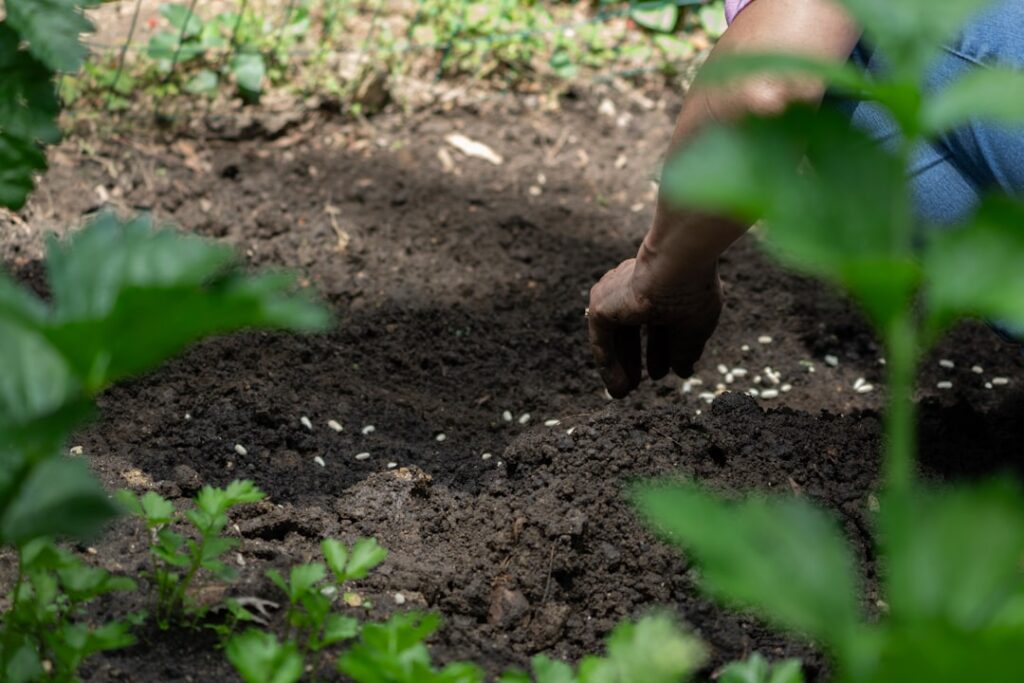
Every spring somebody fills fifteen containers with bagged garden soil, and by July their tomatoes are drowning in bricks. Understanding garden soil vs potting soil saves you from that mistake and its mirror image — paying triple to fill a raised bed with fluffy potting mix that slumps six inches by August. The garden soil vs potting soil question isn’t about quality; the two products are engineered for physically different environments, and each fails predictably when used in the other’s territory. Here’s what’s actually in each bag, why containers change the physics, and how to buy the right one for every job in the yard.
What’s in the Bag: Composition
Bagged garden soil (Miracle-Gro Garden Soil, Kellogg, Scotts, and store brands) is built around real mineral soil and heavy organics: topsoil or sandy loam, composted forest products or bark fines, manure or biosolids compost, and often a modest starter fertilizer charge. It’s dense — a 1-cubic-foot bag weighs 35 to 45 pounds — holds water strongly, and contains actual clay and silt particles plus a living microbial load. It’s labeled for in-ground use and raised beds, diluted into native soil.
Potting soil (better called potting mix, since most contain no soil at all) is a soilless engineered medium: 40 to 60 percent sphagnum peat moss or coconut coir for water holding, 20 to 30 percent perlite or pumice for air space, composted bark for structure, plus lime to correct peat’s acidity (peat runs pH 3.5 to 4.5; the lime brings mix to about 6.0 to 6.5), a wetting agent so dry peat re-absorbs water, and frequently slow-release fertilizer. A cubic foot weighs just 10 to 20 pounds. Premium mixes add mycorrhizae or worm castings; seed-starting versions use finer particles and drop the fertilizer.
Why Containers Change Everything: The Perched Water Table
Here’s the physics most gardeners never hear. In the ground, gravity drains water downward through an effectively infinite soil column. In a pot, drainage stops at the bottom, and capillary forces hold a saturated layer — a perched water table — above the drain holes no matter how many holes you drill. The finer the medium, the taller that soggy zone. Put dense garden soil in a 12-inch pot and the bottom 4 to 6 inches can sit waterlogged for days: roots suffocate (roots need oxygen as much as water), and root-rot organisms like Pythium take over. Potting mix’s coarse perlite fraction shrinks the perched zone to an inch or two and keeps 15 to 25 percent air-filled porosity even right after watering. This — not nutrition — is the core reason the two products aren’t interchangeable. It’s also why the old “gravel in the bottom of the pot” trick backfires: gravel raises the perched water table into the root zone rather than draining it.
Where Each One Fails
- Garden soil in containers: compacts into an airless mass, drains poorly, bakes to a crust, and can import fungus gnats, weed seeds, and damping-off pathogens. The classic result is stunted, yellowing plants that are simultaneously overwatered and underwatered.
- Potting mix in the ground: mostly a waste of money rather than a disaster — but in raised beds used alone, pure potting mix causes real problems: it decomposes and shrinks 20 to 30 percent in a season, dries out brutally fast in summer (peat that fully dries turns hydrophobic and sheds water), provides weak anchorage for tall crops, and its fertility burns off quickly, leaving you fertilizing constantly.
- Bagged garden soil used straight, undiluted, in raised beds: the sleeper failure. Most bags say to mix with native soil; filled neat into a tall bed, dense garden soil can slump and waterlog just like in a giant pot — beds are containers too, just big ones.
Cost Comparison and Buying Math
Prices per cubic foot tell the story of why nobody should fill big volumes with potting mix:
- Bagged garden soil: $2 to $6 per cubic foot ($4 to $9 for a typical 1.5 cu ft bag)
- Potting mix: $6 to $15 per cubic foot ($10 to $20 per 1.5 or 2 cu ft bag; premium brands like FoxFarm Ocean Forest run $18 to $25)
- Bulk topsoil/compost blend delivered: $25 to $50 per cubic yard — that’s roughly $1 to $2 per cubic foot, the cheapest fill there is
Worked example: a 4×8 raised bed 12 inches deep holds 32 cubic feet. Filled with premium potting mix: $250 to $450. Filled with a bulk soil-compost blend plus a few bags of amendments: $60 to $110. Same bed, same tomatoes, a $200 difference — and the bulk blend actually performs better at that depth.
Can You Mix Them? Yes — Here’s the Recipe Book
Mixing is not only allowed, it’s how experienced growers hit the middle ground:
- Raised beds (the workhorse blend): 50 to 60 percent quality topsoil or bagged garden soil, 30 percent compost, 10 to 20 percent potting mix, perlite, or bark fines for structure. Tracks the popular “Mel’s Mix” idea (equal thirds compost, peat, vermiculite) but at a third of the cost.
- Big containers on a budget (15+ gallon): up to 25 percent garden soil blended into 75 percent potting mix adds weight for wind stability and buffers moisture — acceptable where a little drainage loss is tolerable, never for seed starting.
- Refreshing last year’s pots: tired potting mix isn’t trash; recharge with 25 to 30 percent fresh compost and a handful of perlite, or retire it into garden beds as an amendment — its final, honorable job.
- In-ground beds: skip both premiums; 2 to 3 inches of plain compost worked into native soil beats bagged anything per dollar.
Quick Decision Table
- Pots, hanging baskets, seed trays: potting mix, always — never garden soil.
- Raised beds: bulk soil-compost blend or the 50/30/20 recipe above.
- Amending in-ground beds: compost first, bagged garden soil second.
- Filling low spots or new lawn areas: bulk topsoil — neither bagged product justifies the cost.
- Houseplants: potting mix, ideally one matched to the plant (cactus mix drains faster, orchid mix is mostly bark).
Reading Labels Like a Pro
Bag marketing blurs these categories on purpose, so ignore the front panel and read the fine print. “Garden soil” containing zero actual soil exists; so does “potting soil” dense enough to pot nothing successfully. Check three things. Ingredients list: for containers you want peat or coir named first with perlite or pumice clearly present; the words “topsoil,” “sand,” or unspecified “forest products” leading the list mean in-ground use regardless of the bag’s title. Weight test: heft the bag — a 1.5-cubic-foot bag over 30 pounds is too dense for pots, full stop, and you don’t need the label to tell you. Fertilizer charge: bags stating “feeds up to 3 months” carry synthetic slow-release prills, which is convenient for flowers but matters if you garden organically or start seeds (fertilizer charges burn seedlings; always use a charge-free seed-starting mix for germination).
Two more traps worth naming. “Raised bed soil,” the newest category on the shelf, is genuinely useful — it’s blended intermediate between the two products, typically 60/40 soil-to-soilless — but it’s priced near potting mix, so the DIY 50/30/20 blend still wins on volume jobs. And “moisture control” mixes with hydrogel crystals mostly compensate for inconsistent watering; at a 30 to 50 percent price premium, a $15 drip stake kit solves the same problem better. When in doubt between two bags, buy the one whose label tells you exactly what’s inside by percentage — transparency correlates with quality in this aisle remarkably well.
Bottom Line
Match the medium to the physics: containers demand engineered airiness because their drainage is throttled by the perched water table, and open ground rewards dense, mineral, biologically alive soil that holds moisture through August. Buy potting mix by the bag for anything with drain holes, buy soil by the yard for anything without, and use the mixing recipes for everything between. Get that sorting rule right and you’ve prevented the two most common — and most quietly expensive — soil mistakes in home gardening.


