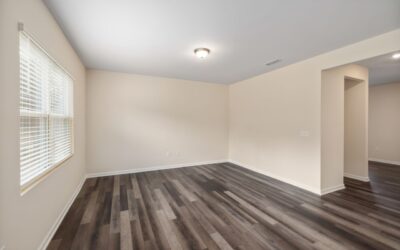
Gray has dominated American floor finishes for the better part of a decade, and the data backs the trend: 41 percent of luxury vinyl tile and plank sales in 2025 went to gray-family color choices according to Floor Covering Weekly industry data. Gray LVT flooring ranges from cool steel and silver tones to warm greige (gray-beige blends) and weathered driftwood looks. Picking the right shade for the room, the right wear-layer thickness for the traffic, and the right install method for the subfloor matters more than chasing the brand name on the box.
What Gray LVT Actually Is
LVT stands for luxury vinyl tile, used loosely to cover both tile-format and plank-format products. Modern LVT comes in two construction families: flexible LVT (3mm to 5mm thick, requires glue-down install on a perfectly flat subfloor) and rigid-core LVT (3.2mm to 8mm with WPC wood-polymer composite or SPC stone-polymer composite core, installs floating with click-lock edges). Gray colorways exist across both families and across every price tier from $1.50 to $7 per square foot material.
Cool, Warm, and Weathered Gray Shades
Gray subdivides into three visual families, each suiting different design directions:
- Cool gray: Blue or silver undertone. Reads contemporary, modern, urban. Pairs with white walls and stainless appliances.
- Warm gray (greige): Beige or brown undertone. Reads transitional, farmhouse, hospitable. Pairs with cream walls and wood cabinetry.
- Weathered gray: Driftwood or barnwood look with visible graining and color variation. Reads coastal, rustic. Hides scratches and pet wear best.
For 2026 design direction, warm greige is outselling cool gray three to two as homeowners pull back from the cold industrial look. Weathered gray remains the strongest seller in vacation homes, beach houses, and short-term rental properties because the texture hides daily wear far better than smooth-faced product.
Wear Layer Thickness Matters Most
The wear layer is the clear protective top film over the printed visual. Thickness directly predicts how the floor will look in 10 years:
- 6 mil: Light residential. Bedrooms, guest rooms, low-traffic dining. Budget products.
- 12 mil: Standard residential. Living rooms, hallways, kitchens. Mid-tier products.
- 20 mil: Heavy residential, light commercial. Premium home floors, rental properties.
- 22-30 mil: Commercial. Restaurants, offices, retail. Premium SPC and commercial LVT.
Skimping on wear layer to save money rarely pays off. A $2 per square foot gray LVT with 6 mil wear layer typically shows scratches within 3 to 5 years; a $4 per square foot product with 20 mil wear layer holds up 15 to 20 years. The 22 mil wear layer products from COREtec Pro Plus, Mannington Adura Max, and Shaw Floorte Pro carry 25-year residential and limited lifetime warranties.
Cost Per Square Foot Installed
Budget breakdown by tier: Budget gray flexible LVT (6 mil wear) installs at $3 to $5 per square foot all-in through big-box retailers. Mid-tier rigid-core SPC (12 mil) lands at $5 to $7 installed. Premium SPC and WPC with 20 to 22 mil wear layers run $7 to $10 installed. Glue-down commercial LVT with 28 mil-plus wear layer pushes $9 to $14 installed but lasts 25-plus years in commercial use.
Top Brands for Gray LVT
Brand selection drives both visual quality and warranty support. For premium residential and light commercial gray LVT, COREtec Pro Plus offers 20 mil wear layer in 15-plus gray visuals at $4 to $6 per square foot. Mannington Adura Max delivers 20 mil with deep texture register at $4 to $7. Karndean Korlok Reserve at 22 mil in stunning gray driftwood visuals runs $5 to $7. Shaw Floorte Pro offers a strong mid-tier 20 mil option at $3 to $5. For budget gray LVT, Lifeproof from Home Depot (Halstead branded) and Smartcore from Lowe’s both deliver 12 mil wear layer at $2.50 to $3.50 per square foot.
Click-Lock vs Glue-Down Install
Each install method suits different conditions. Click-lock floating SPC and WPC works over almost any flat, dry subfloor without adhesive. The expansion gap at perimeter walls is 1/4 inch minimum, hidden by baseboards. Installation runs 200 to 400 square feet per day per installer. Glue-down flexible LVT bonds directly to the subfloor with pressure-sensitive adhesive, providing the most stable result over concrete in commercial and heavy-traffic residential applications, but requires a perfectly flat subfloor (1/8 inch in 10 feet maximum) and slower install (150 to 250 square feet per day).
Subfloor Prep
Click-lock SPC tolerates subfloor irregularities better than flexible LVT but still needs a flat substrate. Use a 3/16 inch in 10 feet flatness tolerance for SPC, 1/8 inch in 10 feet for WPC, 1/8 inch in 6 feet for glue-down flexible LVT. Concrete slabs need an ASTM F2170 in-situ RH test below 75 percent and an ASTM F1869 calcium chloride emission below 3 lbs per 1,000 sq ft per 24 hours. Above those thresholds, install a moisture mitigation primer or membrane like Mapei Mapecem Quickpatch or Schluter Ditra under the LVT.
Care and Maintenance
Gray LVT cleans easily with a vacuum and damp microfiber. Avoid steam mops (they delaminate wear layer adhesive on most LVT), avoid wax (LVT comes pre-finished and wax creates a yellowing film), and avoid oil soap products (Murphy’s leaves residue that attracts dust). Stick to pH-neutral floor cleaners like Bona Stone, Tile and Laminate or COREtec Cleaner. Felt pads under furniture legs prevent point-load indents on softer flexible LVT. Walk-off mats at entries capture grit that scratches even AC5-rated wear layers over time.
Final Verdict
Gray LVT flooring remains a smart pick for kitchens, baths, basements, and whole-house installs through at least the next five-year design cycle. Specify 20 mil wear layer or better for any room with pets, kids, or high traffic; settle for 12 mil only in low-use bedrooms and guest rooms. Choose warm greige or weathered visuals for current design appeal and best resale support; cool gray now reads slightly dated to younger buyers. Budget $5 to $8 per square foot installed for a premium result that will outlast most homeowners’ next two paint refreshes and pet generations.
Prefer to explore on your own?
See how new flooring looks in your actual room in seconds — free, no signup.
Try the free Floor Studio →