The most common complaint about stovetop griddles is a cold spot right in the middle, where the gap between two burners leaves pancakes pale on one side and scorched on the other. A good griddle for gas stove cooking solves that with the right material, the right thickness and a size that matches your grate layout. Cast iron holds heat and evens it out slowly. Aluminum heats up fast and spreads warmth quickly but can run hot over the flames. Once you know which tradeoff you prefer, choosing a double-burner griddle gets much easier.
Griddles turn a standard range into a short-order station for breakfast, smash burgers, grilled sandwiches, quesadillas and fajitas. Material, heat spread across two burners, sizing, preheating and care all shape how well one performs on your range.
- Choosing a Griddle for Gas Stove Cooking
- Cast Iron vs Aluminum
- How Heat Spreads Over Two Burners
- Sizing to Your Grate Layout
- Reversible Grill and Griddle Pans
- Preheating, Cooking and Care
- Troubleshooting Common Griddle Problems
- What to Cook and How to Use the Heat Zones
- General Cost Ranges
- Frequently Asked Questions
Choosing a Griddle for Gas Stove Cooking
A double burner griddle is a flat rectangular pan, usually around 18 to 20 inches long and 9 to 11 inches wide, that spans two burners on one side of the cooktop. Some sit directly on the grates. Others have feet or a recessed underside that locks into the grate pattern so the griddle does not slide.
Look at these features first:
- Material: cast iron, cast aluminum, clad stainless steel or carbon steel.
- Thickness: thicker plates spread heat more evenly and resist warping.
- Surface: seasoned bare metal or a nonstick coating.
- Reversible design: flat griddle on one side, ridged grill pan on the other.
- Drip channel: a groove or trough around the edge to catch grease.
- Handles: side handles make it easier to lift a heavy griddle off the grates.
Cast Iron vs Aluminum
These two materials make up most of the market, and they behave very differently on a gas range.
Cast iron
Cast iron is heavy, often 8 to 12 pounds for a double-burner size. It heats slowly, so you need 10 to 15 minutes of gradual preheating over medium-low heat. Once hot, it holds heat very well: cold food does not drop the surface temperature much, which gives you better searing on burgers and steaks. The mass also helps even out the gap between burners, though a slight cool zone often remains. Bare cast iron needs seasoning and should not soak in water. It can crack if heated too fast on high or plunged into cold water while hot.
Aluminum
Cast aluminum griddles are much lighter, usually 3 to 5 pounds, and conduct heat about four times faster than cast iron. That means a quick preheat and a more uniform surface across the burner gap. The downside is lower heat storage: a batch of cold pancakes cools the surface faster, and the areas directly over the flame can run hotter than the edges. Most aluminum griddles have a nonstick coating, which makes eggs and pancakes easy but limits you to medium heat and non-metal utensils.
Other materials
Clad stainless griddles with an aluminum core spread heat well and are dishwasher tolerant in some cases, but they are pricey and food sticks without enough fat. Carbon steel behaves like a lighter cast iron, seasons the same way and warms faster.
| Feature | Cast iron | Aluminum |
|---|---|---|
| Preheat time | 10 to 15 minutes | 3 to 5 minutes |
| Heat retention | Excellent | Moderate |
| Weight | Heavy | Light |
| Best for | Searing, smash burgers | Pancakes, eggs, quick meals |
How Heat Spreads Over Two Burners
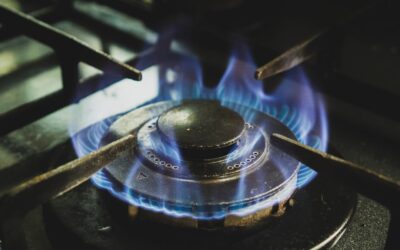
Each gas burner creates a ring of heat. With a griddle across two burners, you get two hot zones and a cooler strip between them, plus cooler ends. You can use this layout to your advantage: sear over the burners, then move finished food to the center or ends to stay warm.
To even out the surface:
- Center the griddle so each burner sits under the middle of its half.
- Start both burners on low for a few minutes, then raise to medium.
- Wait until the whole surface is hot. A few drops of water should dance and evaporate everywhere, including the center.
- Adjust burners independently. If the front burner runs stronger, turn it down slightly to balance the plate.
- Use an infrared thermometer to check surface temperatures if you want precision. Pancakes cook well around 350 to 375°F.
Stoves with an oval or bridge burner designed for griddles give the most even result, since one elongated flame covers the whole length. If your range has one, buy a griddle sized to that burner.
Sizing to Your Grate Layout
Measure before you buy. The griddle should span front and back burners on the same side, with the burner centers lining up under each half. Measure center to center between the two burners, and the overall depth of the grate. Most double-burner griddles fit standard 30-inch ranges, but some ranges have burners spaced unevenly or a large power burner in front that throws off the balance.
Check three things: the griddle sits flat without rocking, it does not block the knobs or overhang the front edge where it could get bumped, and it leaves room for the burner flames to breathe. A griddle that covers a burner too tightly can starve the flame of air, produce yellow flames and increase carbon monoxide, so keep space around the edges and run the vent hood while you cook.
Reversible Grill and Griddle Pans
A reversible model gives you a flat griddle on one side and raised grill ridges on the other. The grill side makes sear marks on chicken, vegetables and steaks, while fat drains into the grooves. These are nearly always cast iron because the ridges need mass to hold heat. Expect more cleanup on the ridged side; a stiff brush or a plastic scraper made for grill pans helps. If you want one pan for both jobs and do not mind the weight, reversible is a solid value.
Preheating, Cooking and Care
Season bare cast iron and carbon steel by wiping a very thin layer of high smoke-point oil over the whole surface and heating it until it smokes and darkens, then letting it cool. Repeat a few times for a durable base. After cooking, scrape off food while the griddle is warm, rinse with hot water, dry fully over a burner and wipe with a thin coat of oil.
For nonstick aluminum, avoid high heat and cooking sprays that leave a sticky film. Wash by hand with a soft sponge and mild soap, and use silicone or wood utensils.
Handle a hot griddle with oven mitts on both handles, and let a cast iron griddle cool on the stove before washing. Keep it away from children while it cools, since it stays hot for a long time.
Troubleshooting Common Griddle Problems
Uneven browning usually means an off-center griddle or a short preheat. Food sticking on cast iron points to thin seasoning or too little fat. Warping, most common on thin aluminum, happens when a cold pan meets high heat; always start low. A rust spot on cast iron scrubs off with steel wool, followed by a fresh seasoning coat. If your burners flicker yellow under the griddle, lift it and check that it is not covering the burner too closely.
What to Cook and How to Use the Heat Zones
Breakfast is where a double-burner griddle pays off first. Bacon goes on the hotter half, pancakes on the gentler side, and eggs finish in the cooler strip between burners. For smash burgers, preheat cast iron on medium-high until a drop of oil shimmers, press the beef balls flat with a sturdy spatula and leave them alone until a deep crust forms. Grilled cheese and quesadillas do best at medium, where the bread browns before the filling has a chance to leak.
Fajitas and stir-fried vegetables like high heat and plenty of room. Spread food in a single layer so it sears instead of steaming. Keep a squeeze bottle of oil and a bench scraper nearby, and push finished food to an end of the griddle to hold warm while the rest cooks. When the meal is done, turn both burners off before you lift the pan, and set it on a trivet or a cool burner rather than a countertop that could be damaged by the heat.
One more tip: resist cranking both burners to high. A griddle concentrates heat, and on thin pans this can scorch food and damage coatings. Moderate heat and patience give better, more even results.
General Cost Ranges
Basic nonstick aluminum griddles fall in the budget range, often under the cost of a nice skillet. Pre-seasoned cast iron reversible griddles sit in a similar low-to-moderate range. Clad stainless and heavy carbon steel models cost more, sometimes several times as much. For most home cooks, a mid-priced cast iron or cast aluminum griddle does the job for years.
Frequently Asked Questions
Is cast iron or aluminum better on a gas stove?
Cast iron sears better and holds heat, while aluminum heats faster and more evenly. Pick cast iron for burgers and steaks, aluminum for pancakes and eggs.
Why is the middle of my griddle cooler?
The space between the two burners gets less direct flame. A longer, gentler preheat and a thicker plate reduce that cool strip.
Can I use a griddle on a glass or induction cooktop?
Double-burner griddles for gas grates are often not flat enough for glass tops, and aluminum will not work on induction. Check the product label.
How do I clean a cast iron griddle?
Scrape it while warm, rinse with hot water, dry over low heat and apply a thin coat of oil. Avoid soaking or the dishwasher.