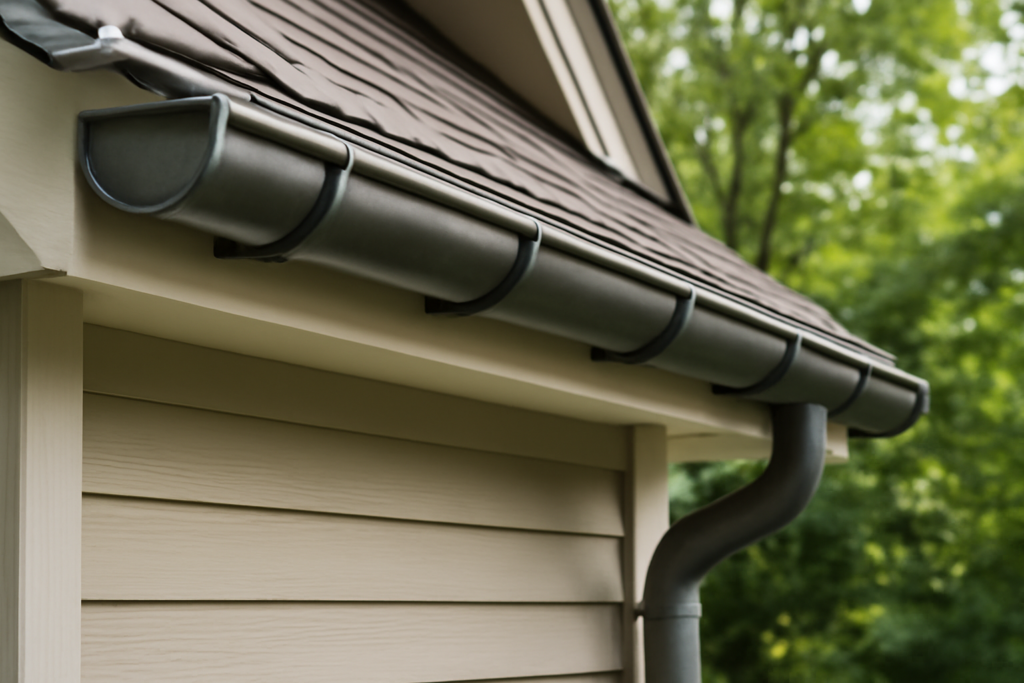
Walk any street of pre-war homes and the gutters you see are not the angular K-style troughs on modern builds — they are simple, open U-shapes hung from decorative brackets. Half round gutters were the American standard until the 1950s, and they are enjoying a genuine revival on historic restorations, European-styled new builds, and high-end homes where the gutter is treated as trim rather than plumbing. This guide sticks to what makes the profile itself different: its shape, capacity, hangers, downspouts, and the price of choosing style over the default.
What Defines the Half-Round Profile
A half-round gutter is exactly what the name says: a trough formed as half of a circle, with no flat back and no decorative front face. The shape predates roll-forming — tinsmiths could hand-form it from sheet stock — which is why it dominates historic architecture from Colonials to Craftsman bungalows. Common sizes are 5-inch and 6-inch diameters, with beaded edges rolled at the lip for stiffness. Because there is no flat back panel, half-rounds cannot be screwed flush to the fascia the way K-style can; they hang from external brackets or internal circle hangers, which is half of their visual charm and most of their installation cost.
The profile pairs with round corrugated or smooth downspouts, typically 3-inch or 4-inch diameter, rather than the rectangular 2x3s on K-style systems. That single detail — round pipe instead of rectangular — does more for the period-correct look than the trough itself.
Capacity: The Honest Trade-Off
Shape costs water-carrying ability. A half circle encloses less cross-sectional area than a K-style trough of the same nominal width, so a 5-inch half-round carries roughly 25 percent less water than a 5-inch K-style. The industry’s standard answer is simple: size up. A 6-inch half-round roughly matches a 5-inch K-style in capacity, which handles most homes in moderate rainfall regions comfortably. Steep roofs, metal roofs, and heavy-rain climates may justify 8-inch half-rounds, which several manufacturers produce for exactly this reason.
The smooth interior gives some of that capacity back in practice. With no creases or inside corners, water moves faster, debris slides toward outlets instead of lodging in folds, and standing water — the thing that corrodes metal gutters — has fewer places to sit. Half-rounds genuinely do self-clean better than K-style; owners under moderate tree cover often report one cleaning a year instead of two. The math for matching trough size to roof area is covered in our gutters and downspouts system guide.
Hangers and Brackets: Where the Look Lives
Half-round hanging hardware comes in three families:
- Shank-and-circle hangers — a cast or forged hook that cradles the trough, mounted to the fascia or roof deck. The traditional choice, visible and decorative, $5 to $15 each.
- Rod-and-nut hangers — a threaded rod through the beaded edges, adjustable and very strong; common on copper installs.
- Hidden half-round hangers — modern internal clips that approximate the clean look of K-style hidden hangers while keeping the profile. Less ornamental, faster to install.
Spacing matters more than on K-style because the profile has no flat back stiffening it against the fascia: set hangers every 24 inches maximum, 18 inches in snow country. Budget for hardware honestly — on a bracket-hung system, hangers can add $300 to $700 in parts alone to a whole-house job, which is a line item K-style quotes simply do not have.
Materials and What They Cost
Every major gutter metal comes in half-round, and the profile skews toward the premium end of each:
- Aluminum — $9 to $18 per linear foot installed. The affordable entry point; available seamless from specialty shops and sectional from suppliers in standard baked-enamel colors.
- Galvanized or Galvalume steel — $12 to $25 per foot. Period-correct for many early-1900s homes; see our galvalume gutters comparison for the coating differences.
- Copper — $30 to $50 per foot. The classic pairing — most copper gutter installations are half-round, soldered at joints, aging to brown then verdigris.
- Zinc — $25 to $40 per foot. The European standard; matte blue-gray patina, 80-year lifespan.
As a rule of thumb, expect half-round to run 25 to 50 percent above K-style in the same material, once brackets and round downspouts are counted. On a typical 180-foot house, aluminum half-round lands around $2,000 to $3,500 installed versus $1,400 to $2,800 for K-style aluminum. Full pricing context is in our gutter cost guide.
Where Half-Round Belongs — and Where It Doesn’t
Choose half-round when the architecture asks for it: pre-1950 homes of nearly any style, Tudor and European Revival designs, modern farmhouses chasing an authentic rather than builder-grade look, and any project where copper or zinc is already in the budget. A matte black aluminum half-round with round downspouts is also one of the sharpest pairings on contemporary homes with standing-seam roofs — more on dark finishes in our black gutters guide.
Skip it when budget is the priority, when your roof sheds extreme water volumes that would force 8-inch troughs, or when no local installer stocks the profile — half-round hung by a crew improvising with K-style habits is where the profile’s bad reputation for sagging comes from. Availability is the real constraint: many seamless operators carry only K-style aluminum coil, so half-round may mean a specialty contractor and a two-to-four-week lead time.
Downspouts, Leader Heads, and the Details That Sell the Look
Round downspouts deserve their own decision. Plain smooth round pipe reads clean and modern; corrugated round pipe is the traditional pattern and hides dents better; and spiral-ribbed European profiles suit zinc and copper systems. Diameter follows capacity: 3-inch round roughly matches a 2×3 rectangular downspout, 4-inch round matches a 3×4 — so heavy-flow runs should get 4-inch pipe without debate. Cast or spun leader heads (conductor heads) are the profile’s signature flourish: an open funnel box at the top of the downspout that collects flow from a scupper or trough outlet, adds air to the column so long drops drain faster, and gives the facade a piece of functional jewelry. Aluminum leader heads start around $75; copper ones run $200 to $600.
Hardware finish ties it together. Match bracket and strap finish to the trough — black on black aluminum, bare copper on copper — and use stainless or coated fasteners so streaks never appear below the mounting points. These small line items are collectively why half-round quotes surprise people, and also why the finished system looks deliberate rather than default.
Installation and Maintenance Notes
Slope and layout follow standard practice — about 1/4 inch of fall per 10 feet toward outlets, one downspout per 30 to 40 feet of run. Two profile-specific details separate good installs from callbacks. First, outlet placement: half-round outlets are formed or soldered into the trough bottom, and cheap press-in outlets restrict flow; insist on full-size formed drops. Second, expansion: long copper and zinc half-round runs need expansion joints or loose-hung sections, because rigid soldered runs over 50 feet will buckle seasonally.
Snow country adds one more consideration. Because half-rounds hang from brackets rather than screwing flat to the fascia, sliding roof ice pries on them differently — snow guards on metal roofs above half-round runs are cheap insurance, and heavier cast brackets at 18-inch spacing hold where light aluminum clips let the trough rotate. Ask any installer bidding the job how they handle ice loading; a confident answer is a good screen for real half-round experience.
Maintenance is the profile’s quiet victory. The open, smooth trough is the easiest of any profile to scoop by hand, guards in half-round sizes are widely available, and there are no folded seams to trap grit. If you love the look, the ownership experience will not talk you out of it. For how the profile fits into the broader decision — sizing, gauges, seamless versus sectional, and the full material lineup — start with our complete house gutters guide.