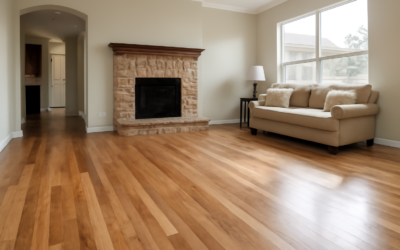
Plano sits in a climate zone that punishes the wrong hardwood choices — hot summers, mild winters, and indoor humidity swings that move from 30 percent in February to 60 percent in August. Picking hardwood flooring Plano homeowners can live with for 20+ years means selecting species and installation methods built for the region. After consulting on installs across Collin County for more than a decade, I can tell you the mistakes are predictable and the wins are equally predictable when buyers know what to look for.
Why North Texas Humidity Matters
Hardwood is a hygroscopic material — it absorbs moisture from the air and releases it as conditions change. The expansion and contraction across seasons in Plano runs higher than in Dallas proper because of the slab foundations and the ventilation patterns of newer subdivisions. Boards that fit perfectly in winter can cup or gap by mid-summer if the species and install method are wrong.
Acclimation is non-negotiable. Quality installers leave flooring in the home for 5 to 14 days before installation, with the HVAC running at normal occupied settings. Skipping this step is the single biggest reason wood floors fail in North Texas. Ask any quote from any company whether they acclimate; the answer tells you everything.
Best Species for Plano Homes
Some woods handle North Texas conditions better than others. Janka hardness tells you the durability; dimensional stability tells you how the wood handles humidity swings.
- White oak — Janka 1,360, excellent stability, accepts stain beautifully, $8 to $14 per square foot installed
- Red oak — Janka 1,290, classic look, pinker undertone, $7 to $12 per square foot installed
- Hickory — Janka 1,820, harder than oak, dramatic grain, $9 to $15 per square foot installed
- Maple — Janka 1,450, lighter color but less stable in humidity swings, $8 to $13 per square foot installed
- Engineered hardwood — multi-layer construction with hardwood veneer, more stable on slabs, $6 to $12 per square foot installed
For Plano slab foundations, engineered hardwood often outperforms solid wood. The plywood core resists the moisture transmission through concrete that solid wood cannot.
Solid Versus Engineered on Slabs
Most Plano homes built after 1985 sit on concrete slabs rather than crawl spaces. Solid hardwood was never designed for direct slab installation. It needs to be nailed to a wood subfloor, which means adding a layer of plywood or sleeper system on top of the slab — adding $3 to $6 per square foot and 3/4 inch of height that interferes with door clearances.
Engineered hardwood glues directly to a properly prepared slab. The cross-ply construction resists cupping and gapping much better than solid wood ever could on the same substrate. For two-story homes with slab first floors and wood subfloor upstairs, run engineered downstairs and solid wood upstairs if budget allows.
Finish Options That Last
The factory finish on prefinished boards almost always outperforms site-finished urethanes in residential settings. Aluminum oxide coatings rated for 25-year warranties run on most quality prefinished hardwood. Site-finished water-based polys peak at 7 to 10 years before needing recoating.
The trade-off is repair. Site-finished floors can be screened and recoated in place every decade. Prefinished floors with beveled edges trap dirt in the grooves and cannot be refinished without sanding off the bevel. Wire-brushed and hand-scraped textures hide the beveled edges visually but still have the same maintenance limitation.
Costs You Should Expect
Total installed costs for hardwood in Plano have climbed steadily since 2020. Plan on these ranges for quality work from licensed installers.
- Mid-grade engineered oak, glue-down on slab: $7 to $11 per square foot installed
- Site-finished solid oak over plywood subfloor: $11 to $16 per square foot installed
- Premium wide-plank engineered (7+ inch) European oak: $12 to $20 per square foot installed
- Exotic species like Brazilian cherry or teak: $14 to $25 per square foot installed
Subfloor prep adds $2 to $5 per square foot if the slab needs grinding, leveling compound, or moisture barrier. Get any quote in writing with subfloor work spelled out separately.
Finding the Right Installer
Plano has dozens of flooring stores, but installation quality varies wildly. The right questions to ask any contractor before signing.
- Are you an NWFA Certified Installer? (National Wood Flooring Association)
- Will you provide a moisture meter reading of the slab before install?
- Do you acclimate the flooring on-site, and for how long?
- What is your written warranty on labor versus material?
- Can you share contact info for three local jobs completed over a year ago?
The last question is the most important. Any installer can show photos of fresh installs. The real test is what those floors look like 12 to 24 months later, after they have been through a full North Texas humidity cycle.
HVAC Setup for Wood Floor Longevity
Your floor’s lifespan depends as much on your HVAC system as on the wood itself. Plano homes need indoor relative humidity held between 35 and 55 percent year-round. Below 30 percent, boards shrink and gap. Above 60 percent, boards cup and crown.
A whole-house humidifier on the furnace adds humidity in winter; a properly sized AC handles summer humidity. Smart thermostats like the Honeywell T9 or Ecobee Premium read indoor humidity and adjust cycles. Spending $400 on a whole-house humidifier protects a $20,000 floor.
Mistakes to Avoid
The classic Plano hardwood failures repeat across new and existing homes. Installing solid wood on a slab without proper subfloor prep. Skipping the moisture meter reading before installation. Choosing dark stains that show every speck of dust and every fingernail scratch. Picking ultra-wide planks (8 inches or wider) in solid wood, where dimensional change is severe.
The smartest hardwood flooring Plano homeowners install is mid-grade engineered oak in a 5 to 7 inch plank, glued to a properly prepared slab, with a wire-brushed natural or light stain finish. That combination handles humidity, hides minor wear, refinishes if needed, and resells well when the time comes.
Prefer to explore on your own?
See how new flooring looks in your actual room in seconds — free, no signup.
Try the free Floor Studio →