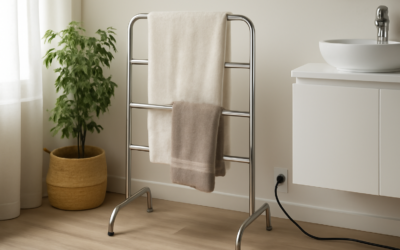
Stepping out of the shower into a warm towel sounds like a hotel-only luxury, but it costs less to add to a home bath than most people expect. Heated towel racks start around $180 plug-in and top out near $1,500 for hardwired hydronic models. Operating cost runs $2 to $8 per month for typical use. The choice that matters most is electric versus hydronic, and whether you want it hardwired or plugged in.
This guide covers what each style does, real wattage and operating costs, top brands worth buying, and where most installs go wrong.
Electric vs Hydronic Towel Warmers
Electric models contain a sealed reservoir of fluid (usually mineral oil or glycol) that heats via an internal element. They install anywhere there is access to power. Plug-in versions need a dedicated GFCI outlet within reach; hardwired versions get spliced into a switch leg by an electrician.
Hydronic models tap into your home’s hot water heating system (forced hot water boiler) and act like a small radiator. They are more efficient if your boiler is already running, but installation requires plumbing the supply and return lines into existing baseboard or radiator runs. Costs $400 to $1,200 in plumbing labor alone.
For 95 percent of American homes — which use forced air heat, not boilers — electric is the only practical choice.
Plug-in vs Hardwired
Plug-in models cost $180 to $500 and install with a screwdriver. The cord drops down to a wall outlet, which must be a GFCI per code. The downside is the visible cord, which most homeowners find unattractive.
Hardwired models cost $300 to $1,500 and need an electrician to splice power from a nearby junction box, usually on the back of the bathroom vanity wall. Add $200 to $400 in labor. Worth it for the clean look.
Top Brands Worth Considering
Amba
The market leader in mid-range electric towel warmers. The Amba Sirio S29 (a 6-bar model 24 inches wide) runs about $385 plug-in. Quality stainless steel construction, 3 different finishes, and a 10-year warranty. Most models can be ordered in either plug-in or hardwired versions for the same price.
Mr. Steam
A step up in finish quality and styling. The Mr. Steam Metro Electric model at $1,100 has a sleek modern look and built-in timer. Best paired with their steam shower products for high-end bathrooms.
Vevor
The budget choice on Amazon. Vevor 8-bar plug-in models run $130 to $200. Build quality is noticeably lighter than Amba, and warranties are short (1 year), but for a guest bath or rental unit they work fine.
Runtal
European maker known for hydronic radiators. Their electric towel warmers run $700 to $2,000. Beautifully made and built to last 25 years. The pick for forever-home installs.
Warmly Yours
Specializes in radiant floor and bath comfort products. Their Sierra and Riviera electric towel warmers ($350 to $750) have built-in programmable timers, which Amba’s basic models lack.
Sizing for Your Bath
Bar count and width determine how many towels you can hang and dry at once:
- 4 to 6 bars, 18 to 24 inches wide — Half bath or guest bath. Holds two to three hand towels or one bath towel
- 8 to 10 bars, 24 to 30 inches wide — Standard family bath. Holds two bath towels plus a hand towel
- 12 to 16 bars, 30 to 36 inches wide — Master bath. Holds two bath towels plus two hand towels with airflow between
- Floor-mount tall styles — 60 to 78 inches tall, dramatic visual, holds a robe plus towels
For a household of two, an 8-bar wall mount handles daily use. Larger families need 12-bar or two units in a shared bath.
Wattage and Operating Cost
Most residential towel warmers draw 100 to 200 watts. At an average US electricity rate of $0.16 per kWh, running an 150-watt unit 6 hours a day costs about $4.30 per month. Even left on 24/7 it runs about $17 per month, but most homeowners use timers to limit operation to morning and evening hours.
The Amba ATW-T4 plug-in timer ($45) lets you set on/off cycles for any non-timer-equipped model. Worth the small cost since it cuts operating expense by 60 to 70 percent.
Installation Steps
- Choose mounting location with at least 4 inches of clearance from the floor and 6 inches from any other heat source
- Locate studs with a magnetic stud finder — never rely on drywall anchors alone for towel warmers since the unit fully loaded with wet towels can hit 25 pounds
- Mark all four mounting points using the template that ships with the unit
- Drill pilot holes for lag screws or use the included toggle bolts if studs are not in the right spot
- Mount the unit, level, and torque mounting hardware fully
- For plug-in: route cord behind the unit if possible and plug into GFCI outlet
- For hardwired: have an electrician run a switched 15-amp circuit from a nearby junction box
Heat tolerance: never mount above a tub or shower where the unit could be splashed during use. Code requires 18 inches of horizontal clearance from any tub or shower zone for electrical fixtures.
Where Heated Towel Racks Earn Their Money
- Drying towels between uses, which dramatically extends time between launderings
- Eliminating mildew smell from towels left damp on hooks
- Adding 2 to 3 degrees of localized warmth in cold bathrooms
- Drying delicates and small laundry items overnight
- Warming towels for a luxury feel post-shower
Common Buying Mistakes
- Buying a smaller unit than needed and ending up with one always-wet towel hung on a 4-bar warmer
- Skipping the timer and paying $15 a month for 24/7 operation
- Installing too low — units mounted at sink height waste 18 inches of usable wall space
- Choosing a cheap stamped-aluminum unit that warps after a year of thermal cycling
- Putting a plug-in unit where the cord shows in every photograph
Style and Finish Choices
Polished chrome and brushed nickel are the safe long-term picks that match most plumbing fixtures. Matte black has been trending for five years and pairs well with modern bathrooms. Brushed brass and gold finishes look premium but make sure your faucet, mirror frame, and pulls are also brass — mismatched metals look like an afterthought.
Stainless steel construction outperforms chromed steel over 10 years. The chrome plating on cheaper units can lift in spots where towels rub repeatedly.
Realistic Total Cost
Budget setup: $180 plug-in Vevor unit, no installer needed. Total $180.
Mid-range: $385 Amba 6-bar with timer, $250 electrician for hardwired install. Total $635.
Premium: $900 Runtal hardwired unit, $400 electrician with neat finish work. Total $1,300.
For most homeowners the mid-range option hits the sweet spot — a quality unit with clean install that lasts a decade-plus and runs at coffee-shop prices for monthly electricity.