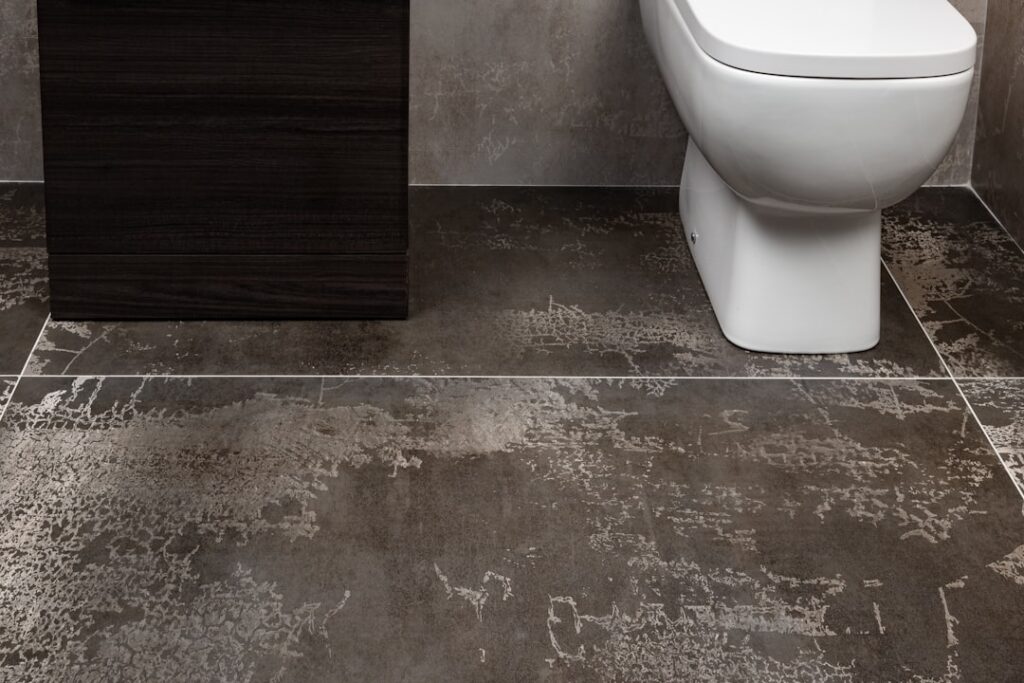
A patient bathroom in a healthcare facility is one of the toughest flooring environments in any building. Wheelchair tires drag grit. Cleaning crews mop with bleach solutions twice a shift. Water pools at toilets and shower thresholds for hours. Slip-and-fall liability hangs over every spec decision. Hospital bathroom flooring has to balance DCOF slip ratings, bacterial resistance, seamless installation to eliminate joint contamination, and durability under chemical cleaners. The wrong spec puts patients at risk and the facility at legal exposure. Get it right and the floor outlasts three flooring cycles in a residential bathroom.
Part of our Bathroom Remodeling & Flooring guide — explore the full guide →
The Code Requirements You Cannot Ignore
The Joint Commission, OSHA, and most state health codes converge on three non-negotiable requirements. First, the floor surface must be impervious to liquid penetration — that means seamless or heat-welded seams, no grout lines that absorb. Second, the DCOF AcuTest result must be 0.42 or higher for wet conditions (ANSI A326.3). Third, the flooring must resist the chemical cleaners used in healthcare — quaternary ammonium, sodium hypochlorite at 1:10 dilution, hydrogen peroxide.
FGI Guidelines for healthcare construction add cove base requirements: the floor must turn up 4 to 6 inches at the wall, heat-welded or formed integral, to eliminate the floor-wall joint as a bacterial harborage. This single detail eliminates most tile options unless paired with a separate sealed cove base system.
Sheet Vinyl: The Industry Default
Heterogeneous sheet vinyl from Armstrong, Tarkett, Mannington Commercial, and Forbo dominates hospital bathrooms for good reason. Rolls come 6.5 feet wide, install with full-spread adhesive, and seams heat-weld with a hot-air gun and matching rod to create a continuous waterproof surface. Cove base of the same material flashes up the wall and welds at the corner.
Cost runs $4 to $8 per sq ft material, plus $3 to $6 per sq ft installed labor. Wear layers range from 20 mil on standard healthcare grade to 40 mil on heavy commercial. The 28-mil tier is the smart minimum for inpatient bathrooms.
Top SKUs to know: Armstrong Medintech and Medintone, Tarkett iQ Granit and Optima, Mannington BioSpec MD, Forbo Marmoleum Sport (linoleum-based but specified similarly). All carry DCOF ratings above 0.42 and are tested against the major healthcare disinfectants.
Epoxy and Polyurethane Resin Systems
Poured resin floors deliver true seamless installation and are popular in operating rooms and procedure spaces. For bathrooms, they show up in higher-end builds. Stonhard, Sika, and Dur-A-Flex sell methyl methacrylate (MMA) and epoxy systems with quartz or aluminum oxide aggregate broadcast into the wet film for slip resistance.
Installed cost runs $10 to $18 per sq ft, with substantial subfloor prep required. Concrete must be shot-blasted to a CSP-3 to CSP-4 profile, moisture-tested per ASTM F1869 (max 3 lbs per 1,000 sq ft per 24 hours), and primed before broadcast. Done right, the floor outlasts 25 years of heavy use.
The trade-off: any cracks in the substrate telegraph through. Resin floors are unforgiving on structural movement. They also yellow under UV exposure unless topped with a polyurethane UV coat.
Porcelain Tile with Epoxy Grout
Where design teams want a more traditional finish, large-format porcelain tile (24 inches by 24 inches or 12 by 24) with 100 percent solids epoxy grout is acceptable in many jurisdictions for non-isolation bathrooms. The DCOF wet rating must be 0.42 minimum — look for tiles tested per ANSI A326.3 with explicit healthcare ratings, like Daltile’s Volcanic series or Crossville’s Empire.
The catch is the cove. Most porcelain manufacturers offer pre-formed sanitary cove pieces that turn up the wall 4 inches with a radiused inside corner. These run $15 to $25 per linear foot before install. Skip the cove and you violate FGI Guidelines.
Installed cost lands at $12 to $20 per sq ft including epoxy grout and cove base. Maintenance is higher than vinyl because epoxy grout, while waterproof, is not stain-proof under iodine and povidone.
Rubber Sheet Flooring
Nora Systems (now Interface) and Roppe make heterogeneous rubber sheet specifically for healthcare. Rubber offers superior underfoot comfort for staff who stand 8 to 12 hours a shift, has excellent acoustic properties, and tests at DCOF above 0.45 wet. Installed cost is $9 to $14 per sq ft.
Limitation: rubber stains badly under iodine and some chlorhexidine cleaners. For bathrooms with high antiseptic exposure, vinyl wins on appearance retention.
What to Specify in Your RFP
- DCOF wet rating 0.42 minimum per ANSI A326.3
- Heat-welded seams or fully poured seamless installation
- Integral or self-welded cove base, 4 to 6 inches up the wall
- Wear layer 28 mil minimum for sheet vinyl
- Resistance documentation for sodium hypochlorite 1:10, quaternary ammonium, hydrogen peroxide
- FloorScore certification for VOC compliance
- Antimicrobial additive (silver ion or similar) for high-risk units
Installation Reality
Hospital bathroom flooring installs after walls are framed, plumbing rough-in is complete and tested, and the substrate has cured a minimum of 60 days for new concrete. Concrete moisture must be tested per ASTM F2170 (RH probe) with 75 percent maximum, or F1869 (calcium chloride) with 3 lbs per 1,000 sq ft per 24 hours.
Install during off-hours or in a fully isolated unit because the adhesives and heat-welding produce odors that cannot enter occupied patient spaces. Allow 24 to 72 hours cure before the bathroom returns to service, depending on adhesive type.
Lifecycle and ROI
Heterogeneous sheet vinyl in a hospital bathroom lasts 15 to 20 years before replacement. Resin systems run 20 to 30 years. Porcelain with epoxy grout lasts the life of the building if installed correctly. Calculate cost per year over expected lifespan rather than upfront cost, and the higher-tier products usually win.
Bottom Line
Hospital bathroom flooring is a technical spec, not a design choice. Lead with code compliance (DCOF, seamless, cove base), select from products with documented healthcare-cleaner resistance, and install with concrete moisture testing complete before adhesive touches the substrate. Heterogeneous sheet vinyl remains the workhorse for good reason — it ticks every requirement at the lowest installed cost per useful year.
Prefer to explore on your own?
See how new flooring looks in your actual room in seconds — free, no signup.
Try the free Floor Studio →