
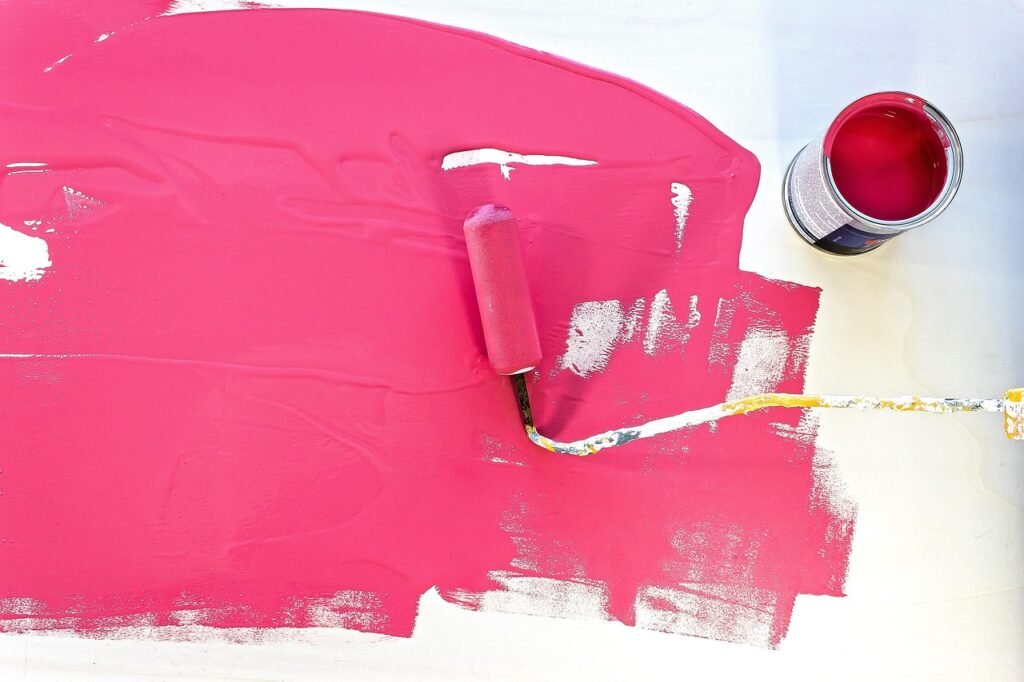
Buying too little paint forces a midnight Home Depot run and risks dye-lot mismatches. Buying too much wastes $40 per leftover gallon and clutters your garage with cans that will fail their tinted shelf life within five years. The math for how many cans of paint for a room is simple once you know the four numbers: wall square footage, primer needs, paint coverage rate per gallon, and number of coats. This guide walks through the calculations with real-world examples.
Part of our Paint & Walls guide — explore the full guide →
Measure Wall Square Footage Accurately
Add the length of every wall in the room and multiply by the ceiling height. A 12 by 14-foot bedroom with 8-foot ceilings has (12+14+12+14) x 8 = 416 sq ft of wall area. Subtract 21 sq ft per standard door and 15 sq ft per average window — most rooms have one door and two windows, dropping the paintable area to roughly 365 sq ft.
For ceilings, multiply length by width. The 12×14 room has a 168 sq ft ceiling. Ceilings need separate paint (usually flat ceiling white) and a separate calculation. Closets count toward total wall area if you plan to paint them — small closets often add 60 to 120 sq ft.
Standard Paint Coverage Rates
One gallon of paint covers 350 to 400 sq ft per coat on smooth drywall. Heavily textured walls (orange peel, knockdown, or popcorn) drop coverage to 250 to 300 sq ft per gallon. Manufacturer claims of “up to 400 sq ft per gallon” assume one coat on previously painted similar-colored walls — not your actual situation.
Coverage rates by product:
- Benjamin Moore Regal Select: 400 to 450 sq ft per gallon
- Sherwin-Williams Emerald: 350 to 400 sq ft per gallon
- Behr Marquee: 250 to 400 sq ft per gallon (varies by claim)
- Valspar Reserve: 350 to 400 sq ft per gallon
- Builder-grade flat: 300 to 350 sq ft per gallon
The Two-Coat Rule
Almost every paint job requires two finish coats — even when manufacturers market “one-coat coverage.” The exception is when you are painting the same color over the same color on properly prepped walls. Color changes, walls with marks or repairs, and any surface previously painted with a contrasting color all need two coats minimum.
For our 365 sq ft bedroom example with smooth walls and a color change, you need 365 sq ft x 2 coats = 730 sq ft of coverage. At 400 sq ft per gallon, that is 1.83 gallons. Round up to 2 gallons. Add 5% to 10% extra for cutting in, touch-ups, and waste — most painters buy 2 gallons and accept the small leftover.
When You Also Need Primer
Skip primer only when painting over a similar color on properly prepared walls. Use primer in these situations:
- New drywall (uses tinted PVA primer at $25 to $40 per gallon)
- Painting over dark colors with light colors
- Painting over stains, smoke damage, or water marks
- Switching from oil-based to latex paint
- Glossy surfaces (cabinets, trim) — use Zinsser Smart Prime or BIN shellac
A gallon of primer covers about the same area as paint — 350 to 400 sq ft. Tinting primer 50% toward your finish color cuts the need for a third paint coat. Most paint stores tint primer for free.
Trim, Doors, and Ceiling Math
Trim paint is calculated separately because the coverage rate differs. One gallon of trim paint covers roughly 700 to 900 linear feet of standard 3.5-inch baseboard or 4.5-inch door casing — about 200 linear feet per door’s worth of trim.
A typical 12×14 bedroom has roughly 52 linear feet of baseboard and one full door surround. That works out to less than 1 gallon of trim paint. Buy a single gallon of Benjamin Moore Advance or Sherwin-Williams ProClassic for trim — both deliver a hard, durable finish on baseboards, doors, and window casings.
Ceilings need 1 gallon of flat ceiling white per 350 to 400 sq ft. The 12×14 example needs less than half a gallon, but a full gallon is the minimum purchase. Save leftover ceiling paint for the next room.
Worked Example: A 10×12 Bedroom
Walls: (10+12+10+12) x 8 = 352 sq ft. Subtract one door (21 sq ft) and one window (15 sq ft) for 316 sq ft of paintable wall.
Two coats: 316 x 2 = 632 sq ft. Divided by 400 sq ft per gallon = 1.58 gallons. Round up to 2 gallons of wall paint.
Ceiling: 10 x 12 = 120 sq ft. One gallon covers this easily — buy 1 gallon of ceiling paint.
Trim: roughly 44 linear feet of baseboard plus door and window casings. Buy 1 quart of trim paint ($18 to $25), or 1 gallon if you have additional rooms to paint.
Total: 2 gallons wall paint + 1 gallon ceiling + 1 quart trim. Add primer (1 gallon) if walls need it.
Worked Example: A 16×18 Great Room
Walls: (16+18+16+18) x 9 ceilings = 612 sq ft. Subtract two doors and three windows for roughly 567 sq ft of paintable wall.
Two coats: 567 x 2 = 1,134 sq ft. Divided by 400 sq ft per gallon = 2.84 gallons. Buy 3 gallons or a single 5-gallon bucket (more cost-effective per gallon at $130 to $200).
Ceiling: 16 x 18 = 288 sq ft. One gallon covers this. Trim: roughly 68 linear feet of baseboard plus three windows and two door surrounds — needs 1 quart to 1 gallon.
The Buffer You Should Always Buy
Order 5% to 10% more paint than your calculation indicates. Reasons include cutting-in losses around windows and doors, paint absorbed into the roller cover, drips and spills, and the inevitable need to touch up after furniture goes back in. Leftover paint stored properly (full can, sealed, in a temperature-stable space) lasts 2 to 5 years for touch-ups.
Always buy from the same dye lot when possible — multiple gallons mixed at the same time will not show subtle color variation that two separate purchases sometimes show. The number on the lid of every can is the mix code. Match those numbers and you avoid every painter’s nightmare of buying one more gallon at the end of the job that prints slightly different on the wall.


