Carpet is still the cheapest way to make a bedroom feel warm and quiet, but the sticker price on a roll only tells part of the story. How much does it cost to lay carpet once you add padding, labor, and hauling away the old stuff? For most homes you are looking at $3.50 to $11 per square foot installed, and where you land depends almost entirely on the carpet grade you pick.
I have priced hundreds of these jobs, and homeowners consistently underestimate the extras. The carpet itself is often less than half the total. Let me walk through every line item so your estimate matches what actually shows up on the invoice.
- Carpet Material Cost Per Square Foot
- Padding: The Layer You Should Not Cheap Out On
- Labor Costs to Install Carpet
- Old Carpet Removal and Disposal
- Real Room-Size Price Examples
- Hidden Costs and Ways to Save
- How Carpet Fiber Affects the Price
- Cut Pile vs. Loop Pile and Why It Matters
- Stairs and Odd Spaces Cost More
- The Bottom Line on Carpet Installation Cost
Carpet Material Cost Per Square Foot
Carpet material ranges widely by fiber, density, and style. Builder-grade polyester starts around $1 to $2 per square foot. Mid-range nylon or triexta in a plush or textured style runs $2.50 to $5. Wool, high-density frieze, and premium patterned carpets climb to $6 to $12 per square foot and beyond.
- Budget polyester: $1 to $2 per sq ft, fine for low-traffic guest rooms.
- Mid-grade nylon/triexta: $2.50 to $5 per sq ft, the sweet spot for families and pets.
- Premium wool/designer: $6 to $12+ per sq ft.
Remember carpet is sold in 12-foot-wide rolls, so most rooms generate waste and seams. Expect to pay for 5 to 15 percent more square footage than the room’s raw measurement to account for cutting and matching pile direction.
Padding: The Layer You Should Not Cheap Out On
Padding, or cushion, adds $0.30 to $1.20 per square foot. It is tempting to grab the thinnest option to save money, but the pad is what makes carpet feel good and what protects the fibers from crushing under foot traffic. Skimp here and even a nice carpet will feel flat and wear out years early.
For bedrooms, a 7 to 8 pound, 7/16-inch rebond pad is the standard. For stairs and high-traffic hallways, go denser at 8 pounds with a firmer feel so the carpet does not stretch and buckle. Some warranties actually require a minimum pad spec, so check before you buy.
Labor Costs to Install Carpet
Professional installation typically runs $0.50 to $2 per square foot, with $1 being a common average. Labor covers stretching the carpet over tack strips, seaming, trimming at walls, and finishing transitions at doorways. Stairs are billed separately because they are slow and fiddly, usually $5 to $12 per step depending on whether they are boxed or open-sided.
Some retailers advertise free installation, but that price is baked into an inflated material cost, so compare the all-in total rather than any single line. Independent installers often beat big-box pricing if you supply your own carpet, but you take on the coordination.
Old Carpet Removal and Disposal
Tearing out and hauling away old carpet and pad adds $0.25 to $1 per square foot, or a flat $50 to $150 per room. If your installer finds damaged subfloor, squeaky boards, or old staples that need pulling, that is extra labor. Many crews will roll removal into the quote if you ask, so get it in writing.
You can save that fee by ripping out the old carpet yourself the day before. It is dusty, sweaty work, but it is not complicated: cut the carpet into 3-foot strips, roll and tape them, pull the pad, and pry the old tack strips only if they are damaged. Just confirm your municipality will take bagged carpet at the curb or whether you need a dump run.
Real Room-Size Price Examples
Numbers make this concrete. Here is what typical rooms cost fully installed with mid-grade nylon carpet, 8-pound pad, labor, and removal at roughly $6 per square foot all in.
- 10×12 bedroom (120 sq ft): about $720 to $850.
- 12×12 bedroom (144 sq ft): about $870 to $1,000.
- 15×20 living room (300 sq ft): about $1,800 to $2,300.
- Full staircase of 13 steps: add $130 to $250 in step labor.
Drop to builder-grade polyester and those totals fall roughly 30 percent. Jump to wool or a designer pattern and they can double. A whole 2,000 sq ft home in mid-grade carpet generally lands between $8,000 and $16,000 installed.
Hidden Costs and Ways to Save
Watch for furniture moving fees, which some crews charge if you leave rooms full. Move what you can yourself and disassemble bed frames ahead of time. Transitions, metal edging strips at tile or wood doorways, and custom seaming in oddly shaped rooms can each add a modest line item.
To trim the bill without hurting quality, buy remnants or roll ends for closets and small bedrooms, schedule during a retailer’s seasonal sale, and negotiate the all-in price rather than haggling line by line. Never downgrade the pad to save fifty dollars, though. The cushion is cheap insurance for a carpet that has to survive a decade of foot traffic.
How Carpet Fiber Affects the Price
The fiber you choose is the single biggest lever on cost and performance, so it pays to understand the four main types. Polyester is the cheapest, stain-resistant out of the box, and soft, but it crushes and mats under traffic, making it best for bedrooms and low-use rooms. Nylon is the durability champion, springing back from foot traffic and lasting a decade or more, which is why it costs more per square foot.
Triexta, sold under names like SmartStrand, resists stains at the fiber level and holds up well with pets and kids, landing in the mid-price tier. Wool sits at the top, natural and luxurious with excellent resilience and flame resistance, but at a premium price and with more careful cleaning requirements.
- Polyester: cheapest, soft, stain-resistant, crushes over time.
- Nylon: most durable synthetic, best for traffic, mid-to-high cost.
- Triexta: pet-friendly, stain-resistant, mid cost.
- Wool: premium, resilient, natural, highest cost.
Cut Pile vs. Loop Pile and Why It Matters
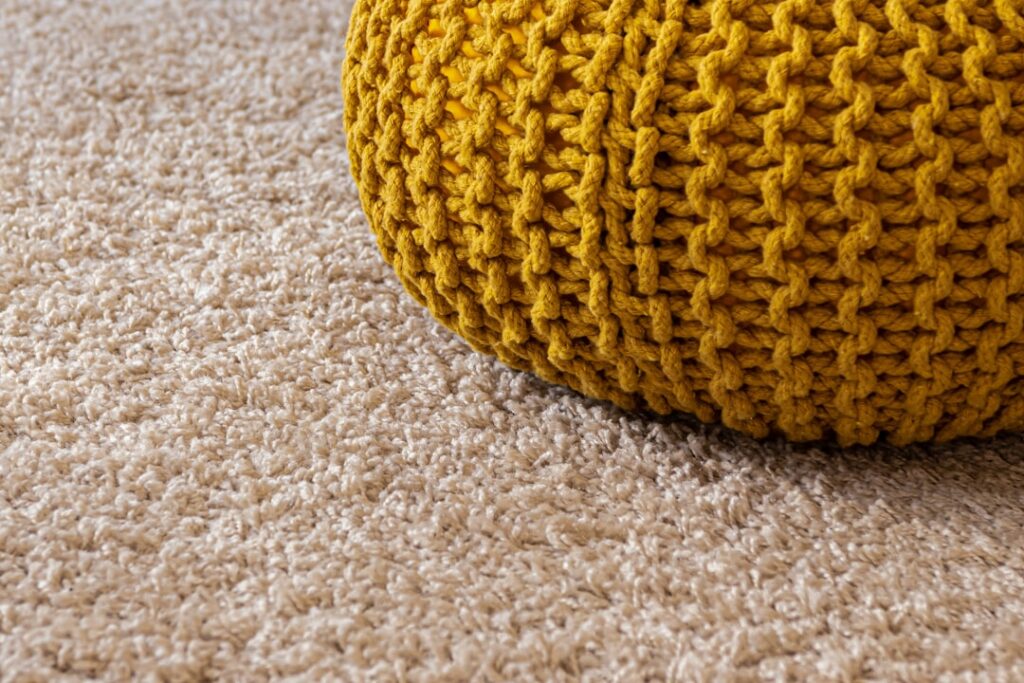
Beyond fiber, the way the carpet is constructed changes both price and how it wears. Cut-pile styles like plush, saxony, and frieze feel soft underfoot, while loop styles like Berber and level-loop are tough and hide dirt but can snag. A denser carpet with more fiber packed into each square inch costs more, but density is the best predictor of how long a carpet lasts.
When you shop, bend a sample backward. If you can easily see the backing through the fibers, the carpet is thin and will wear fast. A dense carpet resists that gap. Paying a bit more per square foot for higher density often saves money over the life of the floor because you replace it far less often, which is exactly why the cheapest carpet is rarely the best value.
Stairs and Odd Spaces Cost More
Flat, rectangular rooms are the cheapest to carpet because they install fast with minimal cuts. Stairs, on the other hand, are slow, precise work and are priced per step at $5 to $12, or more for open-sided staircases where the carpet wraps around the exposed edge. A single flight can add $150 to $400 to a job.
Closets, bay windows, and rooms with many corners also raise the price because each cut and seam takes time and generates waste. Landings, hallways with turns, and split-level transitions all add labor. When you gather quotes, point out these features so the estimate reflects the real complexity rather than a simple square-foot number that will balloon once the crew sees the space.
The Bottom Line on Carpet Installation Cost
For a realistic budget, plan on $5 to $8 per square foot installed for a good mid-grade carpet with proper padding, labor, and old-carpet removal. That puts a single bedroom under a thousand dollars and a large living room in the low thousands. Get at least three itemized quotes, make sure each includes pad weight, removal, and stairs, and you will avoid the surprise upcharges that turn a simple carpet job into a budget headache.