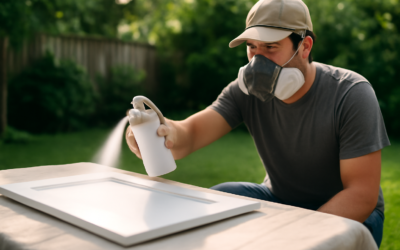
The number printed on a spray can is one of the most misleading figures in the paint aisle. If you are wondering how much paint is in a can of spray paint, the label might say 12 ounces, but that weight includes propellant and solvent, and only a fraction of it ends up as dried paint on your project. Much of what does leave the nozzle drifts past the edges and never lands at all.
Part of our Paint & Walls guide — explore the full guide →
In practical terms, a typical 12-ounce aerosol can covers about 15 to 25 square feet per coat, depending on the surface, the color, and your technique. Many labels claim up to 25 square feet, and you will hit that only on smooth, flat, primed surfaces with a steady hand. Textured, porous, or intricate pieces such as spindle chairs and wicker can drop real-world coverage closer to 10 to 15 square feet per can.
- How Much Paint Is in a Can of Spray Paint, Really?
- What Affects Spray Paint Coverage
- How Many Cans for Common Projects
- When a Paint Sprayer Makes More Sense
- Tools and Materials
- Step-by-Step: Getting the Most Coverage From Each Can
- Safety: Ventilation, Respirators, and Fire Risk
- Troubleshooting Coverage Problems
- Cost Ranges
- When to Call a Pro
- Frequently Asked Questions
Knowing that range, you can estimate how many cans a project needs and decide when a different tool makes more sense. The numbers for common projects, plus ways to stretch every can, are laid out in the sections that follow.
How Much Paint Is in a Can of Spray Paint, Really?
Aerosol cans list contents as net weight, not fluid volume. A can marked “Net Wt 12 oz” holds 12 ounces of combined material: pigment, binder (the resin that forms the film), solvents that keep it liquid, and a liquefied gas propellant that pushes it out. Propellant and solvent together often make up well over half the weight, and both evaporate within seconds of spraying.
The part that stays behind is called solids. Spray paints generally contain a lower percentage of solids than brush-on paint, which is why a single aerosol coat is thinner than a brushed coat. A rough way to think about it: a 12-ounce can delivers somewhere in the range of a few fluid ounces of actual paint film material. That is why one quart of brush-on paint, at roughly 32 fluid ounces of mostly paint, covers around 85 to 100 square feet, while a single aerosol can covers a fraction of that.
Can sizes vary, too. Small craft cans may hold 3 to 6 ounces. Standard hardware-store cans range from about 10 to 12 ounces. Larger “professional” or high-output cans can reach 15 to 20 ounces, though some of those use more propellant to push a wider fan pattern rather than holding proportionally more paint.
What Affects Spray Paint Coverage
Transfer Efficiency
Transfer efficiency is the share of sprayed paint that actually lands on the surface. Aerosol cans have low transfer efficiency because the spray is fine and the fan is wide. On a narrow object such as a chair leg, most of the spray passes right by. On a flat panel, more of it lands. Expect 30 to 50 percent of the paint to land on a flat panel, and much less on spindles or wire.
Surface Texture and Porosity
Raw wood, unsealed MDF edges, concrete, and rusty metal soak up the first coat. A coat of primer seals the surface so finish coats go farther and look more even.
Color Change
Covering dark with light, or switching to bright reds and yellows with weak hiding power, often takes three or more coats. Starting with a gray or white primer cuts the number of color coats.
Finish Type
Metallic, hammered, and textured finishes often cover less area per can than standard gloss or satin enamel. Clear coats usually cover similar areas but need multiple thin layers for durability.
How Many Cans for Common Projects
Use these estimates as starting points. They assume a primer coat plus two color coats on a reasonably smooth surface, and they include a margin for overspray.
| Project | Approximate cans (12 oz) | Notes |
|---|---|---|
| Small side table | 2 to 3 | Flat top goes fast; legs eat paint |
| Wood dining chair (spindle back) | 2 to 3 per chair | Spindles waste spray |
| Metal patio chair | 2 to 3 per chair | Add 1 for rusty metal primer |
| Single cabinet door (both sides) | 1 to 1.5 | Plus primer |
| Bathroom vanity cabinet | 4 to 6 | Frame plus doors and drawers |
| Interior slab door (both sides) | 5 to 7 | About 40 sq ft per side |
| Full kitchen cabinet set | Usually 30 or more | A sprayer is the better tool |
The interior door math shows why aerosols get expensive fast. A standard 30 by 80 inch door has about 16.7 square feet per face, plus edges, so roughly 35 square feet for both sides. Two color coats double that to 70 square feet, plus primer brings the total near 105 square feet. At 15 to 20 square feet per can, that is five to seven cans for a single door.
When a Paint Sprayer Makes More Sense
For anything larger than a few small pieces, an HVLP paint sprayer (high volume, low pressure) is usually the smarter buy. HVLP units atomize regular brush-on paint with a gentle airflow, which puts more of the paint on the surface and less in the air. Transfer efficiency is much higher than aerosol, and a quart of paint goes a long way.
A rough break-even: once a project needs more than about eight to ten aerosol cans, the cost of an entry-level HVLP sprayer and a quart or gallon of paint becomes competitive, and the finish is often more durable because you can choose a high-quality cabinet or trim enamel. For one chair or a mailbox, a can of spray paint remains faster and needs no cleanup.
Tools and Materials
- Spray paint and matching primer from the same product line where possible.
- Sandpaper (180 to 220 grit) or a sanding sponge for scuffing glossy surfaces.
- Degreasing cleaner and lint-free rags.
- Painter’s tape and masking paper or plastic.
- Drop cloths and a simple spray booth made from a cardboard box for small parts.
- Nitrile gloves, safety glasses, and a respirator rated for organic vapors per the can label.
- Optional: a snap-on trigger handle, which reduces finger fatigue and improves control.
Step-by-Step: Getting the Most Coverage From Each Can
- Check the weather. Most aerosols perform best between roughly 50 and 90°F with humidity under about 65 percent. Cold cans sputter and spray heavy droplets.
- Warm the can gently if needed. On cool days, set the can in a bucket of warm tap water (not hot) for a few minutes. Never heat a can with a flame, heat gun, or stove, and never let it exceed the temperature on the label.
- Clean and scuff. Remove grease and dirt, then scuff glossy surfaces so the paint can grip.
- Prime first. A primer coat seals porous areas and reduces the number of color coats.
- Shake thoroughly. Shake for a full minute after the mixing ball starts rattling, and shake again every few passes.
- Hold the can 8 to 12 inches away. Too close causes runs; too far wastes paint as dry overspray.
- Use steady, overlapping passes. Start spraying just before the edge of the piece, move across in one smooth stroke, and release just past the far edge. Overlap each pass by about half.
- Apply thin coats. Two or three light coats look better and cover more evenly than one heavy coat. Follow the recoat window on the label.
- Clear the nozzle. When finished, turn the can upside down and spray until only gas comes out. This keeps the nozzle open so you can use the rest of the can later.
Safety: Ventilation, Respirators, and Fire Risk
Spray paint releases solvent vapors and fine paint mist. Work outdoors when possible, or in a space with strong cross ventilation from open doors and a fan blowing air out. Wear a respirator with organic vapor cartridges and a particulate prefilter if the label recommends one, along with gloves and eye protection. A simple dust mask does not stop solvent vapors.
Aerosol cans are pressurized and the contents are extremely flammable. Keep vapors well away from pilot lights, water heaters, furnaces, space heaters, cigarettes, and sparks from tools. Never spray in a closed garage with a gas appliance running. Store cans in a cool, dry place out of direct sun and away from heat sources, and never leave them in a hot car or puncture or burn them. Do not mix different chemical products, and let rags dry flat outdoors before disposal, since solvent-soaked rags can be a fire risk. Dispose of empty and partly full cans according to your local household hazardous waste rules.
Troubleshooting Coverage Problems
Paint runs or sags. The can was too close or the coat too heavy. Let it dry, sand the run smooth, and recoat with lighter passes.
Rough, sandy texture. This is dry spray, caused by holding the can too far away, spraying in heat or wind, or crossing over partly dried paint. Lightly sand and apply a closer, wetter coat.
Wrinkling or lifting. Recoating outside the label’s recoat window can make fresh solvent attack the previous layer. Wait the full cure time, sand, and recoat.
Can quits with paint still inside. The nozzle is clogged or the propellant ran out first. Try a replacement nozzle; if the can still will not spray, the propellant is spent.
Blotchy color. The surface was not primed evenly or the can was not shaken well enough. Apply another light, even coat after shaking for a full minute.
Cost Ranges
Standard spray paint cans usually cost a few dollars to around ten dollars each, while specialty finishes such as metallics, high-heat paints, and premium enamels cost more. Because real coverage is modest, cost per square foot is higher than brush-on paint, often several times higher. Entry-level HVLP sprayers generally run from under a hundred dollars to a couple hundred, which pays off on larger projects. If you hire a painter for cabinets or doors, expect labor to be the main cost, with spray finishing often priced per door or per linear foot of cabinetry.
When to Call a Pro
For a full kitchen of cabinets, a set of interior doors, or any piece with significant sentimental or resale value, a professional finisher is worth considering. Pros use spray booths, catalyzed finishes, and controlled drying conditions that are hard to match with aerosol cans in a driveway. Also bring in a pro if the item may have old paint that could contain lead (common in homes built before 1978), since sanding it requires lead-safe practices.
Frequently Asked Questions
How many square feet does a 12 oz can of spray paint cover?
Plan on about 15 to 25 square feet per coat on a smooth, primed surface. Intricate or textured items can drop real coverage to 10 to 15 square feet.
Is the 12 oz on a spray can fluid ounces?
No. It is net weight, which includes propellant and solvent. The amount of paint film left on the surface is far smaller than 12 fluid ounces.
How many coats of spray paint do I need?
Most projects need a primer coat and two light color coats. Bright or light colors over dark surfaces may need a third.
How many cans of spray paint does a chair take?
A typical wood or metal chair takes about two to three cans including primer. Spindle backs and wire frames use more because so much spray misses.
Is it safe to spray paint indoors?
Only with strong ventilation, a respirator rated for organic vapors, and no open flames or pilot lights nearby. Outdoors in mild, calm weather is the safer choice.