
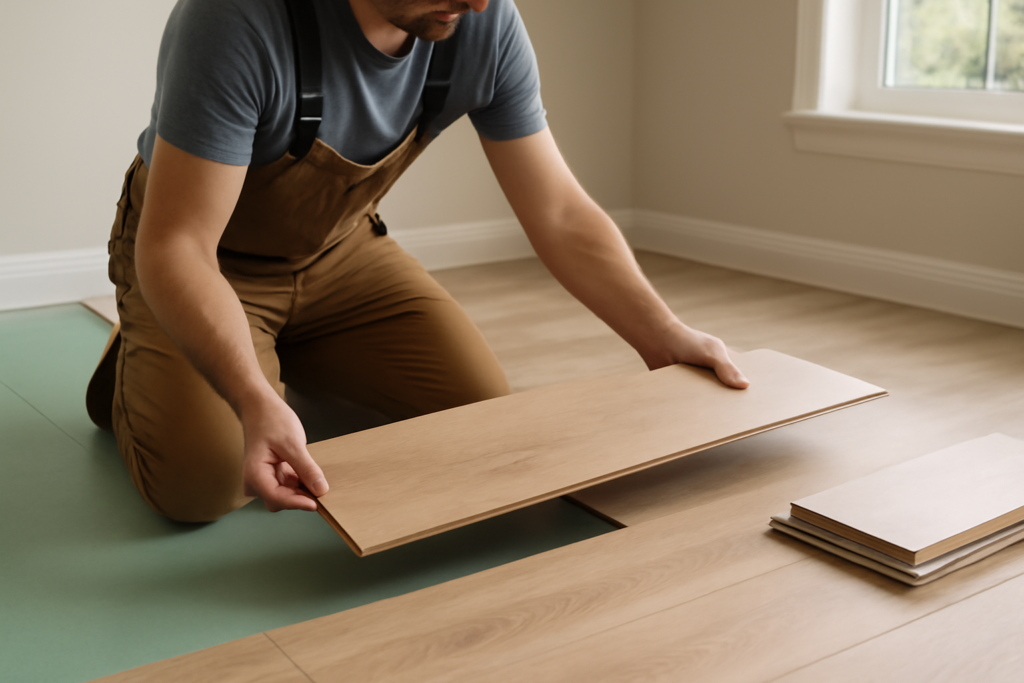
Laminate flooring remains one of the most budget-friendly ways to get a wood look without hardwood prices, but the total bill involves more than the sticker on the box. Understanding how much to lay laminate flooring means accounting for materials, underlayment, labor, and prep, which together typically run between $3 and $8 per square foot installed in the US market. For a 300-square-foot room, that puts most projects in the $900 to $2,400 range, with DIY installation cutting costs significantly.
Breaking Down the Total Cost
The price to lay laminate flooring splits into a few clear categories. Knowing each helps you budget accurately and spot where you can save.
- Laminate planks: Roughly $1 to $4 per square foot depending on quality, thickness, and brand.
- Underlayment: About $0.30 to $0.80 per square foot, sometimes built into the planks.
- Labor: Typically $2 to $5 per square foot if you hire a professional installer.
- Trim, transitions, and supplies: Baseboards, quarter round, transition strips, and adhesive add a few hundred dollars depending on room size.
- Subfloor prep: Leveling, repairs, or old flooring removal can add cost if needed.
Material Costs in Detail
Laminate planks vary widely in price based on quality. Entry-level laminate around $1 to $2 per square foot offers a thinner core and basic wear layer, suitable for low-traffic rooms or rentals. Mid-range laminate at $2 to $3 per square foot brings thicker planks, better water resistance, and more realistic textures. Premium laminate at $3 to $4 per square foot or more features high-density cores, enhanced water resistance, attached underlayment, and authentic embossed-in-register surfaces that align the texture with the printed grain. Thicker planks, generally 10mm to 12mm, feel more solid underfoot and handle minor subfloor imperfections better than 7mm to 8mm budget options.
Labor Costs and What Drives Them
If you hire a pro, labor usually falls between $2 and $5 per square foot, but several factors push the number up or down. Simple rectangular rooms cost less per square foot than spaces with lots of corners, closets, and angles that require extra cutting. Stairs, if included, are charged separately and can be expensive. Removing and disposing of old flooring adds labor. Subfloor leveling or repair increases the bill. Geographic location matters too, since labor rates are higher in major metropolitan areas. Always get itemized quotes so you can compare what each installer includes.
The DIY Savings Opportunity
Laminate is one of the most DIY-friendly floors because most products use a click-lock floating system that requires no nails or glue. Installing it yourself can eliminate the $2 to $5 per square foot labor charge, often cutting the total project cost by 40 to 60 percent. For a 300-square-foot room, that can mean saving $600 to $1,500. The trade-off is your time and the learning curve, plus the cost of tools like a tapping block, pull bar, spacers, and a saw. For motivated homeowners, laminate is an excellent first flooring project.
Additional Costs People Forget
Hidden costs surprise many first-time buyers, so plan for these often-overlooked items:
- Waste overage: Buy 7 to 10 percent extra material for cuts and mistakes, more for diagonal or complex layouts.
- Transition strips: Needed at doorways and where laminate meets other flooring types.
- Baseboard or quarter round: To cover the expansion gap around the room’s perimeter.
- Moisture barrier: Required over concrete subfloors to protect the laminate.
- Tool rental or purchase: If you DIY and do not already own the basics.
- Furniture moving and disposal: Sometimes charged separately by installers.
Pros of Laminate Flooring
Cost aside, laminate offers real advantages. It is highly scratch and dent resistant thanks to its tough wear layer, making it great for busy households with kids and pets. It mimics the look of hardwood, stone, or tile at a fraction of the price. The floating click-lock system makes installation fast and approachable. It is low maintenance, requiring only sweeping and occasional damp mopping. Modern water-resistant laminates even hold up in kitchens and entryways better than older versions ever did.
Cons to Consider
Laminate is not flawless. Standard laminate can swell and delaminate if water seeps into the seams, so it is not ideal for full bathrooms or areas prone to flooding unless you choose a water-resistant product. It cannot be sanded and refinished like real wood, so deep damage means replacing planks. It can sound hollow underfoot without a quality underlayment, and some people find it feels less authentic than hardwood. Knowing these limitations helps you set realistic expectations for the price you pay.
How to Estimate Your Project
To budget your own floor, measure the length and width of each room and multiply for square footage, then add your rooms together. Add 7 to 10 percent for waste. Multiply the total by your chosen plank price, then add underlayment, trim, and transitions. If hiring out, add the labor rate per square foot. For example, a 300-square-foot room with $2.50 planks, $0.50 underlayment, and $3 labor lands around $1,800 plus trim and supplies. Doing it yourself on that same room could bring it closer to $1,000 or less.
Ways to Save Money on Your Project
If your budget is tight, several strategies can lower the total cost without sacrificing a good result. Consider these approaches:
- Install it yourself, which eliminates the single largest expense, the labor charge, and is realistic for click-lock laminate.
- Shop sales and closeouts, since major holiday weekends and discontinued lines often bring quality laminate down to $1 to $2 per square foot.
- Buy attached-underlayment planks, which save you the cost and labor of a separate underlayment layer.
- Prep the subfloor yourself by removing old flooring and cleaning the area before an installer arrives, reducing their billable hours.
- Measure carefully to avoid over-ordering, while still keeping the recommended overage for cuts and repairs.
Even doing part of the work yourself, such as demo and furniture moving, can trim a few hundred dollars from a professional installation.
Is Laminate Worth the Cost?
For most homeowners, laminate delivers strong value relative to its price. Compared to hardwood, which can run $8 to $15 or more per square foot installed, laminate offers a similar wood look at roughly half the cost or less while resisting scratches and dents better. Compared to luxury vinyl plank, laminate is often slightly cheaper but less water resistant. Against tile, laminate is warmer underfoot, faster to install, and easier on a DIY budget. The main trade-off is that laminate cannot be refinished, so its lifespan, typically 15 to 25 years depending on quality and traffic, is finite. Weighing your priorities of budget, durability, moisture exposure, and appearance helps you decide whether laminate is the right investment for your space.
Final Thoughts
How much to lay laminate flooring comes down to the quality of plank you choose, whether you hire a professional, and the condition of your subfloor, with most projects landing between $3 and $8 per square foot installed. Laminate delivers excellent value, durability, and a convincing wood look, and its click-lock design makes it one of the best floors for DIY savings. Budget for the often-forgotten extras like underlayment, transitions, and waste overage so there are no surprises. For more flooring cost guidance and product comparisons, D and G Flooring is here to help you plan your project with confidence.
Prefer to explore on your own?
See how new flooring looks in your actual room in seconds — free, no signup.
Try the free Floor Studio →

