
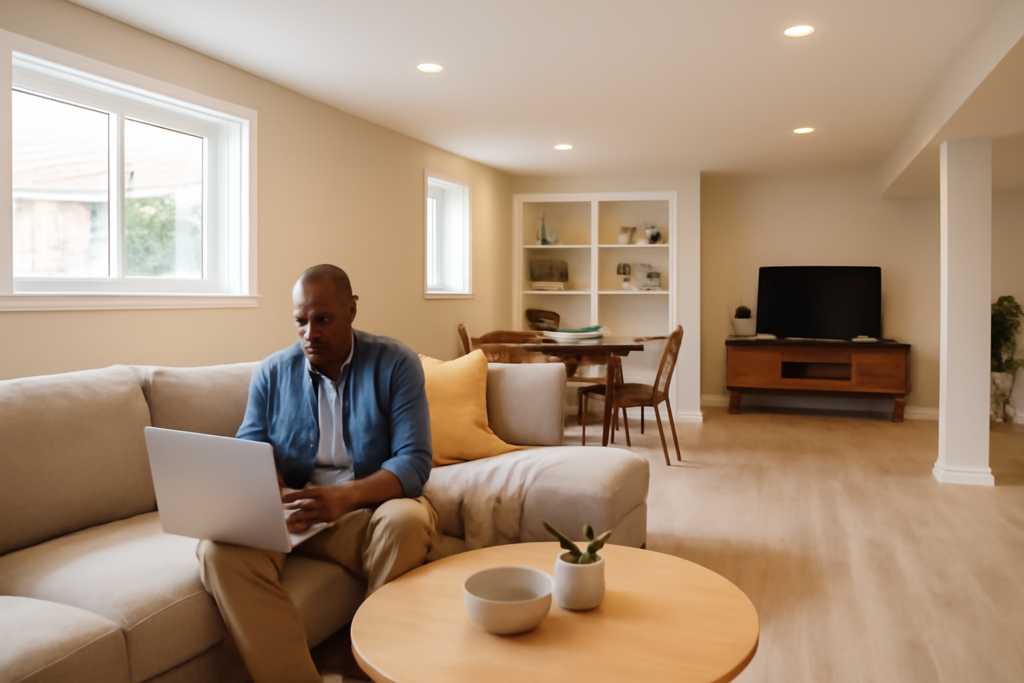
Here is a fact that surprises many homeowners: appraisers usually do not count a finished basement as regular living space, even if it has carpet, a bathroom, and a wet bar. That rule shapes the answer to how much value does finishing a basement add. On a national basis, a basement finish typically returns about 70 to 86 percent of its cost at resale, which is solid for a remodel but rarely a profit. Understanding how appraisers, buyers, and local markets view below-grade space helps you spend where the money comes back.
- How Much Value Does Finishing a Basement Add on Average?
- Why Appraisers Treat Basement Space Differently
- Basement Finishing Cost Per Square Foot
- Upgrades That Return the Most Value
- Flooring Choices and Their Impact on Resale
- Permits, Inspections, and Disclosure
- Finishing a Basement vs. Other Remodels
- Timing and Financing Considerations
- Estimating Your Own Return
How Much Value Does Finishing a Basement Add on Average?
Most cost-versus-value studies place a mid-range basement remodel near the upper tier of interior projects. A typical scenario looks like this: a 1,000-sq-ft basement finished for $50,000 adds roughly $35,000 to $43,000 to the home’s market value. Your return depends heavily on three variables.
- Local market — In regions where most homes have finished lower levels, such as parts of the Midwest and Mid-Atlantic, an unfinished basement can drag down your sale price, so finishing brings you up to par. In markets where basements are rare, buyers may value the space less.
- Quality of work — Permitted, code-compliant finishes appraise better. Unpermitted work can reduce value or complicate a sale.
- Cost control — Buyers pay for usable square footage and function, not luxury finishes. A $120,000 basement in a $300,000 neighborhood will not recover its cost.
Beyond resale, remember the use value. If your family gains a playroom, office, or guest suite you will use for ten years, the lifestyle benefit counts even when the spreadsheet shows a 75 percent return.
Why Appraisers Treat Basement Space Differently
Under ANSI Z765 measurement standards used by many appraisers, finished space that is partially or fully below grade is reported separately from gross living area (GLA). Instead of adding $150 to $250 per sq ft like an above-grade addition might, a finished basement is often valued at roughly 25 to 60 percent of the above-grade price per square foot in the same neighborhood.
Walkout basements are the exception worth noting. When one wall is fully above grade with full-size doors and windows, buyers perceive the level as real living space, and appraisers typically give it more weight through adjustments. A walkout finish can deliver a return near the top of the range or even break even in strong markets.
For a bedroom to count as a bedroom in a listing, it needs an egress window or exterior door meeting code (generally a minimum net opening of 5.7 sq ft, a sill no higher than 44 inches, and a window well with a ladder if deeper than 44 inches), plus a closet in many areas. Adding a legal bedroom is one of the strongest value drivers in a basement project.
Basement Finishing Cost Per Square Foot
To estimate your ROI you first need a realistic cost. Typical 2026 ranges:
| Finish Level | Cost per Sq Ft | 1,000 Sq Ft Total |
|---|---|---|
| Basic (framing, drywall, flooring, lighting) | $25 – $40 | $25,000 – $40,000 |
| Mid-range (adds bathroom, egress, better finishes) | $40 – $75 | $40,000 – $75,000 |
| High-end (wet bar, theater, custom millwork) | $75 – $150+ | $75,000 – $150,000+ |
Major cost drivers include adding a bathroom ($10,000 to $25,000, more if a below-slab ejector pump is required), cutting an egress window ($3,000 to $6,000 each), waterproofing, and HVAC extension. DIY labor on framing, insulation, and painting can shave 20 to 35 percent from the bill and push ROI well above 100 percent, but only if the work passes inspection.
Upgrades That Return the Most Value
Not every basement dollar is equal. These items consistently pay back best at resale.
- Waterproofing and moisture control — Buyers and inspectors look for dampness first. Interior drain tile with a sump pump runs $5,000 to $12,000 and protects everything else you install. A dry basement is the foundation of any return.
- Egress bedroom — Moving a three-bedroom house to four bedrooms can shift it into a new comparable-sales bracket.
- Full or three-quarter bathroom — A basement with a bath functions as a guest suite or teen space, which broadens buyer appeal.
- Flexible open family room — Open, well-lit space suits the most buyers. Recessed LED lighting at about one fixture per 25 to 30 sq ft makes a lower level feel less like a basement.
- Durable, waterproof flooring — Luxury vinyl plank ($3 to $7 per sq ft installed) or porcelain tile resists moisture and appeals to buyers far more than carpet over bare concrete.
Lower-return items include home theaters with tiered seating, elaborate wet bars, wine cellars, and highly personalized themes. Buyers may enjoy them but rarely pay full replacement cost.
Flooring Choices and Their Impact on Resale
Flooring is one of the most visible elements of a basement finish and one of the easiest to get wrong. Concrete slabs wick moisture, and relative humidity at slab level often exceeds 75 percent. Solid hardwood is a poor candidate below grade because it cups and gaps as moisture changes.
Rigid-core luxury vinyl plank (SPC or WPC) has become the default basement floor for good reason. It is 100 percent waterproof at the surface, floats over a 6-mil poly vapor barrier or an attached underlayment, and looks like wood. Engineered hardwood can work over a dimpled subfloor system like a raised panel product, but costs more. Porcelain tile is the most moisture-proof option and pairs well with electric radiant heat mats for warmth underfoot.
Carpet still suits bedrooms and theater rooms, but use a synthetic pad with a moisture barrier and avoid it in rooms near sump pits or laundry. Before any flooring goes down, perform a calcium chloride test or tape a 2-by-2-foot plastic sheet to the slab for 48 hours; condensation under the plastic means you need moisture mitigation first.
Permits, Inspections, and Disclosure
Unpermitted basement finishes create real resale problems. Buyers’ agents check county records, and a finished basement with no permit can trigger lender questions, appraiser exclusions, or a request that you open walls for inspection. In some cases the unpermitted space is valued as if it were unfinished, wiping out the investment entirely.
Permits for basement finishing typically cost $500 to $2,000 depending on the municipality and project value. Inspections usually cover framing, electrical rough-in, plumbing rough-in, insulation, and final. Keeping permit records and contractor warranties organized for your listing reassures buyers and supports your asking price.
Also check radon. Many states require radon disclosure, and a mitigation system costs roughly $800 to $1,500. Testing before finishing is far cheaper than retrofitting a system through finished walls later.
Finishing a Basement vs. Other Remodels
How does a basement stack up against alternatives? Minor kitchen remodels and garage door replacements often post higher percentage returns, while a primary suite addition or upscale bathroom tends to recover less. The difference is that a basement adds a large amount of usable space for the money. An above-grade addition might cost $200 to $400 per sq ft, while a basement finish uses existing foundation, roof, and walls, which is why cost per usable square foot is so much lower.
If your goal is maximizing sale price within 12 months, focus on basic, clean, dry, neutral finishes and a legal bedroom. If you plan to stay five years or more, spend on features your household will enjoy, with the understanding that some of that spend is personal rather than investment.
Timing and Financing Considerations
When you finish a basement also affects the return. A project completed two to five years before selling usually still looks fresh to buyers, while one completed 15 years earlier may need new flooring, paint, and fixtures to compete. If you plan to sell soon, schedule the work so it is finished and photographed before listing; half-finished lower levels tend to hurt showings more than a clean, unfinished space with good lighting and a painted floor.
Financing matters too. Paying 8 to 9 percent interest on a home equity line for several years adds real cost that a simple ROI percentage ignores. Run the numbers including interest, and weigh them against the rental income a legal basement suite could generate where local zoning allows accessory dwelling units.
Estimating Your Own Return
To get a local answer, ask a real estate agent for recent comparable sales that differ mainly by basement finish. Compare prices of similar homes with and without finished lower levels to see the spread in your neighborhood. Then subtract your projected cost. For example, if comps show a $38,000 premium and your planned finish costs $45,000, your expected return is about 84 percent before considering use value.
A pre-listing appraisal ($400 to $600) is another option if you are deciding whether to finish before selling. Ultimately, the honest answer to how much value finishing a basement adds is that it varies by market, but a dry, permitted, well-lit space with a bathroom and egress bedroom gives you the best odds of recovering most of your money while enjoying the extra room in the meantime.


