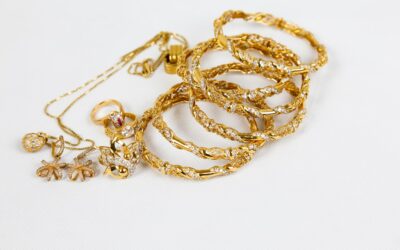
A jeweler will charge $25 to $60 for a professional ultrasonic cleaning that takes about three minutes of actual work. Knowing how to clean gold at home saves that money and lets you maintain your pieces between professional services. Most gold jewelry only needs a 15-minute soak in the right solution to look brand new — but pick the wrong solution and you can damage gemstones, pearls, or thin gold plating.
Understand What You’re Cleaning
Pure 24-karat gold is chemically inert — soap, water, even mild acids barely affect it. The trouble is that almost no jewelry is pure gold. 14k is 58.3 percent gold mixed with copper, silver, nickel, or zinc. 10k is just 41.7 percent gold. Those alloy metals tarnish and react. Gold-plated and gold-filled pieces have an even thinner layer of gold over base metal, and harsh cleaning strips them.
Before you start, identify what you have. Look for stamps inside the band: 14k, 18k, 925 (sterling silver), GP (gold-plated), or GF (gold-filled). Stones usually have visible setting prongs you should inspect for looseness before any soak.
The Standard Mild Soap Method
This works for solid gold without porous stones — diamonds, sapphires, rubies, garnets, and most synthetic stones tolerate it well.
- Fill a small bowl with one cup warm water at about 100 degrees Fahrenheit
- Add 2 to 3 drops of mild dish soap like Dawn — avoid antibacterial or moisturizing formulas
- Soak the jewelry for 15 to 20 minutes
- Scrub gently with a soft toothbrush, paying attention to settings and back of stones
- Rinse in clean lukewarm water — never over an open drain
- Pat dry with a microfiber cloth and air-dry on a soft towel for 10 minutes
Use a strainer or close the drain plug. The number of wedding bands lost to garbage disposals and drain traps every year is staggering.
Baking Soda Paste for Tarnished Pieces
If your gold has heavy tarnish — typical of 10k and 14k pieces worn daily — a mild baking soda paste lifts the discoloration. Mix 2 tablespoons baking soda with about 1 teaspoon water until you have a thick toothpaste consistency. Apply with a soft cloth, rub gently, then rinse thoroughly.
Skip this on jewelry with pearls, opals, turquoise, or coral. The mild abrasion damages those soft, porous stones. Also avoid it on heavily plated pieces — repeated use thins the plating.
Ammonia Solution for Deep Cleaning
For solid gold with diamonds and durable stones that need a stronger lift, dilute one part household ammonia with six parts water. Soak for no more than 60 seconds, then rinse thoroughly and follow with the soap-and-water method to neutralize residue.
Ammonia is the workhorse in commercial jewelry cleaners but also the most damaging solution if misused. Never soak gold-plated, gold-filled, or jewelry with pearls, opals, emeralds, or any organic gemstone. Ventilate the room and don’t mix with bleach products.
What to Use for Specific Stones
- Diamonds: any of the three methods above; ammonia gives the brightest sparkle
- Sapphires and rubies: mild soap or diluted ammonia
- Emeralds: warm water and a dry cloth only — emeralds are oiled and ammonia removes the oil
- Pearls: damp microfiber cloth, no soaking; pearl nacre is calcium carbonate and dissolves in acid
- Opals: soft dry cloth only; opals contain water and crack from temperature shock
- Turquoise and amber: dry cloth or barely-damp wipe; both are porous
- Costume gold or vermeil: barely-damp microfiber, no soaking
Quick Wipe-Down for Daily Maintenance
The single best habit for keeping gold looking good is a 30-second wipe with a microfiber cloth before storing it. Skin oils, lotion residue, and perfume buildup are what cause most of the dullness people blame on the gold itself. A quick wipe after every wear delays the need for deep cleaning by weeks or months.
Keep jewelry off during three activities: showering, swimming, and applying lotion or perfume. Chlorine attacks the alloy metals in gold and weakens prongs over time. Hairspray and fragrance leave a sticky film that traps grit.
Things to Never Do
Skip toothpaste despite the popular tip — modern toothpastes are too abrasive for soft 18k and 22k gold and scratch the surface. Avoid ultrasonic cleaners on pieces with pavé settings, fragile stones, or older jewelry where the prongs may already be weak. Avoid bleach entirely; it destroys the alloy metals and can leave gold permanently discolored.
Never use steam cleaners on emeralds, pearls, opals, or any glued setting. The heat and moisture break the bond on glued stones in a single session.
When to Take It to a Professional
Some jobs are worth the $40 jeweler’s fee. If a stone is loose, if a clasp won’t grip, if you see deep grooves in a band that catches your skin, or if you’ve inherited a piece you can’t identify, get a professional inspection. A reputable jeweler will tighten prongs, polish out surface scratches, and ultrasonic-clean for free or minimal charge if you’re already paying for repair work.
Twice-yearly professional inspections also catch problems before you lose a stone. Worn-out prongs are responsible for nearly every diamond loss in solitaire engagement rings.
Storage That Keeps Gold Looking Clean
Store gold in soft fabric pouches or a fabric-lined box with separate compartments. Pieces rubbing together cause micro-scratches even within the same metal. Keep humidity moderate — too much speeds tarnish on lower-karat pieces. Anti-tarnish strips designed for silver also help slow the dulling on 10k and 14k gold over months of storage.