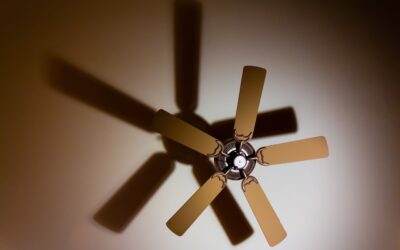
Knowing how to measure ceiling fan size is the key to buying a fan that actually cools your room instead of one that looks lost on the ceiling or crowds the space. Ceiling fan size is defined by the blade span, also called the sweep or diameter, and matching that span to your room’s square footage and ceiling height determines whether the fan moves air effectively and looks proportional. Get it wrong and you either buy a fan that barely stirs the air or one that overwhelms a small room.
The good news is that measuring is simple once you know the method, which changes slightly depending on whether your fan has an even or odd number of blades. This step-by-step guide covers exactly how to measure blade span, how to size a fan to your room, and how ceiling height factors into the choice.
- What Ceiling Fan Size Means
- How to Measure a Fan With an Even Number of Blades
- How to Measure a Fan With an Odd Number of Blades
- Matching Fan Size to Room Size
- Why Ceiling Height Matters Too
- Common Measuring Mistakes
- Airflow Beyond Size
- Measuring for a Replacement Fan
- Special Cases: Sloped Ceilings and Outdoor Spaces
What Ceiling Fan Size Means
Ceiling fan size refers to the diameter of the circle the blades trace as they spin, measured from the tip of one blade straight across to the tip of the blade opposite, passing through the center. This measurement, given in inches, is what manufacturers list as the fan’s size or sweep. Common residential sizes are 42, 48, 52, 56, and 60 inches, with smaller 29- to 36-inch fans for tiny rooms and larger 60-plus-inch fans for great rooms.
The blade span, not the number or length of individual blades, is what matters for airflow and proportion. Two fans can have the same span with different blade counts and both perform similarly, so span is the number to focus on.
How to Measure a Fan With an Even Number of Blades
If your fan has an even number of blades, four, six, or eight, the blades line up directly across from one another, which makes measuring straightforward:
- Grab a tape measure and locate two blades that sit directly opposite each other across the center.
- Measure from the outer tip of one blade straight across to the outer tip of the blade on the opposite side.
- That single measurement, tip to tip through the center, is your blade span and the fan’s size.
For example, if the distance from tip to tip is 52 inches, you have a 52-inch fan. This is the easiest case because one straight measurement gives you the answer.
How to Measure a Fan With an Odd Number of Blades
Fans with an odd number of blades, three, five, or seven, are common and require a two-step calculation because no blade sits directly across from another:
- Measure from the center of the fan (the middle of the motor housing) straight out to the tip of any one blade. This is the radius.
- Multiply that measurement by two to get the full diameter, which is the blade span.
For instance, if the center-to-tip distance is 26 inches, multiply by two to get a 52-inch fan. This method works for any blade count and is the reliable way to measure odd-bladed fans without guessing.
Matching Fan Size to Room Size
Once you know how to measure, the next step is choosing the right size for your room by its square footage. Measure the room’s length and width, multiply them to get the area, and use these guidelines:
- Up to 75 sq ft (bathrooms, small offices, breakfast nooks): 29 to 36 inch fan
- 76 to 144 sq ft (bedrooms, kitchens, dining rooms): 42 to 48 inch fan
- 145 to 225 sq ft (large bedrooms, living rooms): 50 to 54 inch fan
- 226 to 400 sq ft (great rooms, large living areas): 56 to 60 inch fan
- Over 400 sq ft: a 60-inch-plus fan or two smaller fans spaced apart
For long or oddly shaped rooms, two properly spaced fans often move air better than one oversized fan trying to cover the whole space.
Why Ceiling Height Matters Too
Blade span is only part of the equation; the fan’s height above the floor affects both performance and safety. For best airflow, blades should hang 8 to 9 feet above the floor. The bottom of the blades must be at least 7 feet from the floor for safety and typically 18 inches or more from any wall.
Ceiling height determines the mount you need:
- Ceilings under 8 feet: use a flush-mount or “hugger” fan that sits close to the ceiling to preserve headroom.
- 8 to 9 foot ceilings: a standard mount with the included short downrod works well.
- Ceilings over 9 feet: add a longer downrod to drop the fan into the effective 8-to-9-foot zone. A rough rule is one foot of downrod for every foot of ceiling above 8 feet.
A fan mounted too high loses much of its cooling effect because it cannot push air down to where people are.
Common Measuring Mistakes
The most frequent error is measuring a single blade’s length and assuming that is the fan size, when the span is the full tip-to-tip diameter, roughly double a single blade plus the center hub. Another mistake is forgetting the two-step method on odd-bladed fans and simply doubling a blade length, which ignores the motor housing width and gives a slightly wrong number. Always measure from the true center for odd-bladed fans.
People also oversize fans for style, putting a huge fan in a small room where it dominates and moves too much air, or undersize for a big room where a small fan barely helps. Trust the square-footage chart rather than eyeballing it.
Airflow Beyond Size
Once the size is right, check the airflow rating in CFM (cubic feet per minute) to compare fans of the same span. A higher CFM means more air moved. Look for at least 4,000 to 5,000 CFM for bedrooms and 6,000-plus for large living rooms. Blade pitch, the angle of the blades, also affects performance; a steeper 12- to 15-degree pitch moves more air than flatter blades.
Measuring for a Replacement Fan
If you are replacing an existing fan, the measuring approach helps you decide whether to keep the same size or change it. Measure the current fan’s span using the even- or odd-bladed method, then honestly assess whether it cooled the room well. If the old fan felt weak, the room may have been under-sized, and stepping up a size or choosing a higher-CFM model will improve comfort. If the old fan overwhelmed a small room or you found yourself running it only on low, you were likely over-sized.
Also measure the downrod length and the distance from the ceiling to the blades on the current fan. If the fan sat too high and felt ineffective, a longer downrod on the new fan will drop it into the effective zone. Keeping notes on the existing setup makes ordering the right replacement far easier and prevents repeating a sizing mistake.
Special Cases: Sloped Ceilings and Outdoor Spaces
A few situations need extra attention beyond the basic measurement. For a vaulted or sloped ceiling, you need a fan and downrod rated for the slope, plus a sloped-ceiling mounting adapter, and you must confirm the blades will clear the low side of the slope as they spin. Measure from the mounting point down and out to be sure the blade tips have room.
For covered porches and patios, size the fan the same way by the room’s square footage, but choose a damp-rated or wet-rated fan built to handle moisture. Outdoor rooms often feel larger and more open, so err toward a slightly bigger span and higher CFM to move air effectively in the breezier environment. For large great rooms with very high ceilings, remember that a single oversized fan sometimes moves less usable air than two correctly sized fans spaced apart, so measure the space and consider whether one fan or two will serve better.
With the measuring method in hand, sizing a ceiling fan is quick and foolproof. Measure the blade span tip to tip for even-bladed fans, or center to tip and double it for odd-bladed fans, match that span to your room’s square footage, and choose a mount that puts the blades 8 to 9 feet off the floor. Follow those steps and you will buy a ceiling fan that fits the room perfectly, moves air efficiently, and looks right the moment you switch it on.