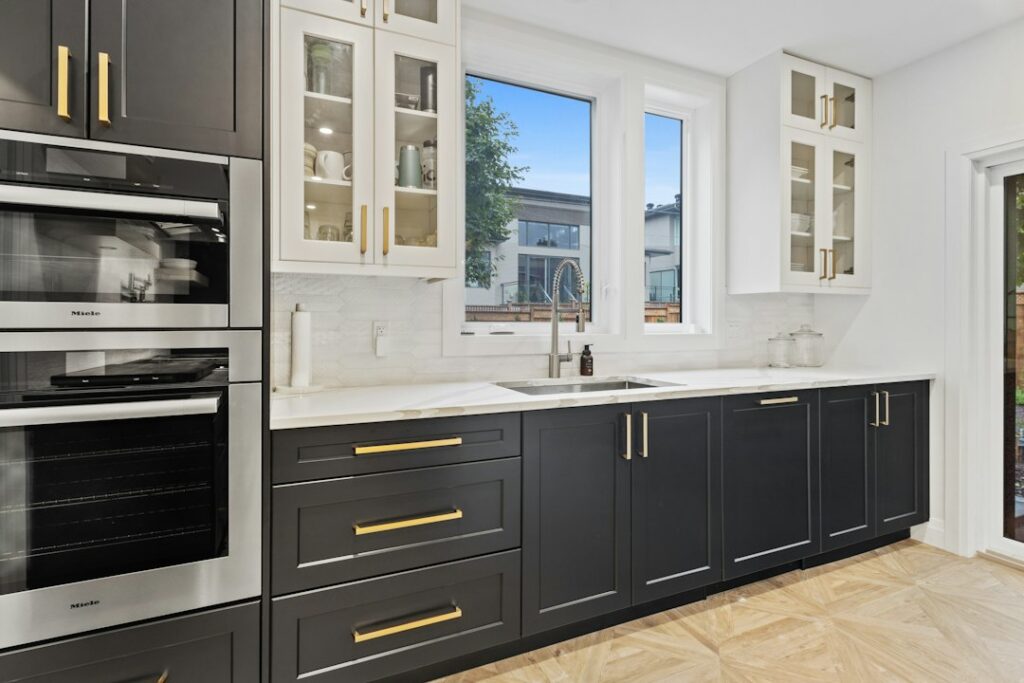
New hardware is one of the cheapest ways to refresh a kitchen, but buy the wrong size and you are left with extra holes to fill, or doors that need a full refinish. Knowing how to measure cabinet pulls correctly comes down to one number more than any other: center-to-center spacing, the distance between the two screw holes. Match that, and new pulls drop right into the existing holes. Overall length and projection matter for looks and comfort, but they will not stop a pull from fitting.
Part of our Kitchen Remodeling guide — explore the full guide →
Measure from the center of one screw hole to the center of the other, in inches or millimeters. Common sizes are 3 inches, 3-3/4 inches (96 mm) and 5-1/32 inches (128 mm), with larger appliance pulls running 12 inches and up. Knobs use a single screw, so they fit anywhere a knob was, and they are the simplest swap of all.
- How to Measure Cabinet Pulls: Center-to-Center Spacing
- Common Center-to-Center Sizes
- Overall Length and Projection
- How to Measure for Drawer Pulls and Handles on New Cabinets
- Screws and Door Thickness
- Step by Step: Replacing Hardware Using Existing Holes
- Adding New Hardware or Changing Sizes
- Measuring Appliance Pulls and Specialty Hardware
- Troubleshooting
- Typical Costs
- When to Call a Pro
- Frequently Asked Questions
How to Measure Cabinet Pulls: Center-to-Center Spacing
Center-to-center (often written as CC or c-c) is the industry standard measurement printed on every pull. Here is the most reliable way to get it:
- Remove one pull. Open the door or drawer, unscrew the two screws from the inside, and take the pull off. Measuring with the pull removed avoids guessing where the screw centers are.
- Measure hole to hole. Put the tape on the center of one threaded hole in the pull (or on the door) and read to the center of the other hole.
- Use a shortcut if needed. Measure from the left edge of one hole to the left edge of the other. That distance equals center-to-center and is easier to read.
- Write it in both units. Many modern pulls are metric. A reading of 3-3/4 inches is 96 mm; 5 inches is close to 128 mm (5-1/32 inches); 6-5/16 inches is 160 mm.
- Check a few doors. Older kitchens sometimes mix sizes; measure each style of door and drawer.
If you cannot remove the pull, measure from the center of one leg (the posts that meet the door) to the center of the other while it is installed. Round to the nearest 1/16 inch, then compare with standard sizes.
Common Center-to-Center Sizes
| Center-to-center | Metric | Typical use |
|---|---|---|
| 3 in | 76 mm | Older cabinets, small drawers |
| 3-3/4 in | 96 mm | Most common on standard doors and drawers |
| 5-1/32 in | 128 mm | Modern drawers and doors |
| 6-5/16 in | 160 mm | Wider drawers, tall doors |
| 7-9/16 in | 192 mm | Larger drawers, pantry doors |
| 8-13/16 to 10-1/16 in | 224 to 256 mm | Wide drawers, statement pulls |
| 12 in and up | 305 mm and up | Appliance pulls, tall pantry doors |
If your measurement falls between sizes, such as exactly 5 inches, the hardware may have been a specialty size. A backplate can cover old holes if you switch sizes.
Overall Length and Projection
Overall length
Overall length is the full tip-to-tip size of the pull. Two pulls with the same 3-3/4 inch center-to-center spacing can be 4-1/4 inches or 6 inches long, because some designs extend past the screw holes. Overall length affects style and how much of the drawer face the pull covers. It does not affect fit, as long as the pull does not run into a neighboring door or a frame edge.
Projection
Projection is how far the pull sticks out from the face of the door. Most fall between 1 and 1-1/2 inches. Measure from the door surface to the outermost point. Too little projection pinches fingers; too much can catch clothing in a narrow aisle or bump an adjacent door when both open. In tight corners, check that pulls on adjacent doors or drawers will not collide.
Knob diameter
Knobs are measured by diameter across the face, usually 1 to 1-1/2 inches, plus projection. Since they use one screw, size is about looks and grip.
How to Measure for Drawer Pulls and Handles on New Cabinets
When there are no holes yet, you get to choose. Some practical rules of thumb:
- Drawers: many designers size pulls at about one-third of the drawer width. A 30 inch drawer often looks right with a pull around 8 to 10 inches overall.
- Narrow drawers (12 to 18 inches): 3-3/4 inch or 5-1/32 inch center-to-center, or a single knob.
- Wide drawers (over 30 to 36 inches): one long pull, or two smaller pulls spaced evenly.
- Doors: 3-3/4 to 5-1/32 inch pulls on standard doors; longer pulls on tall pantry and appliance doors.
- Consistency: using one or two sizes throughout looks cleaner than many sizes.
For anyone figuring out how to measure for cabinet handles on new cabinets, a simple trick is to tape a printed template or a cardboard mockup to the doors and step back before drilling.
Screws and Door Thickness
Most US cabinet pulls and knobs use 8-32 machine screws, and many metric pulls use M4 screws. The screws included in the box are typically sized for 3/4 inch doors, about 1 inch long. Thicker doors, drawer fronts with false fronts, or a backplate may need longer screws. Breakaway screws, with score lines to snap off excess length, are handy when door thickness varies.
Measure door or drawer thickness at the hole, then add about 1/4 inch of engagement into the pull. Too long and the screw bottoms out before the pull is tight; too short and it barely catches the threads.
Step by Step: Replacing Hardware Using Existing Holes
- Measure one of each size. Record center-to-center, overall length and projection. Count how many pulls and knobs you need of each size.
- Buy one sample. Before buying all of them, test-fit one pull to confirm size and comfort.
- Remove old hardware. Keep screws in a cup in case the new set comes short.
- Clean the surfaces. Old pulls leave grime outlines; clean before installing new hardware.
- Install new pulls. Thread screws from inside the door and snug them. Do not overtighten or you may strip threads.
- Check alignment. Stand back and confirm pulls line up across drawers and doors.
Adding New Hardware or Changing Sizes
If you are switching sizes or drilling fresh holes, a cabinet hardware jig makes every hole consistent. Set the jig for your center-to-center spacing and offset from the door edge, clamp it, and drill with a sharp bit (usually 3/16 inch for 8-32 screws). Drill from the front with tape on the surface to reduce chipping, and back the drill with a scrap block to avoid blowout inside the door.
To cover old holes, fill with wood filler and touch up paint, or choose pulls with backplates that hide the old holes. Hardware placement (where on the door to put pulls) is its own decision, so plan it before drilling.
Measuring Appliance Pulls and Specialty Hardware
Appliance pulls for refrigerator and dishwasher panels are measured the same way, center to center, but they attach differently: most use set screws or standoffs that grip mounting studs instead of through-bolts. Measure stud-to-stud spacing carefully, often 12, 18 or 24 inches, and check whether the mounting studs are 8-32, 10-24 or metric. Cup pulls (bin pulls) use two screws like standard pulls, while edge pulls and finger pulls mount along the top edge of a door and are measured by overall length.
Troubleshooting
New pulls do not line up with holes: the center-to-center was mismeasured, or it is metric vs imperial. A 96 mm pull is 3-25/32 inches, close to but not exactly 3-3/4 inches, so it fits; 5 inch and 128 mm are close enough to bind.
Pull wobbles: screws are too short or loose. Use longer screws or add a dab of thread locker.
Screws too long: trim breakaway screws or buy shorter ones.
Doors collide: projection is too much in a corner. Choose a lower-profile pull or a knob there.
Typical Costs
Basic pulls and knobs can cost a few dollars each, while designer and solid-brass options often cost much more. A typical kitchen needs 20 to 40 pieces, so the total ranges widely from under one hundred dollars to several hundred or more. A hardware jig costs roughly ten to forty dollars and pays for itself on the first project.
When to Call a Pro
Replacing pulls on existing holes is a beginner-friendly job. Consider a handyman or cabinet installer for drilling expensive custom doors, refinishing after filling holes, or adjusting doors and drawer slides so the new hardware sits level. Once you know how to measure cabinet pulls and confirm one test piece, the rest goes quickly.
Frequently Asked Questions
How do you measure cabinet pulls?
Measure the center-to-center distance between the two screw holes. That number, such as 3-3/4 inches or 96 mm, tells you which replacement pulls will fit the existing holes.
What is the most common cabinet pull size?
A 3-3/4 inch (96 mm) center-to-center pull is the most common size on standard kitchen doors and drawers, followed by 3 inch and 5-1/32 inch (128 mm).
Do cabinet pulls come in standard sizes?
Yes. Standard center-to-center sizes include 3 in, 3-3/4 in, 5-1/32 in, 6-5/16 in and 7-9/16 in, plus longer appliance pulls.
How do I measure for drawer pulls on new drawers?
A common rule of thumb is a pull about one-third the width of the drawer. Mock it up with tape or a template before drilling.
What size screws do cabinet pulls use?
Most US pulls use 8-32 machine screws, about 1 inch long for a 3/4 inch door. Metric pulls often use M4 screws.