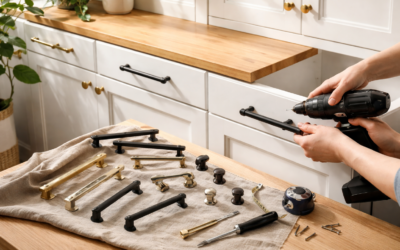
Few upgrades change a kitchen’s look as quickly or affordably as new hardware. Cabinet hardware pulls serve as functional handles and design jewelry all at once, and choosing the right size, finish, and mounting makes a real difference. This guide covers everything you need to select and install pulls with confidence.
Part of our Kitchen Remodeling guide — explore the full guide →
- Pulls vs. Knobs: The Basics
- Understanding Center-to-Center Measurement
- Sizing Pulls to Drawers and Doors
- Popular Pull Styles
- Finishes and How They Wear
- Material Quality
- How Many Pulls You Need
- Installation Tools and Steps
- Placement Guidelines
- Matching Existing Hole Spacing
- Mistakes to Avoid
- Frequently Asked Questions
- Appliance Pulls for Panel-Ready Units
- Using Backplates and Escutcheons
- Coordinating With Other Fixtures
- Budgeting for Hardware
- Comfort and Grip Considerations
- Final Thoughts
Pulls vs. Knobs: The Basics
A knob is a single-point handle you grip with your fingers, while a pull spans two mounting points and offers a bar or handle to grasp. Pulls generally provide a more comfortable grip, especially on heavy drawers, and lend a modern, streamlined look. Many designers use knobs on doors and pulls on drawers, though the current trend leans toward pulls throughout for a cohesive, contemporary feel.
Understanding Center-to-Center Measurement
The single most important spec is center-to-center, the distance between the two mounting screw holes. This determines whether a pull fits your existing holes or requires new drilling. Common sizes include 3 inches (76mm), 96mm, 128mm, 160mm, and larger for oversized drawers. The overall length of a pull is longer than its center-to-center measurement, so always confirm the mounting dimension, not just the visible size.
Sizing Pulls to Drawers and Doors
A good rule of thumb is to size the pull to roughly one-third the width or height of the drawer front. A 30-inch-wide drawer looks balanced with a 10-to-12-inch pull, while a small 12-inch drawer pairs with a 4-inch pull. On cabinet doors, mount vertical pulls so their length is about one-third the door height. Oversized appliance pulls, 12 to 18 inches long, suit large panels on refrigerators and pantry fronts.
Popular Pull Styles
Bar pulls are straight, cylindrical handles that read modern and are the most common choice today. Cup or bin pulls are half-moon shaped and mount on drawer fronts for a classic, farmhouse, or transitional look. Arch and bow pulls have a gentle curve, while finger pulls and edge pulls integrate into the door edge for a handle-free minimalist appearance. Match the style to your cabinet door design and overall kitchen theme.
Finishes and How They Wear
Finish choices shape the whole room. Brushed or satin nickel is versatile and hides fingerprints well. Matte black is on-trend and dramatic against light cabinets but shows dust. Brass and gold tones, especially brushed brass, bring warmth and have surged in popularity. Oil-rubbed bronze suits traditional and rustic kitchens. Polished chrome is bright and easy to clean but shows smudges. Consider how each finish coordinates with your faucet and lighting.
Material Quality
Most quality pulls are solid zinc alloy, brass, or stainless steel. Solid brass and stainless steel are the most durable and feel substantial in the hand. Cheaper pulls use hollow or plated pot metal that can chip or corrode over time. Give a pull a heft test in the store; a reassuring weight usually signals better construction and a finish that will hold up to daily use.
How Many Pulls You Need
Before shopping, count your drawers and doors. A typical kitchen has 25 to 50 pieces of hardware. Buy a few extras of each size to cover installation mistakes and future needs, since finishes and styles get discontinued. Ordering everything at once also ensures the finish matches across the batch, as dye lots can vary slightly.
Installation Tools and Steps
You’ll need a drill, the correct drill bit, a tape measure, and ideally a cabinet hardware jig, which is a template that guarantees consistent placement. Mark your holes, drill from the front through a backer to prevent splintering, and secure the pull with the included machine screws, usually 8-32 thread in 1-inch or 1-1/4-inch lengths. If your drawers are thicker than standard, buy longer screws.
Placement Guidelines
On drawers, center the pull horizontally and vertically, or mount it slightly above center on very tall drawers. On doors, place pulls vertically near the opening edge, typically 2 to 3 inches from the top on lower cabinets and from the bottom on upper cabinets, so they fall within easy reach. Consistency across the kitchen matters more than any single rule; a jig keeps every piece aligned.
Matching Existing Hole Spacing
If you’re replacing pulls without redrilling, measure your current center-to-center distance precisely and buy pulls with the same spacing. When you want a different size, you can fill old holes with wood filler and repaint, or use a backplate that hides the original holes. Backplates also add a decorative element and protect the cabinet finish from fingernails and grime.
Mistakes to Avoid
Common errors include buying pulls by overall length instead of center-to-center, drilling without a jig and ending up with crooked hardware, and mixing finishes that clash with fixtures. Also avoid undersized pulls on large drawers, which look lost and feel awkward. Finally, don’t forget to order enough screws in the right length for your drawer thickness.
Frequently Asked Questions
Can I mix knobs and pulls?
Yes, using knobs on doors and pulls on drawers is a classic combination.
What size screws come with pulls?
Usually 1-inch 8-32 screws, but thick fronts need longer ones.
Are matte black pulls hard to maintain?
They show dust and fingerprints more than brushed finishes, so a quick wipe keeps them sharp.
Appliance Pulls for Panel-Ready Units
Panel-ready refrigerators, dishwashers, and freezer drawers accept cabinet fronts to blend into the kitchen, and these large panels call for oversized appliance pulls. Appliance pulls typically run 12 to 18 inches in length with wider bar diameters to feel proportional on the big door. They mount with longer screws to penetrate the thick panel. Coordinate the appliance pull’s finish and style with the rest of your hardware so the concealed appliances read as part of the cabinetry rather than an afterthought.
Using Backplates and Escutcheons
Backplates are decorative metal plates that sit behind a pull or knob, adding a layer of style and protecting the cabinet surface from wear and fingernails. They shine in traditional and farmhouse kitchens and are also handy for covering old, oversized, or mismatched holes when you swap hardware. Backplates come in finishes that coordinate with pulls, and pairing them thoughtfully can dress up plain slab doors and add visual weight where a simple pull alone would look sparse.
Coordinating With Other Fixtures
Hardware looks best when it converses with the rest of the kitchen. Match or complement your pull finish to the faucet, light fixtures, and even the range’s accents for a cohesive scheme. Brushed brass pulls pair naturally with a brass faucet, while matte black hardware ties to black fixtures and lighting. You don’t have to match everything perfectly, but keeping metals within one or two coordinated families prevents a scattered, unplanned look across the room.
Budgeting for Hardware
Hardware costs add up faster than many expect. With individual pulls running $2 to $20 and a kitchen needing 30 to 50 pieces, the total can range from under $100 for basic hardware to $600 or more for premium solid-brass pulls. Decide early whether hardware is a place to economize or splurge. Because pulls are relatively easy to swap later, some homeowners install budget hardware now and upgrade to designer pieces down the road when funds allow.
Comfort and Grip Considerations
Beyond looks, how a pull feels in the hand matters for daily use. Bar pulls with a rounded profile are comfortable to grip and easy on the fingers, while some square or edged designs can feel sharp if the edges aren’t softened. Consider household members with arthritis or limited hand strength, for whom larger pulls with generous clearance behind the bar are far easier to grasp than small knobs. Test a sample pull before buying a full set, gripping it as you would when opening a heavy drawer, to confirm it feels comfortable and secure.
Final Thoughts
The right cabinet hardware pulls tie a kitchen together, improving both function and style for a modest cost. Measure center-to-center carefully, size pulls proportionally to your drawers and doors, choose a durable finish that coordinates with your fixtures, and use a jig for flawless installation. With a little planning, this simple upgrade delivers an outsized impact on your space.