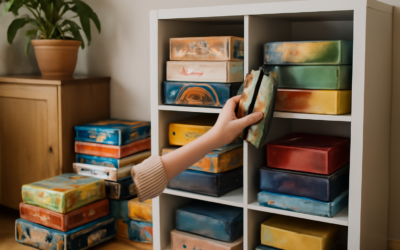
A teetering tower of board game boxes in the closet is more than an eyesore; it is the reason half those games never hit the table. Learning how to organize board games properly solves three problems at once: it stops boxes from crushing, keeps tiny components from going missing, and makes it obvious what you own so game night actually happens. Whether you have a dozen classics or a serious 200-title collection, the right system scales, and most of it can be set up in an afternoon with shelving you may already own.
- Start by Decluttering the Collection
- Choose the Right Shelving
- Sort So You Can Actually Find Things
- Tame the Loose Components
- Upgrade or Eliminate Bulky Boxes
- Special Cases: Kids, Small Spaces, and Big Collections
- Protecting Games From Damage
- Apps and Tools to Track Your Collection
- Keeping the System Going
Start by Decluttering the Collection
Before buying a single bin, pull every game out and sort honestly into three piles: keep, donate, and incomplete. Games missing critical pieces either need replacement parts or should go. Many publishers sell replacement components, and sites like BoardGameGeek list piece counts so you can verify completeness. Donate the games no one has played in two years to a library, school, or thrift store. A trimmed collection is dramatically easier to store and access.
Choose the Right Shelving
The single best upgrade is shelving deep enough to hold boxes flat-faced or spine-out rather than stacked. The IKEA KALLAX cube system is the community favorite because its 13-by-13-inch cubbies fit most standard and large game boxes perfectly, and a 4×4 unit holds a substantial collection for about $130. Key principles:
- Store boxes vertically like books whenever the box construction allows, so you can pull one without toppling the rest.
- Keep heavy boxes low to protect lids and reduce strain.
- Reinforce sagging shelves for heavy collections; games are surprisingly weighty.
If a box is too flimsy to stand on its spine, store it flat in its own cubby or upgrade the storage as described below.
Sort So You Can Actually Find Things
An organized shelf is only useful if you can locate a game fast. Pick a sorting logic and stick with it:
- By size: Practical for fitting boxes efficiently into cubbies.
- By player count or play time: Great for quickly grabbing a game that fits the evening.
- By type: Strategy, party, family, two-player, and kids in separate zones.
- By frequency: Keep your most-played titles at eye level and the deep cuts up high.
Label cube edges or add small spine tags so the system survives other people reshelving games.
Tame the Loose Components
The chaos inside the box is what ruins most games. Replace flimsy plastic baggies and the original cardboard inserts with a tackle box, a divided craft organizer, or fishing-tackle trays (a 3700-size box runs $8 to $15 and holds tokens beautifully). Resealable zip bags sorted by component type keep cards, meeples, and resource tokens separated. For card-heavy games, deck boxes or rubber bands prevent shuffling and loss. Some hobbyists buy or 3D-print custom foam-core inserts that hold every piece in place, which also keeps the box from rattling on the shelf.
Upgrade or Eliminate Bulky Boxes
Big-box games and expansions waste enormous shelf space. Two space-saving moves help: consolidate a base game and its expansions into one larger storage box or a fabric bin, or for the most aggressive savings, transfer everything into plano boxes or photo-storage cases and ditch the original cardboard. Just photograph or save the rulebook first, and keep the original box if resale value matters to you, since collectors prefer complete original packaging.
Special Cases: Kids, Small Spaces, and Big Collections
For kids’ games with lots of loose pieces, clear stackable bins with latching lids survive rough handling far better than original boxes. In a small apartment, look up: a tall bookcase or wall-mounted shelves use vertical space that floor cabinets cannot. For collections topping 100 games, dedicate a closet or a full wall of KALLAX, group by category into zones, and maintain a simple spreadsheet or use a collection app so you can find any title in seconds.
Protecting Games From Damage
Storage is also about preservation, especially for games you have invested real money in. Keep boxes out of direct sunlight, which fades artwork and box colors over time. Avoid damp basements and hot attics; humidity warps cardboard boards and breeds mold, while heat can melt plastic components and curl cards. The ideal storage environment is a climate-controlled room between roughly 60 and 75°F with moderate humidity. For valuable or collectible games, sleeving the cards in protective plastic sleeves (a 100-pack runs about $5) prevents wear from shuffling, and storing the box upright on its spine, rather than stacked flat under weight, prevents the lid and bottom from crushing and bowing.
Apps and Tools to Track Your Collection
Once a collection passes 30 or 40 titles, memory alone fails you. Free apps like the BoardGameGeek app let you catalog everything you own, log plays, and check at a glance whether you already have a game before buying a duplicate. A simple spreadsheet works too, listing each title with its player count, play time, and shelf location. This pays off in two ways: you grab the right game faster on game night, and you avoid the surprisingly common mistake of buying a game you already own. Some collectors add a column for whether all components are present, turning the catalog into a maintenance checklist.
Keeping the System Going
The hardest part of how to organize board games is not the initial setup, it is maintenance. Build in a quick reset habit: at the end of game night, confirm all pieces are bagged and the game returns to its assigned spot. Do a 20-minute audit every few months to re-sort impulse purchases and catch any missing components early. A collection that stays organized is a collection that gets played, and that, ultimately, is the whole point of owning the games in the first place. Make returning a game as easy as taking one out, label generously so guests can help reshelve correctly, and your system will hold up for years rather than collapsing the first busy month. Start small if the whole collection feels daunting: organize one shelf or one category this weekend, and let the momentum carry you through the rest over the next few sessions.