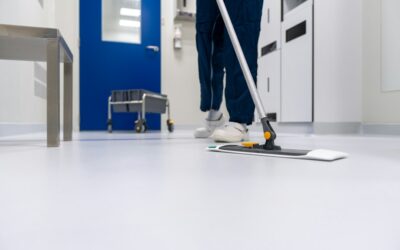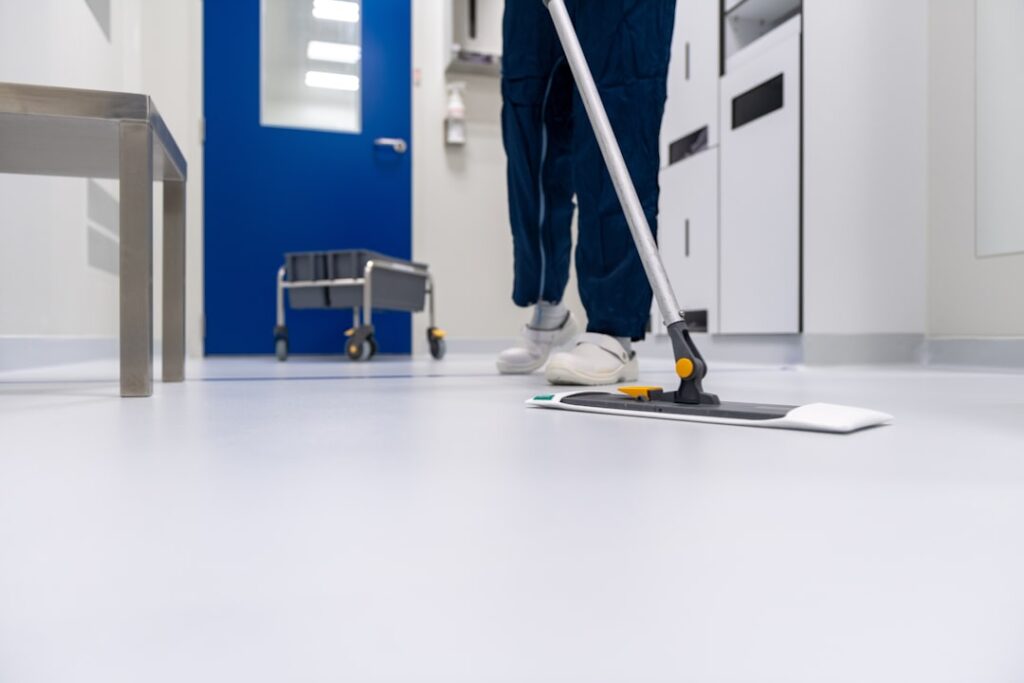
In any space where cleanliness is not a preference but a requirement, the floor is the first line of defense, and hygienic vinyl flooring is engineered specifically to eliminate the cracks, seams and porous surfaces where dirt and bacteria hide. Having specified and installed this flooring in clinics, commercial kitchens, laboratories and domestic wet rooms, I have seen how a properly welded, coved hygienic floor transforms a space from difficult-to-clean to genuinely wipe-down sanitary. It is a very different product from a decorative domestic vinyl, and it is worth understanding why.
This guide explains what makes a floor hygienic rather than merely water-resistant, how homogeneous sheet vinyl is built, why hot-welded seams and coved skirting matter so much, what antimicrobial coatings and slip ratings actually mean, and where this flooring belongs. Whether you are fitting out a treatment room or building a serious wet room at home, the same principles apply.
What Makes a Floor Truly Hygienic
A hygienic floor is defined less by the material itself than by how it is installed as a continuous, impervious surface. The goal is to remove every gap, joint and porous edge where moisture, food residue or biological matter can lodge and multiply. Ordinary tiled floors fail this test because grout lines are porous and hold bacteria, and standard click flooring fails because its joints allow liquid to seep beneath. Hygienic vinyl solves both problems through sheet material and sealed, welded joints.
The result is a floor you can flood-clean or wipe down completely, with no seam or crevice left behind to harbor contamination. In a healthcare or food setting this is the difference between passing and failing an inspection. The specification typically combines a homogeneous or heterogeneous sheet vinyl, hot-welded seams, coved edges running up the wall and a resilient wear surface, all working together to create one unbroken cleanable membrane across floor and skirting.
Homogeneous Sheet Vinyl Explained
Homogeneous sheet vinyl is the workhorse of hygienic flooring. Homogeneous means the material has the same composition and color all the way through its thickness, so the wear layer and the base are one and the same. Because the color and pattern run through the full depth, surface scratches and wear are far less visible, and the floor can be maintained and, if needed, buffed over many years without exposing a different colored core. This through-body construction is why you see it in hospitals and schools that expect decades of heavy traffic.
Heterogeneous sheet vinyl is the alternative, built in layers with a separate printed design film protected by a clear wear layer. It offers a wider range of appearances, including wood and stone effects, and often a thicker dedicated wear layer, but it is layered rather than solid. Both can be installed to hygienic standards with welding and coving. For the most demanding clinical and laboratory environments, homogeneous is usually specified for its durability and consistent cleanability, while heterogeneous suits areas where appearance and acoustic comfort carry more weight.
Hot-Welded Seams: The Critical Detail
The single most important element of a hygienic floor is how the sheets are joined, and the answer is hot welding. Where two sheets of vinyl meet, the installer routs a shallow groove along the joint and then welds a color-matched vinyl weld rod into it using a hot-air gun, fusing the sheets together. Once the excess rod is trimmed flush, the two sheets become one continuous, watertight surface with no gap for liquid or bacteria to penetrate.
This is what separates a genuinely hygienic installation from ordinary sheet vinyl that is merely glued down with butt joints. A hot-welded seam is impermeable and can be scrubbed, mopped and flood-cleaned without water working its way underneath. The quality of the weld matters enormously: an under-heated weld will not fuse and will eventually lift, while an over-heated one scorches the rod. This is skilled work, and for any clinical, laboratory or food-safe installation it should be carried out by an experienced floor layer, not improvised.
Coving and Skirting Up the Wall
A hygienic floor does not stop at the wall. To remove the dirt-trapping right angle where floor meets wall, the vinyl is coved, meaning it is curved upward and continued vertically as an integral skirting, typically 100mm high. A former, a small quadrant strip, is fixed into the floor-wall junction and the vinyl is dressed up and over it to create a smooth, curved transition with no sharp internal corner for grime to collect in.
The top edge of the coved skirting is then finished with a capping seal or a proprietary trim so water cannot run behind it. The effect is a continuous impervious surface that sweeps from the middle of the floor seamlessly up the wall, so a mop or hose can clean the junction completely. In wet rooms, operating theaters and commercial kitchens this coved detail is not optional; it is fundamental to the floor doing its hygienic job. Even in a domestic wet room, coving the vinyl a short way up the wall dramatically improves waterproofing and cleanability.
Antimicrobial Coatings and What They Do
Many hygienic vinyl floors incorporate a bacteriostatic and fungistatic treatment, either built into the material or applied as a surface coating. Bacteriostatic means the treatment inhibits the growth and multiplication of bacteria on the floor surface, while fungistatic does the same for mold and fungi. This is typically achieved through additives such as silver-ion or triclosan-based agents dispersed in the wear layer, and reputable products are tested against standards such as ISO 22196 for antibacterial activity.
It is important to keep expectations realistic. An antimicrobial coating supplements good cleaning practice; it does not replace it. The physical design of the floor, the impervious welded surface and the coved edges, does the heavy lifting by removing the places contamination can hide and by allowing thorough cleaning. The bacteriostatic treatment is a useful additional safeguard between cleans, but a floor still needs a proper cleaning regime. Treat the coating as a belt-and-braces bonus rather than a substitute for hygiene discipline.
Slip Resistance and R-Ratings
Hygienic environments are frequently wet, so slip resistance is a safety-critical specification. Slip performance is commonly expressed as an R-rating from the ramp test, running from R9 for the lowest slip resistance up to R13 for the highest. A general clinical corridor or reception might use R9 or R10, while a commercial kitchen, a wet room or a shower area demands R10 to R12, and heavy grease or constant-water zones may call for R12 to R13.
Safety vinyl achieves this enhanced grip by embedding aggregates such as quartz, aluminum oxide or silicon carbide into the wear layer, which give the surface texture that maintains traction even under water or contamination. There is a genuine trade-off to manage: the more aggressive the slip resistance, the more textured the surface, which makes it slightly harder to clean and can feel rough underfoot. Matching the R-rating to the actual risk of each area, rather than over-specifying everywhere, gives the best balance of safety and cleanability.
Where Hygienic Vinyl Flooring Is Used
The natural homes for this flooring are the environments where contamination control is paramount. In healthcare, that means hospitals, dental and medical clinics, operating theaters, treatment rooms and care homes, where welded seams and coved skirting allow rigorous cleaning and infection control. In food settings, commercial kitchens, food-processing areas, butcheries and bakeries rely on the impervious, slip-resistant surface to meet food-safety regulations.
Laboratories use it for its chemical resistance and cleanability, and schools, nurseries, veterinary practices and public washrooms all benefit from the same properties. At home, the same specification makes an excellent wet room, utility room or downstairs bathroom floor, giving a fully waterproof, easy-clean surface with coved edges that a tiled floor cannot match. Anywhere that must be genuinely sanitary, resist water and stand up to frequent aggressive cleaning is a candidate for hygienic vinyl.
Cleaning, Maintenance and Longevity
A hygienic floor is only as good as its upkeep, but the good news is that the design makes cleaning straightforward. Daily maintenance is usually a dust mop or vacuum to remove grit, followed by damp mopping with a neutral pH cleaner suited to safety vinyl. In commercial settings a periodic deep clean with a scrubber-dryer or mechanical scrubbing pad lifts embedded soil from the textured surface, which is important because the same texture that provides slip resistance also traps dirt if neglected.
Avoid harsh solvents and heavy abrasives that can damage the wear layer or degrade any antimicrobial treatment, and never let a slip-resistant floor build up a film of grease or soap residue, which quietly undermines its grip. Properly installed and maintained, a quality hygienic homogeneous vinyl floor will serve for 15 to 20 years or more in a commercial setting. The upfront cost and the need for skilled welded installation are real, but for any space where hygiene genuinely matters, it is the right investment.
Prefer to explore on your own?
See how new flooring looks in your actual room in seconds — free, no signup.
Try the free Floor Studio →