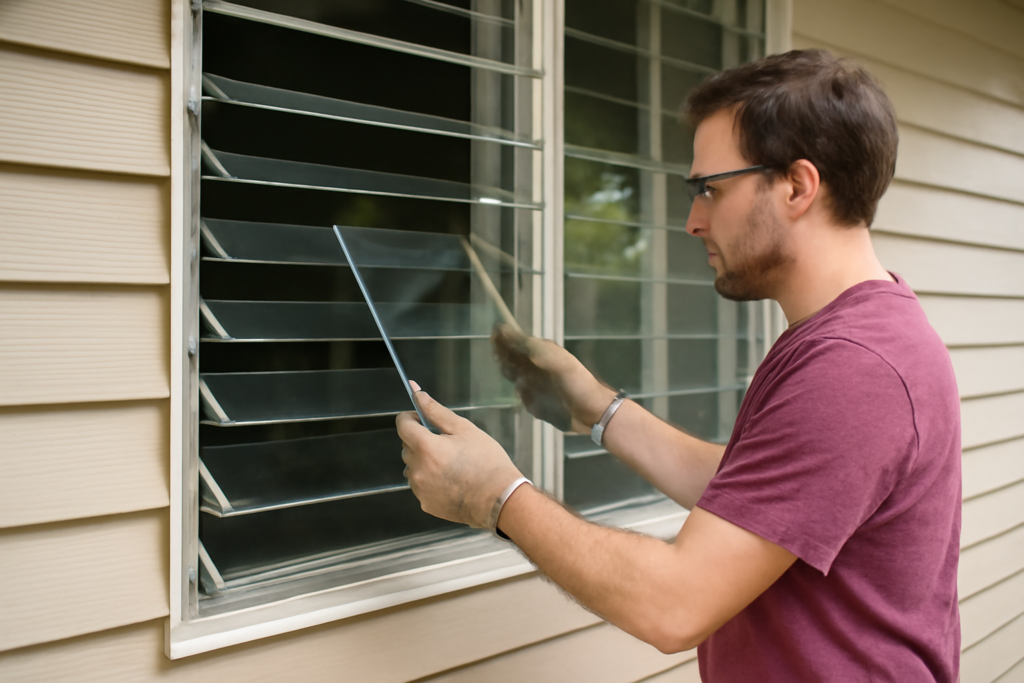
Jalousie windows still line porches and Florida rooms across the South, and the most common repair is one cracked slat. The good news is that jalousie glass replacement is usually a 15- to 30-minute job with no putty and no glazing. Each louver pane slides into a pair of aluminum clips at its ends, so you open the window, bend the clip tabs, slide the broken blade out, and slide a new one in.
Part of our Windows & Doors guide — explore the full guide →
The key steps: measure the blade length, width, and thickness; buy a matching pane from a glass shop or window parts supplier; crank the louvers open to a horizontal position; release the clip tabs; remove the broken glass carefully; slide in the new blade; and bend the tabs back. A replacement blade typically costs $10 to $40 depending on size and whether it is clear, obscure, or tinted glass.
This guide covers how jalousie windows are built, how to measure and order blades, safe glass handling, the swap itself, fixing operators and cranks, and when it makes more sense to upgrade to awning or impact windows.
How Jalousie Glass Replacement Works
A jalousie window is a stack of horizontal glass slats, often called louvers or blades, held at each end by clips attached to vertical aluminum frames. The clips pivot together through a linkage bar connected to a crank operator at the bottom. Turning the crank tilts every louver at once, like a Venetian blind made of glass.
Because each blade simply sits in its clips, removing one does not disturb the others. There is no glazing compound, stop, or bead to remove. That makes glass replacement simpler than on almost any other window type, as long as you match the blade dimensions and edge finish.
The clips come in two general styles. Most have small bendable metal tabs at the end that keep the glass from sliding out. Others use a spring clip or a set screw. Look closely at the ends of an intact louver before you start so you know which style you have.
Measuring and Ordering Louver Blades
Accuracy matters because the blade must fit snugly between two clips. Measure an undamaged blade in the same window if possible, rather than trying to piece together a broken one.
- Length: Measure end to end across the full blade, not the visible portion between clips. Common lengths range from about 20 to 40 inches.
- Width: Measure front to back. Many residential jalousie blades are about 4 inches wide, but widths vary by manufacturer and era.
- Thickness: Most older jalousie glass is 3/16 inch thick; some newer units use 1/4 inch. Use calipers or compare against a known sample.
- Glass type: Note whether it is clear, obscure (textured for privacy), or tinted, and whether the edges are ground smooth.
Order from a local glass shop or a supplier that stocks jalousie parts. Ask for polished or seamed edges, since the long edges are exposed when the window opens. If safety glass is required in your location, such as within a certain distance of a door or floor, a glass shop can advise whether tempered or laminated blades are needed; tempered blades must be ordered to size because they cannot be cut after tempering. Buy an extra blade or two if the window has multiple aging panes.
Glass Handling Safety
Broken louver glass has long, sharp edges and often cracks further as you handle it. Wear cut-resistant gloves and safety glasses throughout, and wear long sleeves. Put a drop cloth or cardboard beneath the window on both sides. Apply painter’s tape across a cracked blade in a crosshatch so shards stay together as you slide it out. Never try to snap or cut tempered glass; it will shatter into small granules. Carry new blades on edge, not flat, and set them on a padded surface. If the window sits above the first floor, work from inside when possible rather than from a ladder.
Tools and Materials
- Replacement louver blade in the correct size and glass type
- Cut-resistant gloves, safety glasses, and long sleeves
- Needle-nose pliers and a small flat screwdriver
- Painter’s tape and a drop cloth
- Tape measure and calipers
- Silicone spray lubricant or dry lubricant for the linkage
- Replacement clip vinyl inserts, if the old ones are cracked
- Stiff cardboard or a bucket for broken glass
Step-by-Step Jalousie Glass Replacement
- Open the louvers fully. Turn the crank until the blades are close to horizontal. This gives clear access to the clip ends.
- Tape the broken blade. Crosshatch painter’s tape over the cracked glass on both faces.
- Release the clip tabs. At each end, use needle-nose pliers or a small screwdriver to bend the small retaining tab outward just enough for the glass to pass. Bend gently; aluminum tabs break if worked too far. If your clips use a screw or spring, loosen or depress it instead.
- Slide the blade out. Grip the taped glass with gloved hands and slide it lengthwise out of the clips. If it binds, check the far end for a second tab.
- Clean the clips. Remove glass fragments, dirt, and old broken vinyl inserts from the clip channels. Replace inserts if they are cracked or missing; they cushion the glass and reduce rattling.
- Test-fit the new blade. Slide the replacement into the clips, keeping any textured face oriented the same way as the other blades.
- Center it. Make sure the blade sits evenly between both clips with similar engagement at each end.
- Bend the tabs back. Press the retaining tabs back into position so they hold the glass without pinching it.
- Operate the window. Crank the window closed and open several times. The new blade should seat against its neighbors like the rest, without rattling.
Fixing Operator and Crank Problems
If the glass is fine but the window will not open or close properly, the problem is usually the operator or linkage rather than the panes.
Crank spins without moving the louvers. The gears in the operator are stripped. Remove the handle, unscrew the operator from the frame, and match its style and hand at a window parts supplier. Replacement operators commonly run $20 to $60.
Louvers are stiff or uneven. Clean the vertical linkage bars, remove dirt and corrosion, and apply a dry or silicone lubricant to pivot points. Avoid heavy grease, which traps sand.
Blades do not close tightly. Check for a bent clip or linkage bar. Gently straighten minor bends, or replace the damaged clip if it is cracked. Old vinyl seals along the blades may also need replacement.
Rattling in wind. Replace missing clip inserts and confirm every tab is snug.
Corroded frame near the coast. Salt air eats aluminum. Surface oxidation can be cleaned, but pitted or crumbling clips and frames are a sign the unit is near the end of its life.
Costs
Individual louver blades generally run $10 to $40, with tempered, tinted, or unusually long blades at the high end. Clip inserts and small parts usually cost a few dollars each. A handyman or glass shop typically charges a service call fee plus $15 to $50 per blade installed. Replacing an entire jalousie window with a modern awning, casement, or single-hung unit often costs several hundred dollars, and impact-rated windows in hurricane zones cost considerably more per opening. These are general ranges; local pricing and window sizes vary widely.
When to Upgrade to Awning or Impact Windows
Jalousies are excellent for ventilation but poor at stopping air, water, and intruders. The overlapping blades never seal completely, and single-pane glass offers little insulation. Consider replacement if:
- The room is air-conditioned and the energy loss is noticeable
- Several blades are broken or the aluminum frame is corroded
- Operators keep failing and parts are hard to match
- You live in a hurricane-prone area and want impact protection
- Security is a concern, since blades can be slid out from outside on some units
Awning windows offer a similar tilt-out look with far better sealing. In hurricane zones, impact-rated windows or approved shutters may be required for new installations, so check local building requirements and permits before ordering.
When to Call a Professional
Call a glass shop if you need tempered or laminated blades, the window is on an upper floor, or several blades are cracked at once. Bring in a window contractor if the frame is loose in its opening, water is leaking into the wall, or you plan to replace jalousies with impact windows, which usually involves permits and product approvals. For a single cracked clear pane on a ground-floor porch window, jalousie glass replacement is well within DIY range.
Jalousie Glass Replacement FAQ
Can I cut jalousie glass myself?
You can cut standard annealed glass with a glass cutter, but a glass shop will cut and seam the edges cleanly for a small fee. Never try to cut tempered glass, which shatters when scored.
What thickness is jalousie window glass?
Most older residential jalousie glass is 3/16 inch thick, while some newer units use 1/4 inch. Measure an intact blade to confirm before ordering.
How do I remove a jalousie louver without breaking it?
Open the window fully, gently bend the retaining tabs at both ends, and slide the blade lengthwise out of the clips while wearing gloves.
Are jalousie windows energy efficient?
No. The blades overlap but do not seal tightly, and most use single-pane glass. They work well for screened porches but lose significant heating and cooling energy in conditioned rooms.
Can jalousie windows be replaced with impact windows?
Yes. Many homeowners in coastal areas replace jalousies with impact-rated awning or single-hung windows. Expect permits and product approvals to be part of the project.