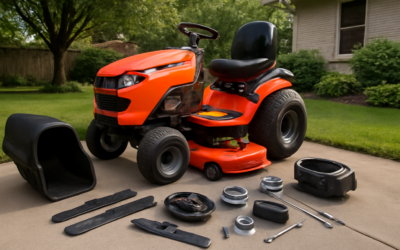
A John Deere mower is built to run for 15 to 20 seasons, but only if you feed it the right wear items on schedule. Ordering the correct John Deere lawn mower parts starts with one thing most owners overlook: your exact model and serial number. A blade that fits a D110 will not fit an X350, and a belt off by two inches will squeal, slip, and shred within an hour. This guide walks through the parts you will actually replace, how to identify them, and roughly what each costs.
- Finding Your Model and Serial Number First
- Mower Blades: The Most-Replaced Part
- Belts: Deck and Transmission
- Filters, Plugs, and Tune-Up Parts
- Deck Spindles, Wheels, and Steering Parts
- Batteries, Cables, and Electrical
- Genuine vs. Aftermarket Parts
- A Seasonal Parts Replacement Schedule
- Tools You Need for Common Repairs
Finding Your Model and Serial Number First
Every part lookup begins at the product identification number, or PIN. On most John Deere riding mowers the label is on the frame below the seat or on the rear frame near the drawbar. Walk-behind mowers carry it on the deck housing. The 13 or 17-character serial confirms the exact production run, which matters because Deere revised parts mid-model on several machines.
Write down both the model designation (for example, D130, E120, X350, or S240) and the full serial. With those in hand you can use the official John Deere Parts Catalog online, which shows exploded diagrams for every assembly. This step alone prevents the most common ordering mistake, buying a part that fits a similar-looking machine but not yours.
Mower Blades: The Most-Replaced Part
Blades dull faster than owners expect. A ragged, torn grass tip that browns a day after mowing is the classic sign your blade needs sharpening or replacement. Most homeowners replace blades every one to three seasons depending on how much sand and debris they hit.
John Deere sells blades in three cutting styles:
- Standard (flat) blades for general mowing and bagging in dry conditions
- Mulching blades with extra cutting surface to chop clippings finer
- High-lift blades that create strong airflow for tall grass and full bagging
A 42-inch deck uses two blades, and a 54-inch deck typically uses three. Genuine Deere blades run about $18 to $35 each; a full deck set is $40 to $90. Always match the center hole shape and mounting boss, not just the length, and replace blades in complete sets so the deck stays balanced.
Belts: Deck and Transmission
Your mower has at least two critical belts. The deck (mower) belt drives the blades, and the transmission or drive belt moves the machine. Belts stretch, glaze, and crack over 100 to 300 hours of use. A slipping deck belt makes the blades bog down in thick grass; a worn drive belt leaves the mower crawling uphill.
Belt part numbers are model-specific because length and rib count vary. A D130 deck belt is not interchangeable with an X350. Genuine deck belts cost roughly $25 to $55, drive belts $20 to $45. When you replace one, inspect the idler pulleys and tensioner spring, since a seized pulley will chew through a fresh belt in a single season.
Filters, Plugs, and Tune-Up Parts
Routine tune-up parts are cheap insurance against expensive engine damage. Most John Deere residential mowers run Briggs & Stratton, Kawasaki, or Kohler engines, so the filter and plug numbers trace to the engine maker as much as to Deere.
Air and Oil Filters
Change the oil filter every 50 hours or once a season, and inspect the air filter every 25 hours. A clogged air filter starves the engine, causing black smoke and hard starting. Filters run $8 to $20. Keep two on the shelf so a dirty filter never becomes an excuse to skip a change.
Spark Plugs and Fuel Filters
Replace spark plugs annually; a fouled plug is the number-one cause of rough running and no-starts. Gapped correctly to the engine spec, usually around 0.030 inch, a fresh plug costs $4 to $10. Inline fuel filters are $6 to $12 and should be swapped yearly to keep the carburetor clean.
Deck Spindles, Wheels, and Steering Parts
Beyond the fast-wearing consumables, several assemblies fail on higher-hour machines. Deck spindles, the bearings the blades bolt to, start whining or wobbling after several hundred hours, especially if the mower hits stumps or curbs. A complete spindle assembly runs $30 to $70; replacing it also gives you a chance to swap the deck belt at the same time.
Front wheels and axle bushings wear on riders that turn tight all day, producing a sloppy, drifting steer. Tie rods and steering sector gears are common repair parts on aging X and D-series machines. None of these are difficult jobs for a homeowner with basic tools, and Deere’s exploded parts diagrams number every bolt so you can order the exact bushing or gear you need.
Batteries, Cables, and Electrical
Riding mowers depend on a 12-volt battery for starting, and cold storage kills batteries faster than use. Most last three to five seasons. A replacement Deere-spec battery runs $45 to $90; keep it on a maintenance charger over winter and you will push toward the top of that range. If the mower cranks slowly or clicks, test the battery before assuming the starter has failed.
Other common electrical parts include the ignition switch, safety interlock switches under the seat and on the brake, and the solenoid. A dead safety switch is a frequent reason a mower will not start even though everything else is fine, and each switch is an inexpensive $10 to $30 part.
Genuine vs. Aftermarket Parts
You will find aftermarket blades, belts, and filters at a fraction of genuine prices, and for some items they are perfectly acceptable. Reputable aftermarket blades and filters generally perform fine. Where genuine John Deere lawn mower parts earn their premium is on precision components like spindles, transmission belts, and steering gears, where a slightly off tolerance causes vibration or premature failure.
A sensible approach: buy quality aftermarket for high-turnover consumables like air filters and standard blades, and stick with genuine parts for drivetrain and deck-critical assemblies. Whatever you choose, verify the part against your PIN, because the money you save on a cheap belt vanishes the first time it strips and strands you mid-yard. Keep a small shelf of the parts you replace most, and your Deere will start on the first pull every spring.
A Seasonal Parts Replacement Schedule
The easiest way to avoid mid-season breakdowns is to work off a calendar rather than waiting for something to fail. John Deere publishes hour-based service intervals, and translating them into a homeowner routine keeps the machine reliable. For a mower that logs 40 to 60 hours a season, here is a practical timeline.
- Every spring startup: new spark plug, fresh oil and oil filter, new fuel filter, and a sharpened or new blade set
- Mid-season (25-30 hours): inspect and clean or replace the air filter, check belt tension and blade sharpness
- Every 50 hours: change oil and filter again on hard-working machines
- End of season: stabilize fuel or drain it, inspect belts and spindles, check battery charge before winter storage
Buying a spring tune-up kit in one order, plug, both filters, and blades, usually runs $40 to $70 and takes the guesswork out of what to stock. Doing this work in your own garage saves the $150 to $250 a dealer charges for the same annual service.
Tools You Need for Common Repairs
Most homeowner-level John Deere repairs need only basic hand tools, and having them ready turns a two-day dealer trip into a one-hour driveway job. A blade change, for example, requires a socket wrench, a block of wood to lock the blade, and a pair of heavy gloves.
Keep these on hand for routine parts work:
- A socket set and torque wrench for blade bolts and spindle nuts
- A blade balancer, a $10 cone tool, so a freshly sharpened blade does not vibrate the deck
- A spark plug socket and gap gauge
- An oil drain pan and filter wrench
- A mower jack or ramps to safely lift the deck for underside access
Never work under a raised mower without proper support, and always disconnect the spark plug wire before reaching near the blade. With the right tools and genuine parts matched to your PIN, there is very little on a residential Deere a capable homeowner cannot service, and every repair you handle yourself extends the life of a machine built to run for two decades.