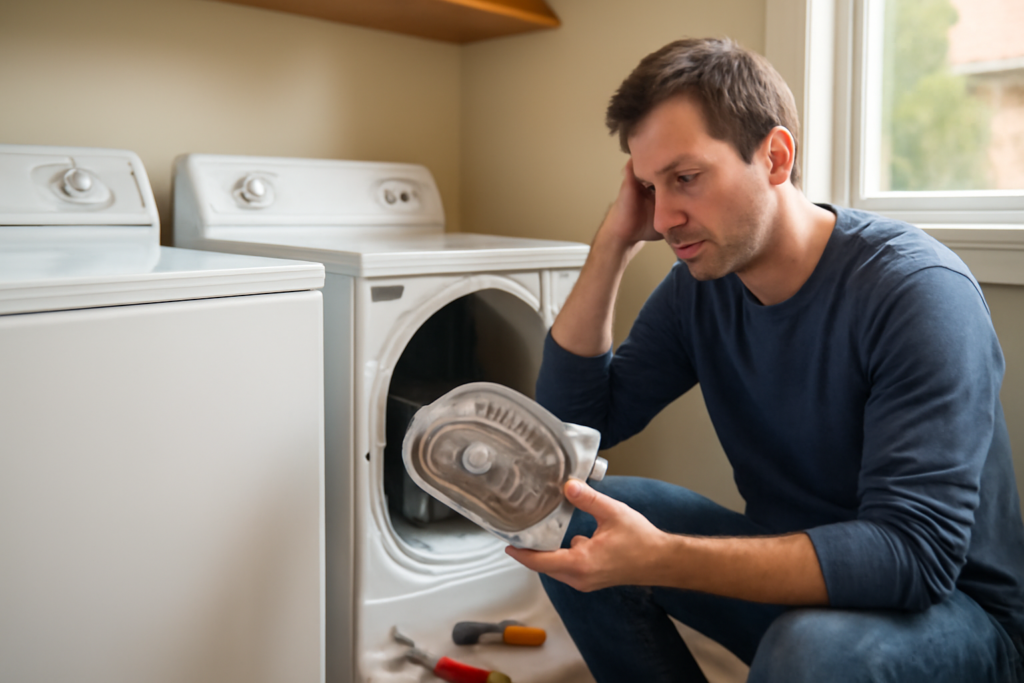
A Kenmore dryer not heating is one of the most common laundry-day failures, and the good news is that most causes are cheap parts you can swap in an afternoon. When the drum spins fine but your clothes come out cold and damp after a full 60-minute cycle, the motor is healthy and the problem lives in the heat circuit. That narrows things down fast.
- First: Electric or Gas, and What “No Heat” Really Means
- Cause 1: A Blown Thermal Fuse
- Cause 2: Failed Heating Element (Electric)
- Cause 3: Tripped Thermostats and Thermal Cut-Off
- Cause 4: Gas Igniter or Flame Sensor (Gas Models)
- Cause 5: Power Supply and the 240-Volt Leg
- A Safe Diagnostic Order
- When to Call a Pro and What It Costs
- Restrictions That Mimic a No-Heat Fault
- Kenmore Error Codes and Electronic Controls
Before you touch anything, unplug the dryer at the wall or shut off the 240-volt breaker. Electric dryers carry enough current to be dangerous, and a gas model adds a live gas line to the mix. Give the machine a minute, then work through the causes below in order of likelihood.
First: Electric or Gas, and What “No Heat” Really Means
Most Kenmore dryers are built by Whirlpool, though older units came from Frigidaire (Electrolux) or LG. Check the model number on the door jamb sticker. A model starting in 110 is Whirlpool-built, and those share parts with Whirlpool, Roper and Amana dryers. This matters because part numbers and prices track the manufacturer, not the Kenmore badge.
Electric dryers run on a 240-volt circuit split into two 120-volt legs. If one leg trips or a fuse blows, the drum and light still work on the remaining 120 volts, but the heating element gets no power. That single fact explains a huge share of “spins but no heat” calls. Gas dryers, by contrast, use 120 volts to turn the drum and a gas valve plus igniter to make heat, so a no-heat gas dryer usually points at the igniter or gas supply.
Cause 1: A Blown Thermal Fuse
The thermal fuse is a one-time safety device mounted on the blower housing or exhaust duct. If the dryer overheats, it blows and cuts power to the heating element (electric) or the whole machine (some gas models), and it does not reset. On Whirlpool-built Kenmores the common part is 3392519, a $6 to $12 item.
Here is the part people miss: a thermal fuse almost never blows on its own. It blows because the vent is clogged and heat backed up. If you replace the fuse without clearing the lint, the new one will blow too. Pull the flexible transition hose off the back, run a vent brush through it and the wall duct, and confirm strong airflow at the outside hood before you install the new fuse. A clogged vent is also the number-one dryer fire hazard, so this step protects your home, not just the fuse.
Cause 2: Failed Heating Element (Electric)
On an electric Kenmore, a coil-type heating element sits in a housing behind the drum or in a duct at the back. Over years the nichrome coil sags, touches the housing and shorts, or simply burns through and opens. A broken element makes no heat at all.
Test it with a multimeter set to ohms across the two element terminals. A good element reads roughly 8 to 12 ohms. Infinite (OL) means it is open and needs replacing. The Whirlpool-style element assembly, part 279838, runs $18 to $40. Swapping it is a matter of removing the back panel, disconnecting two wires and a couple of screws. Expect 30 to 45 minutes.
Cause 3: Tripped Thermostats and Thermal Cut-Off
Beyond the thermal fuse, Kenmore dryers use a cycling thermostat that switches the element on and off to hold temperature, plus a high-limit thermostat and, on many models, a thermal cut-off kit. These are resettable or one-time depending on the part. A high-limit thermostat that has opened kills the heat.
The thermal cut-off kit for Whirlpool-built units, part 279816, bundles the cut-off and a high-limit thermostat for about $12 to $25. Test each part for continuity across its terminals with the meter; a good thermostat reads near zero ohms at room temperature. Like the thermal fuse, a tripped high-limit thermostat usually points back to restricted airflow, so clean the vent before you blame the part.
Cause 4: Gas Igniter or Flame Sensor (Gas Models)
On a gas Kenmore, the sequence is: the igniter glows orange and hot, the flame sensor confirms it is hot enough, then the gas valve opens and the burner lights. The most common failure is a cracked igniter that no longer glows. The Whirlpool-style igniter, part 279311, costs $15 to $30.
Watch the burner through the inspection port during a cycle. If the igniter glows but no flame follows, suspect the gas valve coils (part 279834, about $30) or the flame sensor. If the igniter never glows, the igniter itself is open, or the thermal fuse or thermostat upstream has cut power to it. Because you are working near a gas line, shut the gas valve at the dryer and never use an open flame to check for leaks. If you smell gas or are unsure, stop and call a licensed technician.
Cause 5: Power Supply and the 240-Volt Leg
If your electric Kenmore spins but makes zero heat and every part above tests good, check the outlet. A double-pole breaker can trip on just one leg, or one half of an old fuse box can blow. Reset the breaker fully to off, then on. On homes with a 30-amp fuse block, replace both cartridge fuses even if only one looks bad. A loose or burnt outlet connection does the same thing and is a real fire risk, so look for scorching at the plug.
A Safe Diagnostic Order
- Unplug the dryer or kill the breaker first, every time.
- Clean the full vent path and confirm airflow at the exterior hood.
- Check the breaker and outlet for a lost 240-volt leg.
- Test the thermal fuse, then the heating element or igniter.
- Test the high-limit thermostat and thermal cut-off.
- Replace matched safety parts as a set, not one at a time.
Work in that order and you will find the fault without buying parts you do not need. A meter that reads ohms turns guesswork into a five-minute test on each component.
When to Call a Pro and What It Costs
A DIY fix on a Kenmore dryer not heating typically costs $10 to $45 in parts. A professional repair runs $150 to $300 including the service call, mostly labor. That math favors DIY for a thermal fuse, element or igniter. Call a pro if you smell gas, if the machine is under warranty, or if the control board is throwing error codes, since a board on a modern electronic-control Kenmore can top $200 and needs proper diagnosis.
One last habit: clean the lint screen every load and vacuum the vent path once a year. Restricted airflow is behind most blown fuses and tripped thermostats, so keeping the exhaust clear is the single best way to stop the no-heat problem from coming back and to keep a lint fire out of your laundry room.
Restrictions That Mimic a No-Heat Fault
Not every “no heat” complaint is a dead part. Sometimes the dryer makes heat but can’t move it, and the clothes stay damp so it feels like a heat failure. A packed lint screen is the first thing to rule out; clean it before every load, and once a month wash it in warm soapy water to strip the invisible film that dryer sheets leave behind. That film chokes airflow enough to add 15 minutes to a cycle and to trip a high-limit thermostat over time.
Also check the cycle you selected. An air-fluff or air-only setting runs the drum with no heat by design, and it is easy to bump on a dial or touchpad. On sensor-dry models, a failed moisture sensor can end a cycle early while the load is still wet, which reads as “not drying” even though the heater is fine. Wipe the two metal sensor bars inside the drum with a little rubbing alcohol; fabric-softener residue on them fools the sensor into thinking the load is dry.
Kenmore Error Codes and Electronic Controls
Newer Kenmore dryers with a digital display can flag heat problems directly. On many Whirlpool-built models an “F22,” “F23,” or “E1/E2” points at a thermistor or temperature-sensing fault rather than a blown fuse. Look up the exact code for your model number before you tear into the machine, because chasing the wrong part on an electronically controlled dryer wastes money.
If the codes point at the control board and every mechanical part tests good, that is the moment to weigh the repair against the machine’s age. A control board can run $150 to $250, and on a dryer more than 10 years old the sensible move is often a new appliance. For anything mechanical, though, a thermal fuse, element, thermostat or igniter, the DIY fix pays for itself many times over. Keep the vent clear, and a Kenmore dryer will run trouble-free for well over a decade.