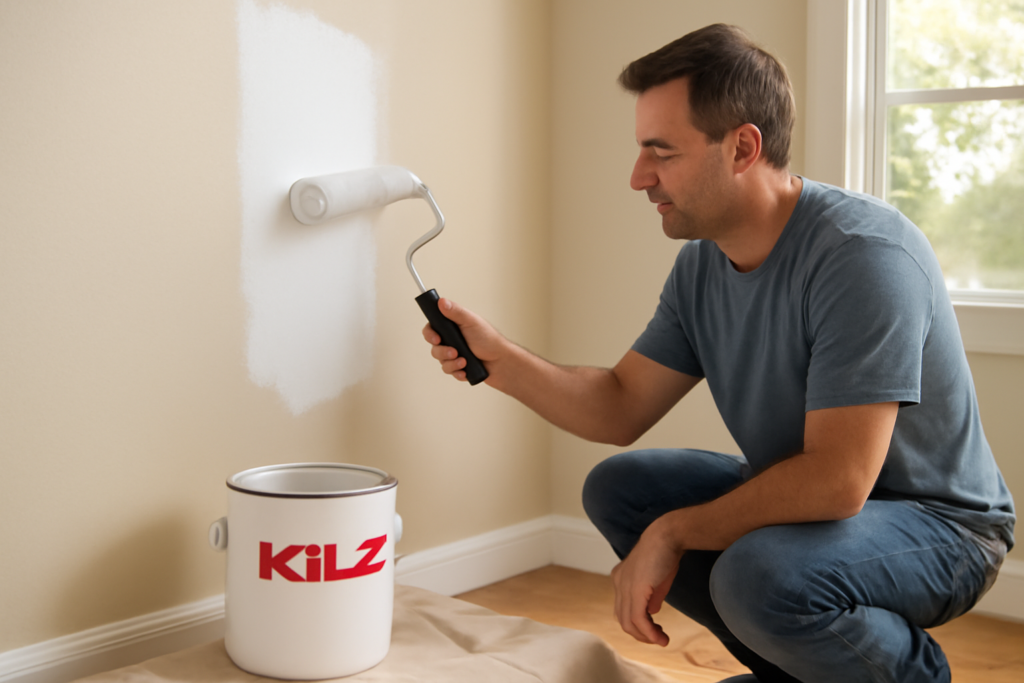
Skip the primer and you’ll usually pay for it later — with bleed-through stains, patchy sheen, and a topcoat that peels off a year down the road. Kilz paint primer has been the default answer to those problems for decades, but the brand now sells close to a dozen different formulas, and grabbing the wrong can off the shelf wastes both money and a weekend. This guide breaks down which Kilz product does what, how far a gallon actually goes, and where a primer earns its keep versus where you’re better off with a self-priming paint.
- What a Primer Actually Does
- The Main Kilz Formulas, Decoded
- Kilz Original (oil-based)
- Kilz 2 All-Purpose (water-based)
- Kilz Restoration (formerly Kilz Max)
- Kilz Adhesion
- Kilz Mold & Mildew and Kilz Kitchen & Bath
- Coverage: How Much to Buy
- Water-Based vs. Solvent-Based: How to Choose
- Safety and Ventilation
- How to Apply It for a Clean Result
- Matching the Right Kilz to the Job
- Common Mistakes to Avoid
- Is Kilz Worth It Over a Paint-and-Primer-in-One?
What a Primer Actually Does
Primer is not watered-down paint. It’s a bonding and sealing layer engineered to grip difficult surfaces and give your finish coat something uniform to stick to. A good primer does three jobs: it blocks stains and old colors from bleeding through, it seals porous material so your topcoat doesn’t soak in unevenly, and it improves adhesion on glossy or chalky surfaces that paint alone would slide right off of.
You get the biggest payoff on new drywall, water-stained ceilings, bare wood, and any surface you’re painting a lighter color over a much darker one. On a wall that’s already painted a similar color in good condition, primer is often optional — a quality paint-and-primer-in-one will do fine.
The Main Kilz Formulas, Decoded
The lineup splits into two families: latex (water-based) and shellac or oil-based (solvent). Water-based cleans up with soap and water and has low odor. Solvent-based blocks the toughest stains but smells strong and needs mineral spirits or ammonia to clean up.
Kilz Original (oil-based)
The heavy hitter. Blocks water, smoke, tannin, and grease stains, and seals in odors from pets or fire damage. Expect to pay around $22 to $28 a gallon. Use it when a water-based primer has already failed or when you know the stain is severe.
Kilz 2 All-Purpose (water-based)
The everyday workhorse and the one most homeowners want. Low odor, dries to the touch in about 30 minutes, and handles light to moderate stains. Runs roughly $18 to $24 a gallon. This is my default for repainting interior walls, new drywall, and previously painted trim.
Kilz Restoration (formerly Kilz Max)
A water-based primer that punches like an oil-based one. It blocks heavy water stains, smoke, and tannin bleed while still cleaning up with water. Around $28 to $34 a gallon — the premium is worth it when you want oil-level blocking without the fumes.
Kilz Adhesion
A bonding primer built for slick surfaces — tile, glass, PVC, laminate, Kynar, and glossy trim. If you’re painting over something a normal primer would peel off, this is the can. About $26 to $32 a gallon.
Kilz Mold & Mildew and Kilz Kitchen & Bath
Specialty water-based primers with mildewcide baked in, aimed at bathrooms, laundry rooms, and basements. Worth it in genuinely damp rooms; overkill for a dry bedroom.
Coverage: How Much to Buy
A gallon of Kilz covers roughly 300 to 400 square feet in a single coat, depending on how porous and textured the surface is. Fresh drywall and bare wood drink it up, so plan closer to 300. For a standard 10-by-12-foot bedroom with 8-foot walls, that’s about 352 square feet of wall — one gallon covers it in one coat, with a little left for touch-ups.
Quart cans (around $8 to $12) make sense for spot-priming stains, patched drywall, or a single door. Don’t buy a full gallon to seal three water rings on a ceiling.
Water-Based vs. Solvent-Based: How to Choose
The single biggest decision is which chemistry to run, and it comes down to what you’re fighting. Water-based (latex) primers are the right call about 80 percent of the time: repaints, new drywall, patched walls, and light stains. They dry fast, smell mild enough to use in a closed room, and clean off your brush under the tap. Modern water-based formulas like Kilz Restoration have closed much of the performance gap that used to make oil the only serious option.
Solvent-based primers — Kilz Original (oil) and Kilz Original Aerosol, plus true shellac products — still win on the nastiest problems. Deep water stains that have oxidized brown, cigarette tar, soot from a kitchen fire, and pet-urine odor all need a solvent primer to lock them down for good. The price you pay is strong fumes that demand ventilation, a respirator, and mineral-spirits cleanup. My rule: reach for water-based first, and only step up to oil or shellac when the stain is oily, the odor is baked in, or a water-based primer has already let something bleed through.
Safety and Ventilation
Even low-odor primers move a lot of solvent into the air, and the oil-based cans are genuinely strong. Open windows, run a box fan pointing out, and wear an organic-vapor respirator — not just a dust mask — when spraying or rolling oil-based Kilz in a small bathroom or closet. Keep the rags spread out to dry rather than balled up, since oil-soaked rags can self-heat. Gloves save your hands a mineral-spirits scrub, and safety glasses matter most when you’re priming a ceiling and drips are coming straight down at you.
How to Apply It for a Clean Result
Clean the surface first — grease and dust wreck adhesion no matter how good the primer is. Wipe kitchen and bath surfaces with a degreaser like TSP substitute and let them dry fully. Patch and sand any holes, then knock down the dust with a tack cloth.
- Stir the primer thoroughly; the solids settle to the bottom of the can.
- Cut in edges and corners with a 2.5-inch angled brush, then roll the field with a 3/8-inch nap roller for smooth walls or a 1/2-inch nap for texture.
- Keep a wet edge and work in 3-by-3-foot sections so lap marks don’t set up.
- Spot-prime stubborn stains with a second pass rather than flooding the whole wall.
Kilz 2 dries to recoat in about an hour. Kilz Original wants a full hour or two and is fussier in humidity. Don’t rush the topcoat — painting over primer that isn’t cured just drags it around.
Matching the Right Kilz to the Job
Water-stained ceiling from an old roof leak: fix the leak, then hit the ring with Kilz Original or Restoration. Water-based primers alone often let brown tannin stains ghost back through.
New drywall in a remodel: Kilz 2 all over. It seals the paper facing and joint compound so your paint’s sheen looks even instead of blotchy over the mudded seams.
Painting oak cabinets or glossy trim: Kilz Adhesion. The slick factory finish will reject a standard primer within months.
Covering a dark accent wall with a pale color: Kilz 2 knocks down the color so you need one or two topcoats instead of three or four. Tinting the primer gray or toward your finish color helps even more.
Smoke or pet odor in a rental turnover: Kilz Original or Restoration seals the smell into the substrate — one of the few products that genuinely does this.
Common Mistakes to Avoid
Treating primer as a finish coat is the big one. Primer is porous and chalky by design; leave it exposed and it’ll collect dirt and won’t clean up. Always topcoat it.
Using water-based primer over a fresh water stain is a close second. If the stain is active or was oily to begin with, the water in the primer reactivates it and pulls it right back to the surface. When in doubt on tough stains, go solvent-based.
Skipping surface prep is the quiet killer. No primer bonds to grease, dust, or a glossy sheen that hasn’t been scuffed. Ten minutes of cleaning and a light sand saves you a repaint.
Is Kilz Worth It Over a Paint-and-Primer-in-One?
For a straightforward repaint — same color family, walls in decent shape — a quality self-priming paint is usually enough, and you skip a step. Dedicated primer earns its cost when you’re dealing with stains, odors, bare or slick surfaces, big color changes, or new construction. In those situations a $20 gallon of the right Kilz saves you extra topcoats and callbacks, which makes it some of the cheapest insurance in the paint aisle.
Buy the formula that matches your worst problem on the wall, prep properly, and give it time to dry. Do that and your finish coat will look better and last years longer than it would have gone on straight.