Kitchen cabinet accessories are the inserts, organizers, and hardware upgrades that transform ordinary cabinets from dark, hard-to-reach boxes into efficient, functional storage. From pull-out shelves that end the crawl to the back of a deep cabinet to lazy Susans that tame a corner, these add-ons deliver some of the highest return per dollar of any kitchen improvement. You do not need to replace cabinets to gain organization; the right accessories retrofit into what you already have.
Part of our Kitchen Remodeling guide — explore the full guide →
This guide covers the most useful accessory categories, where each one solves a specific storage problem, what they cost, how hard they are to install, and the mistakes that lead to inserts that do not fit or do not get used.
- Why Accessories Beat New Cabinets
- Pull-Out Shelves and Drawers
- Corner Cabinet Solutions
- Drawer Organizers
- Waste and Recycling Pull-Outs
- Vertical and Specialty Storage
- What Cabinet Accessories Cost
- Installation and Fit
- Soft-Close and Full-Extension Upgrades
- Planning Which Accessories to Prioritize
- Common Mistakes to Avoid
Why Accessories Beat New Cabinets
New cabinets are one of the most expensive parts of a kitchen remodel, often running $10,000 to $30,000 or more. Accessories let you keep your existing boxes while dramatically improving how they work, at a fraction of the cost. A few hundred dollars in pull-outs and organizers can make a dated kitchen feel custom and function far better. Accessories also let you tailor storage to your habits, since you can prioritize pot storage, spice organization, or trash concealment based on how you actually cook.
Pull-Out Shelves and Drawers
The single most impactful accessory is the pull-out shelf, also called a roll-out tray. Deep base cabinets waste their back half because items disappear into the dark and require kneeling to reach. A pull-out shelf mounts on drawer slides so the whole shelf rolls out to you. They come in wood or wire, in standard cabinet widths, and many are adjustable-fit models that trim to your exact opening. Pull-outs are ideal for pots, pans, small appliances, and pantry goods. Full-extension slides that pull all the way out are worth the small extra cost for true back-of-cabinet access.
Corner Cabinet Solutions
Corner cabinets are notorious dead zones, and several accessories reclaim them.
- Lazy Susan: A rotating shelf, either a full round for a blind corner or a kidney-shaped pie-cut for a diagonal corner door, that spins items into reach.
- Blind corner pull-out: A hinged, swing-out system that pulls the hidden contents of a blind corner out into the open.
- Magic corner: A premium articulating unit whose shelves glide out and swing forward for full access to the deepest corner space.
The blind corner, where a cabinet disappears behind the adjacent run, is the hardest to use without an accessory, so a swing-out or magic corner there pays off the most.
Drawer Organizers
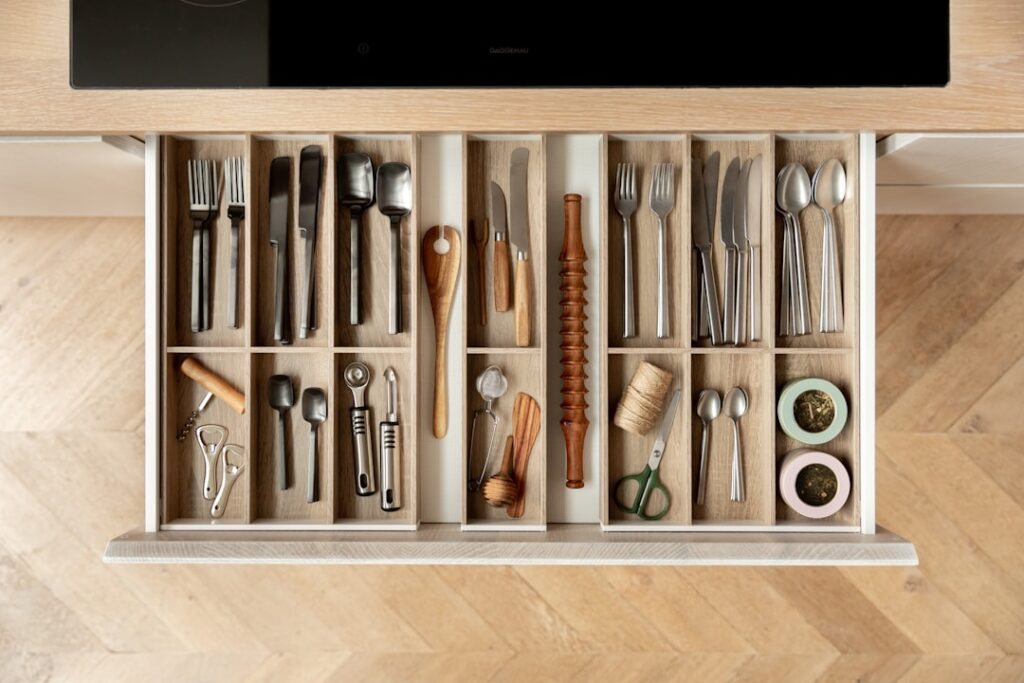
Drawers benefit from dividers that keep contents from becoming a jumble. Cutlery trays are the obvious one, but the category runs deeper: adjustable dividers for utensils, deep drawer peg systems that hold plates and bowls upright, knife blocks that lie flat in a drawer, and spice inserts that angle jars for easy reading. Custom-cut wood inserts give a built-in look, while adjustable plastic and bamboo organizers are cheaper and fit a range of drawer sizes. Well-divided drawers often replace the need for countertop clutter.
Waste and Recycling Pull-Outs
Hiding the trash is one of the most popular upgrades. A pull-out waste bin system mounts one or two bins on a sliding frame inside a base cabinet, concealing garbage and recycling behind a cabinet door and freeing the floor space a standalone can occupies. Dual-bin units make sorting recycling easy. Look for soft-close slides and bins sized to standard liners. This accessory improves both function and the look of the kitchen by removing the visible trash can.
Vertical and Specialty Storage
Several accessories solve niche but real problems.
- Tray dividers: Vertical partitions in a tall narrow cabinet for baking sheets, cutting boards, and platters that otherwise stack awkwardly.
- Pull-out pantry: A tall, narrow sliding tower with shelves on both sides for canned and boxed goods in a slim space.
- Spice pull-outs: Narrow vertical racks that fill a filler gap or slim cabinet with tiered spice storage.
- Under-sink organizers: Two-tier and U-shaped shelves that work around the plumbing to use the awkward space below the sink.
- Mixer and appliance lifts: Spring-loaded shelves that swing a heavy stand mixer up to counter height.
What Cabinet Accessories Cost
Prices span a broad range depending on quality and mechanism. Simple wire or bamboo drawer organizers run $10 to $40. Basic pull-out shelves are $25 to $75 each, while soft-close wood roll-outs run $50 to $150. Lazy Susans cost $30 to $150, and premium magic-corner or blind-corner systems run $150 to $400. Pull-out waste bins are $40 to $150. Outfitting a whole kitchen with a mix of accessories typically lands between $500 and $2,500, a small fraction of new cabinetry for a large gain in usability.
Installation and Fit
Most accessories are DIY-friendly with a drill, screwdriver, and tape measure, but fit is everything. Measure the cabinet’s interior opening width, depth, and height precisely, and account for face-frame cabinets, where the opening is narrower than the box, versus frameless cabinets. Many pull-outs are sold in nominal sizes with adjustable brackets, but a shelf that is too wide simply will not go in. Confirm the accessory clears hinges and door swings. For heavier items and full-extension slides, mount into solid cabinet sides, not just thin backing. When in doubt, order the adjustable-fit versions that trim to your opening.
Soft-Close and Full-Extension Upgrades
Two hardware upgrades quietly transform how cabinets feel to use every day. Soft-close hinges and drawer slides use a hydraulic or spring mechanism to catch a door or drawer in the last inch and ease it shut silently, eliminating slamming and the wear it causes. Retrofitting soft-close dampers onto existing hinges is inexpensive and quick, and dedicated soft-close drawer slides bring the same gentle action to drawers. For families with children, the end of slammed cabinet doors alone justifies the small cost.
Full-extension slides are the other high-impact upgrade. Standard drawer slides stop several inches short, hiding the back of the drawer, while full-extension slides pull the drawer all the way out so you can see and reach every item. Combined with soft-close, they make deep drawers genuinely usable for pots and pantry goods. When you replace or upgrade drawer boxes, choosing full-extension soft-close slides rated for the weight you plan to store is one of the best value decisions in the whole kitchen.
Planning Which Accessories to Prioritize
With so many options, the smart approach is to spend on the cabinets that frustrate you most rather than trying to outfit everything at once. Spend a week noticing which cabinets you dread opening, the deep base cabinet where pots hide, the dead corner, the cluttered drawer, the visible trash can, and target those first. Those pain points deliver the biggest daily payoff per dollar.
- Deep base cabinets almost always benefit most from pull-out shelves.
- Corner cabinets reclaim the most wasted space with a lazy Susan or swing-out.
- The trash area gains both function and looks from a concealed pull-out bin.
- Everyday drawers improve instantly with dividers and organizers.
Because most accessories retrofit independently, you can tackle them one at a time as budget allows, learning what helps before buying more. This staged approach avoids spending on inserts you will not use and steadily turns an ordinary kitchen into one that feels thoughtfully custom.
Common Mistakes to Avoid
The frequent errors are buying before measuring the true interior opening, overlooking the narrower opening of face-frame cabinets, choosing bargain slides that sag under a loaded pot drawer, and installing accessories you will not actually use. Focus your budget on the cabinets that frustrate you most, usually the deep base cabinets and the corners, and choose soft-close, full-extension mechanisms where you handle heavy items. Thoughtfully chosen kitchen cabinet accessories turn wasted space into effortless storage and make an existing kitchen feel custom-built, all without the cost and disruption of replacing a single cabinet.