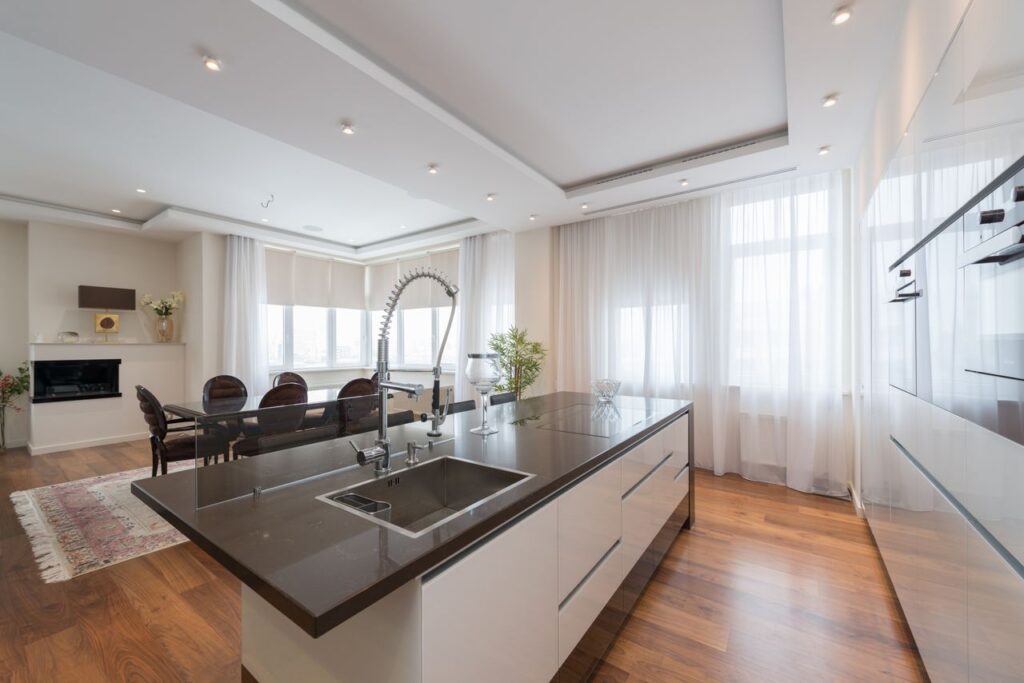
The window above the kitchen sink gets more eye traffic than any other window in the house, yet it is also the hardest to dress because of splash, steam, sun, and limited rod clearance. Choosing the right kitchen curtain ideas above sink means balancing style with washable fabrics, coordinating with cabinets and counters, and respecting the practical reality that this curtain will absorb cooking grease whether you like it or not. The good news: half a dozen approaches consistently look great and hold up. Here is what works in real kitchens.
Part of our Kitchen Remodeling guide — explore the full guide →
- Cafe Curtains: The Classic Choice
- Roman Shades for a Tailored Look
- Valances and Toppers
- Full-Length Panels for Wider Windows
- No-Sew and Affordable Options
- Fabric Choices: What Survives the Sink
- Hardware: Rods, Rings, and Brackets
- Privacy vs. Light: The Balance
- Coordinating With Cabinet and Counter Colors
- Care, Cleaning, and Replacement
Cafe Curtains: The Classic Choice
Cafe curtains cover the lower half of the window only, providing privacy at sink level while letting full daylight through the top. They are the single most common kitchen window treatment for good reason — practical, affordable, and timeless across decor styles.
For dimensions, hang the rod at the midpoint of the window or just below where the muntin would naturally divide the panes. Standard cafe curtains run 24 to 36 inches long. Choose 100 percent cotton or linen-cotton blends in a tight weave that washes well. Avoid silk and rayon — they spot from water splashes.
Roman Shades for a Tailored Look
A flat or relaxed Roman shade reads more polished than curtains and works especially well in narrow windows where panels would crowd counter space. Mount the shade as a deck-mount inside the window frame for a clean look, or outside for more visual height.
Use linen, cotton duck, or a poly-cotton blend treated for wrinkle resistance. Avoid stack-pleated Roman shades over a sink — the folds collect water droplets and grease. A flat-fold Roman in natural linen is the photographer’s favorite for a reason: it looks intentional from any angle.
Valances and Toppers
If your window has minimal space below for a curtain (a deep sink or backsplash) but you want softness, a valance covers just the top 10 to 18 inches of the window. Box-pleated valances read traditional; a simple linen banner reads modern.
Pair valances with a roller shade if you need privacy at night. The valance softens the line of the shade when it is rolled up and provides decoration even when the shade is fully retracted. Skip the gathered “country” valances unless that is the deliberate decor of the entire kitchen.
Full-Length Panels for Wider Windows
Garden windows, bay windows, and double or triple windows over the sink can take full-length panels. A clean linen or cotton panel hung from a rod 4 to 6 inches above the window frame and extending to the floor frames the view without blocking it.
Tie the panels back during the day and let them hang at night. The floor-length scale only works if there are no countertops or appliances directly under the window — meaning the panel hangs in front of empty wall space. In a typical kitchen, the panels would brush the counter and look awkward.
No-Sew and Affordable Options
For renters or homeowners on a budget, no-sew cafe curtains made from a $20 cotton tea towel or two and a tension rod cost under $40 total. The Williams Sonoma classic cotton kitchen towel and the Sur La Table linen tea towel both work as instant cafe curtains when clipped to a rod with curtain rings.
IKEA Sanela velvet panels or the Lill cotton sheers from IKEA run $5 to $15 per panel and cover most window styles for under $40 a window. They are not high-end fabrics, but they look perfectly good and wash easily.
Fabric Choices: What Survives the Sink
The fabric you choose matters more than the style. The window above a sink fights steam, water splashes, grease aerosols from sauteing, and afternoon sun. Cotton and linen are the only natural fibers that consistently hold up; they wash, dry, and iron without losing color.
Skip silk, rayon, polyester sateen, and any fabric described as “dry clean only.” Skip dark colors over a sink that gets afternoon sun — they fade unevenly within a year. Stick to whites, creams, light grays, and small-scale patterns that hide minor grease spots until the next wash.
Hardware: Rods, Rings, and Brackets
Use a 5/8 inch or 3/4 inch rod for cafe curtains and small valances. For full panels, step up to 1 inch or 1.25 inch diameter for visual weight. Brushed nickel and oil-rubbed bronze coordinate with most modern faucets; unlacquered brass works in traditional kitchens.
Tension rods are quick and damage-free, but they slip if the rod is over 36 inches long or if the curtain weighs more than 2 lbs. For anything heavier or wider, use bracket-mounted rods anchored to studs or with toggle bolts in drywall.
Privacy vs. Light: The Balance
Privacy from the back yard is often the reason for kitchen curtain ideas above sink in the first place. The fix is layered: a sheer linen panel for daytime privacy that still lets light in, plus a roller shade or Roman shade behind it for nighttime full coverage.
Frosted privacy film on the lower half of the glass is another option that costs $25 and lasts a decade. Combine the film with a simple top-mounted Roman shade and you eliminate the need for a curtain entirely while keeping the window minimal.
Coordinating With Cabinet and Counter Colors
Pull the curtain color from a secondary tone in the kitchen, not the primary cabinet or counter color. White cabinets with a black or navy curtain looks intentional. White cabinets with a slightly different white curtain looks like an unfinished decoration.
For warm wood cabinets, a cream or natural linen curtain ties everything together. For painted cabinets in green, blue, or black, a small-print pattern or a textured neutral linen works better than a contrasting solid color.
Care, Cleaning, and Replacement
Wash kitchen curtains every 6 to 8 weeks. The grease and water vapor that accumulates is invisible until you see how dingy the curtain looks next to a clean one. Cold wash, low-tumble dry, and iron while still slightly damp.
Plan to replace kitchen curtains every 3 to 5 years. Sun fade, accumulated grease, and fabric wear at the rod will show eventually. The good news: at $30 to $80 per panel, replacement is the cheapest decor refresh in the entire kitchen.