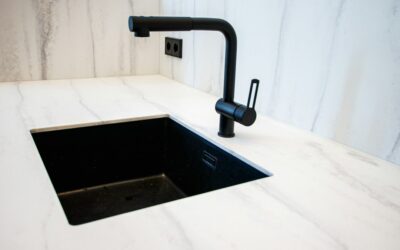
Roughly nine out of ten new kitchen faucets sold today include some form of integrated spray head, and the reason is simple: nothing rinses a stockpot faster. A kitchen faucet with pull down sprayer tucks the sprayer into the spout itself, so you pull the head straight down toward the basin instead of yanking a separate side hose. It is a small design change that removes clutter, frees up a deck hole, and gives you far more reach across a double-bowl sink. Before you buy, though, a few specs matter more than the marketing photos suggest.
Part of our Kitchen Remodeling guide — explore the full guide →
- Pull-Down vs. Pull-Out: Know the Difference
- Spray Head Features Worth Paying For
- Choosing a Finish That Lasts
- Flow Rate and Water Efficiency
- Installation: What to Expect
- Price Ranges and What They Buy
- Common Problems and Quick Fixes
- Matching the Faucet to Your Sink and Water Pressure
- The Bottom Line
Pull-Down vs. Pull-Out: Know the Difference
These two terms get mixed up constantly at the hardware store. A pull-down faucet has a tall, arched spout, and the wand slides down vertically. A pull-out faucet sits lower and the wand pulls horizontally toward you. Pull-down models suit deep sinks and heavy pot-filling, while pull-out designs work better under low windowsills or tight upper cabinets.
If you routinely wash large sheet pans, the pull-down’s high clearance wins. Measure the distance from your countertop to any obstruction above the sink first. Most pull-down spouts stand between 15 and 18 inches tall, so a windowsill at 14 inches will force you into pull-out territory.
Spray Head Features Worth Paying For
The wand is where cheap and quality faucets separate. Look for a magnetic docking collar rather than a plastic weight-and-clip system; magnets snap the head back into place cleanly and never sag over time. A dual-function head that toggles between aerated stream and a concentrated spray covers most kitchen chores, and a third “boost” or “sweep” setting adds punch for scrubbing stuck-on food.
- Magnetic dock (MagneDock, Docknetik): keeps the wand seated for years
- Spot-resist or PVD finish: hides water marks and fingerprints
- Ceramic disc valve: rated for 500,000+ cycles, drip-free
- Nylon braided hose: retracts smoothly without kinking
Choosing a Finish That Lasts
Finish is about durability as much as looks. Brushed nickel and stainless remain the most forgiving choices because they mask spots and pair with nearly any appliance package. Matte black looks striking but shows hard-water residue in regions with mineral-heavy supply, so keep a microfiber cloth handy. Chrome is the budget standard, easy to clean but prone to visible fingerprints.
Whatever you pick, confirm the finish is a genuine PVD (physical vapor deposition) coating on mid- and upper-tier models. PVD bonds at a molecular level and resists scratching far better than the electroplated coatings on entry-level faucets under $80.
Flow Rate and Water Efficiency
Federal standards cap kitchen faucets at 2.2 gallons per minute, but many quality models ship with a 1.8 or 1.5 GPM aerator. That reduction barely affects the feel at the sink while trimming both water and water-heating bills. If your faucet feels weak, check the aerator for sediment before assuming the flow rate is too low; a two-minute soak in vinegar often restores full pressure.
Installation: What to Expect
Most pull-down faucets install through a single deck hole, which is why they pair so well with a modern undermount sink. If your existing sink has three or four holes from an old faucet-and-sprayer setup, you will need a matching deck plate (often included) to cover the extras.
Basic Steps
- Shut off the hot and cold supply valves under the sink and open the old faucet to relieve pressure.
- Disconnect the supply lines and remove the mounting nut with a basin wrench.
- Feed the new faucet’s supply lines and spray hose through the deck hole.
- Secure the mounting hardware from below, then connect the braided lines hand-tight plus a quarter turn.
- Attach the quick-connect hose weight, run water for 15 seconds with the aerator removed to flush debris, then reinstall it.
Budget about 45 to 90 minutes for a straightforward swap. A first-timer working in a cramped cabinet should double that. If the shutoff valves are corroded or missing, add a plumber’s visit to the plan rather than fighting old fittings.
Price Ranges and What They Buy
Expect to spend $60 to $120 for a serviceable name-brand faucet, $120 to $250 for a model with magnetic docking, a lifetime finish warranty, and a metal wand, and $250 to $450 for touchless or professional-style spring-spout designs. Touchless faucets add a motion sensor that is genuinely useful when your hands are covered in raw chicken, though they require batteries or an under-sink transformer.
Brands with strong parts availability, such as Moen, Delta, and Kohler, stand out here. A faucet is a 15-year fixture, and being able to order a $12 replacement cartridge a decade later matters more than a slightly lower sticker price today.
Common Problems and Quick Fixes
A wand that will not retract is almost always a hose caught on the shutoff valves or the garbage disposal below. Clear the path and add a hose guide clip. Low or sputtering spray usually points to a clogged aerator or a kinked hose. And if the spout swivels too loosely over time, most models hide an adjustable tension nut at the base you can snug up with an Allen key.
Matching the Faucet to Your Sink and Water Pressure
Before you fall for a particular model, check two things about your setup. First, confirm your sink has a single deck hole or that the included escutcheon plate covers your existing three-hole configuration. Second, consider your home’s water pressure; homes on a well or at the end of a municipal line sometimes run 40 psi or lower, and a heavily aerated 1.5 GPM head can feel weak there. In low-pressure homes, a 1.8 GPM aerator restores a satisfying stream without wasting water. It is a small spec that makes a daily difference at the sink.
The Bottom Line
A well-chosen kitchen faucet with a pull-down sprayer combines reach, flexibility, and a clean single-hole look that suits almost every kitchen. Prioritize a metal wand, magnetic docking, and a ceramic disc valve, then choose a finish that fits both your decor and your local water quality. Spend in the $120 to $200 range from a brand with easy parts access, install it in an afternoon, and you will have a fixture that performs daily for well over a decade.