A kitchen with one flush-mount ceiling fixture casts your own shadow on every cutting task, yet 70 percent of builder-grade kitchens still ship that way. Smart kitchen lighting design layers three types of light so the room works for 6 a.m. coffee, 3 p.m. meal prep, and 9 p.m. dinner parties with equal confidence. The budget range is wide — $400 to $8,000 for a full upgrade — but the design rules are the same at every price point. This guide covers the layered approach, specific fixture picks by zone, and dimmer planning that makes or breaks the final feel.
Part of our Kitchen Remodeling guide — explore the full guide →
The Three Layers Every Kitchen Needs
Professional designers work in layers. Each layer does one thing well, and the combination creates depth. Miss one and the room feels incomplete regardless of fixture quality.
- Ambient: overall room illumination, typically from recessed cans or a ceiling fixture
- Task: focused light on work surfaces from under-cabinet lights and pendants
- Accent: decorative or architectural highlights on art, glass cabinets, or range hoods
A kitchen with all three layers on separate dimmers feels twice the size of one with a single lighting circuit.
Ambient Lighting Done Right
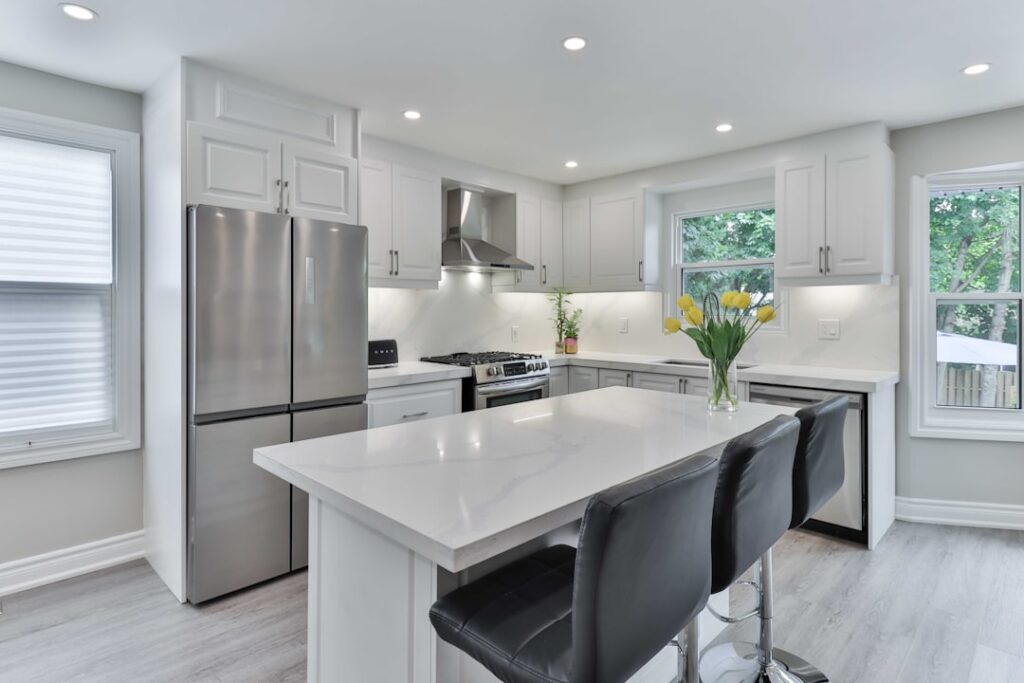
Recessed cans are the workhorse of ambient lighting. Space 4-inch or 6-inch LED cans roughly every 4 to 6 feet in a grid, staying 24 inches off any wall. For a 12×14 kitchen, that’s typically 6 to 9 cans delivering 5,000 to 7,500 lumens total.
Skip the builder-grade 6-inch cans if you can. Modern 4-inch low-profile LED downlights from Halo, Lithonia, or Commercial Electric look cleaner on the ceiling and provide sharper beam control. Budget $20 to $50 per fixture installed in retrofit, $100 to $200 per fixture in new construction.
Task Lighting on Work Surfaces
Task lighting is non-negotiable. Under-cabinet LED strips or bars eliminate the shadow your body casts on the counter when standing under overhead fixtures. Budget 175 to 300 lumens per linear foot of counter. A 10-foot run wants roughly 2,500 lumens.
Color temperature matters here. Stick with 2700K or 3000K to match your ambient fixtures — mismatched color temperatures make a kitchen look unfinished. Avoid anything above 3500K unless you want a commercial-kitchen feel.
Pendants Over Islands
Island pendants serve double duty as task light and statement decor. The rule of thumb: bottom of pendant 30 to 36 inches above counter, fixture diameter roughly two-thirds of island width divided by the number of pendants.
- For a 5 to 6-foot island: 2 pendants 28 to 32 inches apart
- For a 7 to 8-foot island: 3 pendants 24 to 28 inches apart
- For a 9 to 12-foot island: single linear fixture or 3 larger pendants 30 to 36 inches apart
Spend money on pendants — they’re the visual anchor of the kitchen and read from every angle. $150 to $500 per pendant is reasonable; under $100 usually looks cheap up close.
Accent Lighting Adds Polish
In-cabinet LED puck lights illuminate glass-front cabinets and glassware. Toe-kick LED strips add a floating look to lower cabinets at night. Small picture lights or art spots above open shelving turn dishware displays into intentional design moments.
Accent lighting rarely exceeds $200 per zone in materials but adds disproportionate visual value. It’s the difference between kitchen lighting design that looks professional and one that looks DIY.
Dimmer Strategy
Every circuit gets a dimmer. Full. Stop. A single-level switch is a missed opportunity in 2026 when LED dimmers cost $35 to $120.
- Lutron Caseta: the industry reference for reliability, $55 to $90 per dimmer
- Leviton Decora Smart: matches broader Decora hardware aesthetic
- Kasa Smart Dimmer: budget Wi-Fi option at $25 to $40
Group circuits logically: ambient on one scene, task on another, accent on a third. A “dinner party” scene pulls all three to 30 to 50 percent for an entirely different feel than the noon full-bright working light.
Color Temperature and CRI
Mixing color temperatures ruins even the best fixture selection. Commit to 2700K (warm, cozy) or 3000K (slightly crisper, most balanced) across every fixture. CRI (color rendering index) matters for food presentation — stick with 90+ CRI bulbs so produce and cooked food look accurate.
High-end fixtures use tunable white LEDs that shift from 2700K to 5000K on demand. This is an upgrade worth considering if you cook professionally or photograph food.
Common Mistakes to Avoid
The top kitchen lighting design mistakes repeat across builder-grade homes and DIY remodels:
- A single flush-mount as the only light source
- Recessed cans placed directly over cabinets (light hits the top of your head, not the counter)
- Undersized pendants (a 10-inch pendant over a 10-foot island disappears)
- Mismatched color temperatures within the same room
- No dimmers, making bright kitchens glaring at night
- Skipping under-cabinet task lighting to save $200
Budget Tiers That Work
Minimal refresh ($400 to $800): new LED bulbs in existing fixtures, swap a single outdated flush-mount for a semi-flush drum, add one dimmer. Midrange ($1,500 to $3,500): 6 recessed cans, 2 island pendants, under-cabinet LEDs, three dimmer circuits. Full design ($5,000 to $9,000): professional electrical with 10+ cans, custom pendants, in-cabinet and accent lighting, smart home integration.
Hiring an Electrician vs DIY
Swapping fixtures is often DIY-appropriate for confident homeowners. Adding new circuits or installing recessed cans through a ceiling requires an electrician in most jurisdictions. Budget $75 to $150 per hour for licensed electricians, with a typical kitchen retrofit running 8 to 16 hours of labor plus materials.